
The Evolution of Aegean Ship Design in the Early Bronze Age

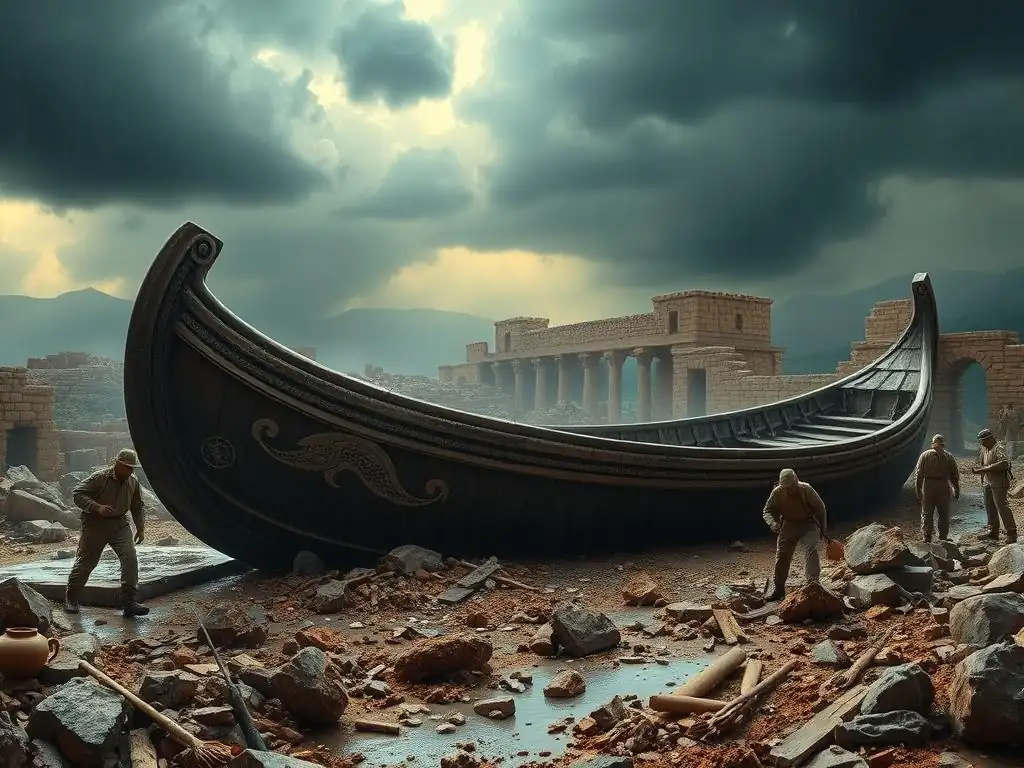
Welcome to ArchaeologyHub.org, your portal to the past! Ever wondered how the civilizations of the Aegean mastered the seas? Uncover the secrets of their maritime ingenuity as we delve into the fascinating evolution of Aegean ship design timeline in the Early Bronze Age. Explore the innovations that shaped their world and set the stage for future maritime empires. What ingenious techniques did they employ, and how did their designs adapt over time? Let's embark on this journey of discovery together!
- Aegean Seafaring in the Early Bronze Age: An Introduction
- Precursors to Aegean Ship Design: Early Maritime Technology
- Early Cycladic Ship Design (c. 3200-2700 BCE): The Dawn of Aegean Maritime Technology
- Middle Cycladic Ship Design (c. 2700-2000 BCE): Innovations and Advancements
- Late Cycladic/Early Minoan Ship Design (c. 2000-1700 BCE): Transition and Regional Variations
- Key Features of Early Aegean Ships: A Comparative Analysis
- Archaeological Evidence for Early Aegean Ships: Discoveries and Interpretations
- The Aegean Ship Design Timeline: A Summary of Key Developments
- The Impact of Aegean Ship Design on Trade and Cultural Exchange
- Aegean Ship Design: Conclusion and Future Research Directions
-
Frequently Asked Questions
- ### What were the key innovations in Aegean ship design during the Early Bronze Age?
- ### How did Aegean ship design influence trade and cultural exchange in the region?
- ### What evidence supports our understanding of early Aegean ship construction techniques?
- ### Can you describe the general characteristics of Aegean ships from this period?
- ### How does understanding the "Aegean ship design timeline" help us better understand the broader history of the Aegean Bronze Age?
- Final Reflection: Charting the Seas of Innovation
- Unearth Your Inner Explorer: Set Sail with Ancient Aegean Knowledge!
Aegean Seafaring in the Early Bronze Age: An Introduction
The Importance of Maritime Activity in the Early Bronze Age Aegean
The unique geography of the Aegean Sea, characterized by its numerous islands and intricate coastline, rendered maritime activity not merely convenient but absolutely essential for the burgeoning civilizations of the Early Bronze Age. From approximately 3200 BCE, seafaring became the lifeblood for interaction, trade, and cultural exchange among the Cycladic, Minoan, and early Helladic communities.
This reliance on the sea facilitated the movement of crucial resources such as obsidian from Melos, copper from Cyprus, and various agricultural products, underpinning the economic prosperity and interconnectedness of island cultures like those of the Cyclades. The development of early Aegean ship design was therefore directly linked to the survival and growth of these societies, enabling them to overcome geographical barriers and establish complex networks.
This profound maritime dependence also shaped the social and political landscape, fostering the growth of specialized seafaring communities and the emergence of early maritime powers. The ability to navigate the Aegean's sometimes treacherous waters, transport goods, and maintain communication lines was a cornerstone of regional stability and advancement. As such, the evolution of Aegean ship design is not merely a technical narrative but a story intrinsically tied to the very fabric of Early Bronze Age Aegean civilization, reflecting its ingenuity, adaptability, and ambition.
Scope of this Article: Tracing the Development of Aegean Ship Design
This article aims to provide a comprehensive Aegean ship design timeline, meticulously tracing the technological and morphological advancements of watercraft in the region during the Early Bronze Age, roughly from 3200 BCE to 1700 BCE. We will examine the progression from rudimentary watercraft to more sophisticated vessels, analyzing the archaeological evidence that illuminates these developments. Our focus will be on the distinct phases of Early, Middle, and Late Cycladic/Early Minoan ship design, highlighting key innovations such as the introduction of sails and improvements in hull construction.
By synthesizing data from artistic depictions, rare physical finds, and the broader archaeological context, this exploration will detail how the early Aegean peoples adapted their vessels to meet evolving needs for trade, exploration, and perhaps even conflict. Understanding this development of Aegean ship design offers critical insights into the maritime capabilities and economic strategies that defined this pivotal period in Mediterranean history.
Precursors to Aegean Ship Design: Early Maritime Technology
Watercraft Before the Early Bronze Age: Rafts and Dugout Canoes
Long before the sophisticated vessels of the Early Bronze Age, the waters of the Aegean were traversed by far simpler forms of watercraft. Evidence suggests that rudimentary rafts and dugout canoes were in use as early as the Mesolithic period, around 10,000 BCE.
The transportation of obsidian from Melos, a volcanic island, to mainland Greece and other islands during this period, provides compelling indirect evidence for such early seafaring capabilities. These initial vessels, likely constructed from readily available materials such as logs or bundles of reeds, would have been limited in their capacity, speed, and seaworthiness, primarily suitable for short-distance coastal travel or riverine navigation.
These early forms laid the foundational understanding of buoyancy and propulsion, albeit in a very basic sense. The technology involved minimal tools, focusing on hollowing out logs for canoes or lashing together buoyant materials for rafts. While not directly contributing to the complex hull forms of later Aegean ship design, these initial forays into maritime technology established the critical link between human activity and water transport, setting the stage for more advanced shipbuilding in the millennia to come.
The Influence of Mesopotamian and Egyptian Shipbuilding
While the Aegean region developed its distinct shipbuilding traditions, it is plausible that indirect influences from major contemporary maritime powers like Mesopotamia and Egypt played a role in the broader technological context. Both civilizations had established advanced shipbuilding practices well before the Early Bronze Age Aegean.
Mesopotamian boats, such as the kufa (a round coracle) and later more elongated vessels, were primarily riverine, constructed from reeds or planks, and used for trade along the Tigris and Euphrates. Egyptian shipbuilding, particularly evident from the Old Kingdom onwards, showcased sophisticated techniques for constructing large wooden vessels, such as the Khufu ship from around 2500 BCE, which measured over 40 meters in length and featured an advanced plank-built hull.
Although direct transfers of specific blueprints for Aegean ship design are difficult to prove, the general exchange of ideas, materials, and skilled artisans across the Eastern Mediterranean could have subtly influenced Aegean innovations. The presence of Egyptian artifacts in the Aegean, and vice-versa, indicates established trade routes that would have exposed Aegean mariners and craftsmen to different maritime technologies and construction principles. This broader context of advanced shipbuilding in neighboring regions likely fostered an environment of innovation within the Aegean, encouraging experimentation with larger vessels and more robust construction methods.
Early Cycladic Ship Design (c. 3200-2700 BCE): The Dawn of Aegean Maritime Technology
Early Cycladic Longboat Types and Characteristics
The Early Cycladic period marks a significant advancement in the Aegean ship design timeline, characterized by the emergence of distinctive longboat types, vividly depicted on ceramic "frying pans" and other artifacts. These vessels were typically long, narrow, and shallow-drafted, optimized for speed and maneuverability across the island-dotted Aegean.
Their most striking features include a distinctive high, often decorated prow, sometimes resembling a fish or bird, and a similar stern. Propulsion was primarily by oars or paddles, with numerous oar ports or paddler positions visible along the hull, suggesting crews of 20 to 30 individuals for larger vessels, which might have reached lengths of 15-20 meters.
These early longboats, while primarily oared, represent a crucial stage in the development of Aegean maritime technology. Their design facilitated rapid inter-island travel and the efficient movement of goods and people across the Cyclades. The stylized depictions, though not engineering blueprints, provide valuable insights into their general form and function, indicating a clear understanding of hydrodynamic principles necessary for effective seafaring in the region.
Evidence for Early Cycladic Seafaring Capabilities
The extensive distribution of Cycladic artifacts across the Aegean provides compelling evidence of their advanced seafaring capabilities during this period. For instance, marble figurines crafted in the Cyclades have been found in mainland Greece, Crete, and even as far as Anatolia, indicating well-established maritime trade routes.
The widespread trade in obsidian from Melos, a volcanic glass highly valued for tools, further underscores the necessity and proficiency of Early Cycladic mariners. Obsidian from Melos has been discovered at sites like Franchthi Cave in the Peloponnese, dating back much earlier, but its continued and extensive distribution in the Early Bronze Age demonstrates sustained maritime activity.
Archaeological excavations on islands such as Syros, Naxos, and Keros have uncovered numerous settlements from this period, many strategically located near natural harbors, further emphasizing the importance of maritime connections. The ability to maintain these extensive networks for the exchange of raw materials, finished goods, and cultural ideas across a fragmented geographical area speaks volumes about the robustness and reliability of Early Cycladic ship design and the navigational skills of their crews.
Middle Cycladic Ship Design (c. 2700-2000 BCE): Innovations and Advancements
Middle Cycladic Ship Types: Increased Size and Complexity
During the Middle Cycladic period, the Aegean ship design timeline shows a clear progression towards larger, more complex vessels. While oared longboats continued to be used, there is increasing evidence for the widespread adoption of sails as a primary propulsion method, particularly for longer voyages. This innovation allowed for greater cargo capacity and reduced reliance on human power, making long-distance trade more efficient and economically viable. Depictions from this era, though less frequent than in the Early Cycladic period, suggest vessels with a higher freeboard and a more robust hull, indicating an enhanced ability to withstand open-sea conditions.
These advancements also likely led to the development of more specialized ship types. While specific archaeological remains are scarce, the increased volume of trade goods, including pottery, metals, and agricultural products, implies the existence of dedicated cargo vessels. These would have featured broader beams and deeper hulls compared to the earlier, sleeker longboats, prioritizing capacity over sheer speed, signifying a maturing maritime economy.
The Role of Metal Tools in Shipbuilding Advancements
The increasing availability and sophistication of metal tools, particularly bronze implements, played a pivotal role in the advancements observed in Middle Cycladic ship design. Bronze axes, adzes, saws, and chisels allowed shipwrights to process timber with greater precision and efficiency than earlier stone or flint tools. This technological leap facilitated more intricate joinery, such as the use of mortise-and-tenon joints, which created stronger and more watertight hull constructions. The ability to cut and shape planks more accurately also allowed for more complex hull forms, improving both hydrodynamics and structural integrity.
Moreover, the improved tools enabled the use of harder woods and larger timber pieces, leading to more durable and substantial vessels. This directly contributed to the increased size and complexity of Middle Cycladic ships, making them more capable of enduring long voyages and carrying heavier loads. The symbiotic relationship between metallurgical innovation and shipbuilding technology was a key driver in the evolution of Aegean ship design during this critical period.
Evidence from Akrotiri Regarding Middle Cycladic Ships
While the Akrotiri frescoes on Thera primarily date to the Late Cycladic I period (c. 1700 BCE), they offer invaluable insights into the preceding Middle Cycladic shipbuilding traditions, as many of the depicted vessels represent long-standing designs. The famous "Flotilla Fresco" vividly portrays a variety of ships, including large, multi-oared vessels with prominent square sails and elaborate decorations. These ships appear significantly more robust and complex than the Early Cycladic longboats, featuring high sterns, multiple steering oars, and detailed rigging, indicating a sophisticated understanding of naval architecture.
The fresco depicts ships with up to 20 or more oars, suggesting substantial crew sizes and significant propulsion power. The presence of a mast and sail on many vessels confirms the widespread adoption of wind power, a crucial innovation for long-distance travel. The detail in the Akrotiri depictions provides one of the most comprehensive visual records of Middle Cycladic and early Late Cycladic ship design, offering tangible evidence of their advanced capabilities and the aesthetic importance placed on these vital vessels.
Late Cycladic/Early Minoan Ship Design (c. 2000-1700 BCE): Transition and Regional Variations
The Influence of Minoan Culture on Ship Design
As the Late Cycladic period commenced, coinciding with the rise of Minoan civilization on Crete, Minoan culture began to exert a significant influence on Aegean ship design. Minoan Crete, with its burgeoning palatial centers and extensive trade networks, rapidly became a dominant maritime power, often associated with the concept of a "thalassocracy."
Minoan ships, as depicted in frescoes and on seals, typically appear more rounded and substantial than their earlier Cycladic counterparts, designed for greater cargo capacity and long-distance voyages across the open sea to Egypt, the Levant, and other distant lands. They often feature a high stern and bow, a single square sail, and steering oars, reflecting a design optimized for mercantile activities rather than speed or raiding.
This emphasis on trade and sustained maritime control led to the development of robust, seafaring vessels capable of carrying substantial quantities of olive oil, wine, pottery, and raw materials. The Minoan approach to shipbuilding, prioritizing stability and cargo volume, likely permeated the Cycladic islands, influencing local shipwrights to adapt their own designs to better serve the expanding trade economy. The Minoan influence on the Aegean ship design timeline marked a shift towards more dedicated cargo-carrying capabilities.
Regional Variations in Ship Construction Techniques
Despite the overarching trends in Aegean ship design, distinct regional variations in construction techniques and vessel types persisted across the Cyclades and Crete during this transitional period. While Minoan ship designs gravitated towards broader, deeper hulls for long-distance trade, some Cycladic islands might have continued to favor variations of the traditional longboat for inter-island transport or specific local needs, such as fishing or short-range raiding. These variations could stem from differences in available timber resources, local shipbuilding traditions passed down through generations, or the specific economic activities prevalent on each island.
For example, a community heavily reliant on fishing would likely develop smaller, more agile vessels, while a major trading hub would invest in larger cargo ships. The specific archaeological evidence, though fragmentary, suggests that while there was a general progression in the Aegean ship design timeline towards more advanced forms, local adaptations ensured a rich diversity of maritime craft tailored to the unique demands of their respective environments.
The Emergence of Specialized Vessel Types
The increasing complexity of maritime activities in the Late Cycladic/Early Minoan period led to the emergence of more specialized vessel types, a significant development in the Aegean ship design timeline. While earlier ships served multiple purposes, the demands of a sophisticated trading economy and potential conflicts necessitated differentiation. Cargo vessels became more distinct, characterized by their wider beams and deeper hulls, designed to maximize carrying capacity for bulk goods. These ships, often relying primarily on sails, could traverse longer distances more efficiently.
Alongside these merchant vessels, there is subtle evidence, particularly from the Akrotiri frescoes, suggesting ships that might have been optimized for speed or ceremonial purposes, potentially hinting at early forms of "warships" or fast transport vessels. These ships often appear sleeker, with more oars, and might have been used for rapid deployment or conveying important individuals. This specialization reflects a maturing maritime culture where different economic and social needs were met by distinct adaptations in ship design.
Key Features of Early Aegean Ships: A Comparative Analysis

Hull Construction Techniques: From Simple to Complex
The evolution of hull construction techniques is a cornerstone of the Aegean ship design timeline. Early vessels, such as rudimentary rafts or dugout canoes, likely involved minimal construction, focusing on the inherent buoyancy of materials. As the Early Bronze Age progressed, shipwrights moved towards more sophisticated methods. The earliest plank-built vessels might have used simple lashing or stitching techniques to join planks, relying on internal framing for rigidity. However, by the Middle and Late Cycladic periods, evidence suggests the adoption of more advanced joinery.
The use of mortise-and-tenon joints, where a projecting tenon on one plank fits into a mortise in another, secured by wooden pegs, became increasingly prevalent. This technique, while demanding precise carpentry, created strong, watertight seams and allowed for the construction of larger, more durable hulls. The primary timber used for these vessels would have been local species such as pine, fir, and cypress, chosen for their availability, workability, and natural resistance to rot, reflecting a growing mastery of shipbuilding materials and methods.
Propulsion Methods: Oars and Sails
The development of propulsion methods marks a significant shift in the Aegean ship design timeline. In the Early Cycladic period, oars or paddles were the predominant, if not sole, means of propulsion. Longboats, as depicted on "frying pans," show numerous paddlers, indicating that human muscle power was crucial for movement. These vessels were highly maneuverable, especially in the often-calm waters between islands, but their range and cargo capacity were limited by the endurance of their crews.
By the Middle Cycladic period, the square sail began to be widely adopted, revolutionizing Aegean seafaring. While oars continued to be used for maneuvering in harbors or during periods of calm, sails provided a far more efficient means of propulsion for long-distance voyages. This allowed ships to cover greater distances with fewer crew members dedicated to propulsion, freeing up space for more cargo. The integration of sail technology fundamentally transformed the economic viability of long-distance trade and expanded the reach of Aegean mariners.
Steering Mechanisms: Early Rudder Systems
The evolution of steering mechanisms in early Aegean ships also reflects a gradual progression from rudimentary control to more refined systems. In the earliest vessels, steering was likely achieved by a large oar or paddle held by a steersman at the stern, or simply by the coordinated paddling of the crew. As ships grew larger and more complex, particularly with the introduction of sails, more dedicated and effective steering mechanisms became necessary.
By the Middle and Late Cycladic periods, large steering oars, often one or two, positioned on the stern quarter of the vessel, became standard. These steering oars were essentially oversized paddles, sometimes with a distinctive blade shape, pivoted and maneuvered by a helmsman to control the ship's direction. While not a true central rudder as seen in later periods, these steering oars represented a significant advancement, allowing for more precise navigation and control, especially under sail, and contributing to the overall sophistication of Aegean ship design.
Cargo Capacity and Design Considerations
The increasing demands of trade and resource exchange directly influenced the cargo capacity and design considerations of early Aegean ships. Early Cycladic longboats, optimized for speed and human transport, had limited cargo space, likely carrying high-value, low-volume goods such as obsidian blades, small marble figurines, or perishable items. Their shallow draft allowed access to numerous small coves and beaches, but restricted the weight they could carry.
As the Aegean ship design timeline progressed into the Middle and Late Cycladic/Early Minoan periods, the emphasis shifted towards maximizing cargo capacity. The introduction of sails and more robust hull constructions allowed for the development of broader, deeper-hulled vessels capable of transporting bulk goods like large quantities of pottery, olive oil, wine, timber, and metal ingots. These design changes reflect a strategic balance between seaworthiness, speed, and the economic imperative to carry as much freight as possible, underpinning the burgeoning trade networks of the Early Bronze Age.
Archaeological Evidence for Early Aegean Ships: Discoveries and Interpretations
Ship Depictions on Pottery and Seals
The most abundant and informative archaeological evidence for early Aegean ship design comes from artistic depictions on pottery and seals. The "frying pans" from the Early Cycladic period, specifically from sites like Chalandriani on Syros and Kastri on Amorgos, feature numerous incised images of longboats. These stylized yet distinct representations show long, narrow hulls, high, often fish- or bird-headed prows, and rows of oar ports, providing crucial insights into the appearance of these early vessels. While schematic, they consistently depict key features, offering a foundational understanding of Early Cycladic Aegean ship design.
Later depictions, such as those found on Minoan seals from Crete (e.g., from Knossos or Phaistos) and the famous "Flotilla Fresco" from Akrotiri on Thera, provide more detailed insights into Middle and Late Cycladic/Early Minoan ships. These images show vessels with sails, more complex rigging, steering oars, and varying hull forms, from slender to more rounded. Interpreting these depictions requires careful consideration of artistic conventions, but collectively, they paint a vivid picture of the evolving Aegean ship design timeline.
Ship Models and Their Significance
While rare, the discovery of actual ship models provides invaluable three-dimensional insights into early Aegean ship design that two-dimensional depictions cannot fully convey. A notable example is the lead ship model from Naxos, dating to the Early Cycladic II period (c. 2700-2200 BCE), which, despite its small size, offers a tangible representation of a longboat's hull shape and proportions. Similarly, clay models, such as those found at Phylakopi on Melos, provide further clues to the general form and features of vessels.
These models, whether votive offerings or toys, offer a more direct understanding of the intended design and construction of the actual ships. They can reveal details about the curvature of the hull, the placement of masts (even if sails are not explicitly shown), and the general profile of the vessel. Such finds are critical for archaeologists and naval historians attempting to reconstruct the precise forms and capabilities within the Aegean ship design timeline.
Shipwrecks and Their Contribution to Understanding Ship Design
Actual shipwrecks offer the most direct and detailed evidence of ancient ship construction and cargo, though Early Bronze Age examples in the Aegean are exceedingly rare due to the fragility of organic materials and the challenges of underwater preservation. One of the most significant early Bronze Age shipwrecks in the Aegean is the Dokos wreck, discovered off the coast of Ermioni, Greece, dating to the Early Helladic II period (c. 2200 BCE).
While the wooden hull itself has not survived in substantial form, the distribution of its cargo of thousands of pottery vessels provides strong evidence of its size and capacity, estimated to have been a vessel of perhaps 15-20 meters in length.
Such discoveries, even when only the cargo remains, allow archaeologists to infer the size, type, and purpose of the vessel, and sometimes even aspects of its construction based on the spatial arrangement of the artifacts. Should a well-preserved Early Bronze Age hull ever be discovered, it would revolutionize our understanding of timber choices, joinery techniques, and the precise dimensions of vessels, filling crucial gaps in the Aegean ship design timeline.
The Aegean Ship Design Timeline: A Summary of Key Developments
Early Cycladic Period: Foundations of Aegean Shipbuilding
The Early Cycladic period, roughly from 3200 to 2700 BCE, laid the fundamental groundwork for Aegean shipbuilding. This era is characterized by the widespread use of the longboat, a sleek, oared vessel typically depicted on ceramic "frying pans." These ships were narrow, shallow-drafted, and highly dependent on human propulsion, with rows of paddlers. Their design was optimized for speed and maneuverability, facilitating crucial inter-island communication and the initial stages of long-distance trade, particularly in high-value goods like obsidian and marble.
These foundational vessels, while relatively simple in construction, represent a significant leap from earlier rudimentary watercraft. They enabled the establishment of regular maritime routes and the cultural integration of the Cycladic islands, setting a crucial precedent for the future development of the Aegean ship design timeline.
Middle Cycladic Period: Technological Advancements and Increased Seafaring
The Middle Cycladic period, spanning approximately 2700 to 2000 BCE, witnessed substantial technological advancements that profoundly impacted Aegean ship design. The most significant innovation was the widespread adoption of the sail, which complemented or, for longer voyages, largely replaced oars as the primary means of propulsion. This allowed for the construction of larger, more robust vessels with increased cargo capacity, making long-distance trade more efficient and economically viable.
Improved metal tools, particularly bronze implements, enabled more precise woodworking and sophisticated hull construction techniques, leading to stronger and more seaworthy ships. Evidence from sites like Akrotiri, though slightly later, visually confirms these advancements, showing larger, sail-equipped vessels with detailed rigging, underscoring a period of significant expansion in maritime capabilities and trade networks within the Aegean ship design timeline.
Late Cycladic/Early Minoan Period: Regional Specialization and Minoan Influence
The Late Cycladic/Early Minoan period, from approximately 2000 to 1700 BCE, marks a phase of increasing regional specialization and the growing influence of Minoan culture on Aegean ship design. Minoan Crete, emerging as a dominant maritime power, developed distinct ship types characterized by their more rounded, deeper hulls, optimized for substantial cargo capacity and extended voyages across the open sea to distant lands like Egypt and the Levant. These vessels heavily relied on sails, reflecting a focus on mercantile efficiency.
Concurrently, regional variations persisted, with some Cycladic islands potentially retaining specific designs for local needs while also adapting to Minoan maritime trends. This period saw the emergence of more specialized vessel types, ranging from dedicated cargo ships to potentially faster, more agile vessels for specific purposes. This diversification reflects a maturing maritime economy and further solidifies the complex trajectory of the Aegean ship design timeline.
The Impact of Aegean Ship Design on Trade and Cultural Exchange
Maritime Routes and Trade Networks in the Early Bronze Age
The evolution of Aegean ship design was a critical enabler of the extensive maritime routes and complex trade networks that characterized the Early Bronze Age Aegean. From the earliest periods, ships facilitated the exchange of essential raw materials: obsidian from Melos reached sites across the Aegean and mainland Greece, copper from Cyprus flowed into the region, and tin, likely from distant sources, was imported for bronze production. As ship design advanced, allowing for greater cargo capacity and longer voyages, the volume and diversity of traded goods expanded significantly.
Pottery, olive oil, wine, timber, and even luxury items moved across the sea, connecting disparate communities and fostering a vibrant economy. Major hubs like the Cycladic islands and Minoan Crete became nexus points in these networks, demonstrating how advancements in vessel technology directly translated into economic prosperity and interdependence across the Aegean basin. The efficiency of the Aegean ship design timeline directly correlated with the robustness of these vital maritime arteries.
The Role of Ships in the Spread of Ideas and Technologies
Beyond mere trade, ships served as crucial vectors for the spread of ideas, technologies, and cultural practices throughout the Early Bronze Age Aegean and beyond. The consistent movement of people, goods, and information across maritime routes facilitated the diffusion of artistic styles, such as the distinctive Cycladic marble figurines whose influence can be seen in early mainland Greek art. Metallurgical techniques, particularly those related to bronze working, also traveled by sea, leading to the standardization of tools and weapons across the region.
Furthermore, ships enabled the exchange of agricultural innovations, religious beliefs, and social customs, contributing to a degree of cultural homogeneity while also fostering regional distinctiveness. The very act of seafaring itself, with its demands for navigation, construction, and organization, spurred technological and social development. Thus, the advancements in Aegean ship design were not just about moving goods, but about shaping the cultural landscape and intellectual currents of the entire Early Bronze Age Aegean.
Aegean Ship Design: Conclusion and Future Research Directions
Summary of the Evolution of Aegean Ship Design
The Early Bronze Age witnessed a remarkable evolution in Aegean ship design, transforming from simple oared longboats to more complex, sail-equipped vessels optimized for diverse purposes. The Aegean ship design timeline began with the Early Cycladic period's emphasis on speed and maneuverability for inter-island transport, evidenced by the iconic "frying pan" depictions. This progressed through the Middle Cycladic period, where the adoption of sails and improved metal tools led to larger, more robust ships capable of greater cargo capacity and extended voyages.
Finally, the Late Cycladic/Early Minoan period saw the emergence of specialized vessel types, particularly under Minoan influence, with a strong focus on large cargo ships for long-distance trade. This entire trajectory underscores a continuous process of innovation, adaptation, and increasing sophistication in maritime technology, directly mirroring the growing economic and cultural complexity of the Aegean civilizations.
Unanswered Questions and Areas for Future Archaeological Investigation
Despite the significant insights gained from archaeological evidence, many questions about early Aegean ship design remain unanswered, highlighting crucial areas for future research. The scarcity of well-preserved Early Bronze Age shipwrecks in the Aegean is a major limitation; finding intact hulls would provide invaluable direct evidence of construction techniques, timber types, and precise dimensions. Future underwater archaeological investigations, employing advanced sonar and remote sensing technologies, hold the promise of uncovering such elusive finds.
Furthermore, applying new analytical techniques, such as dendrochronology on any surviving timber fragments or advanced imaging of stylized artistic depictions, could yield more precise data. Detailed studies comparing Aegean ship designs with those from contemporary Mediterranean cultures could also shed light on potential influences and unique regional innovations. Addressing these gaps will further refine our understanding of the Aegean ship design timeline and the maritime capabilities of these ancient civilizations.
The Legacy of Early Aegean Seafaring
The legacy of early Aegean seafaring and the evolution of Aegean ship design resonate far beyond the Bronze Age, laying fundamental groundwork for subsequent maritime traditions in the Mediterranean. The innovations in hull construction, propulsion methods, and steering mechanisms developed by the Cycladic and Minoan peoples formed the conceptual and technological basis for later Greek and Roman naval architecture. Their mastery of navigating the challenging Aegean waters and establishing extensive trade networks demonstrated the profound impact of maritime power on societal development.
The understanding of shipbuilding and seamanship gained during this formative period not only facilitated the economic and cultural flourishing of the Early Bronze Age Aegean but also paved the way for the later emergence of powerful maritime states in the region. The lessons learned and the designs perfected during this early phase were crucial stepping stones in the long and rich history of Mediterranean seafaring.
Frequently Asked Questions
### What were the key innovations in Aegean ship design during the Early Bronze Age?
Early Bronze Age Aegean ships saw the development of keel-like structures for stability and the use of sails for propulsion, marking a significant departure from earlier raft-based designs. These advancements allowed for longer voyages and heavier cargo.
### How did Aegean ship design influence trade and cultural exchange in the region?
Improved ship design directly facilitated increased maritime trade, connecting Aegean communities with wider networks across the Mediterranean. This led to a more extensive exchange of goods, ideas, and cultural practices.
### What evidence supports our understanding of early Aegean ship construction techniques?
Archaeological finds such as ship models, depictions on pottery, and remnants of shipwrecks provide valuable insights. Analysis of these materials helps reconstruct construction methods and materials used.
### Can you describe the general characteristics of Aegean ships from this period?
Early Aegean ships were typically small, open vessels, likely propelled by both sail and oars. They were designed for coastal navigation and short open-sea crossings, not long voyages.
### How does understanding the "Aegean ship design timeline" help us better understand the broader history of the Aegean Bronze Age?
Understanding the evolution of ship design provides crucial context for understanding trade routes, migration patterns, and the spread of technology. It allows us to reconstruct the economic and social dynamics of the period.
Okay, here's a final reflection designed to close your article "The Evolution of Aegean Ship Design in the Early Bronze Age," optimized for the keyword "Aegean ship design timeline" and following your specified structure:
Final Reflection: Charting the Seas of Innovation
The journey through the Aegean ship design timeline reveals more than just the evolution of watercraft; it illuminates the ingenuity and resourcefulness of early Bronze Age societies. These vessels, meticulously crafted and constantly refined, were not merely tools for transport, but vital arteries connecting communities, facilitating trade, and shaping the cultural landscape of the Aegean. Their legacy resonates even today, reminding us of the profound impact of technological innovation on human civilization.
The enduring influence of these early Aegean ships is undeniable. Understanding their design principles and the timeline of their development allows us to appreciate the sophisticated maritime capabilities of these ancient peoples. It underscores the crucial role of maritime technology in fostering cultural exchange and economic growth, a principle that continues to shape our interconnected world. The sea unites what the land divides.
This ancient sentiment perfectly encapsulates the transformative power of Aegean ship design and its lasting impact on the region.
As we conclude this exploration of the Aegean ship design timeline, I invite you to consider the lessons gleaned from these ancient mariners. How can we, like them, embrace innovation and ingenuity to navigate the challenges of our own time? Let us draw inspiration from their dedication to craftsmanship and their unwavering pursuit of progress, and strive to build a future where technology serves to connect, empower, and enrich the lives of all.
Unearth Your Inner Explorer: Set Sail with Ancient Aegean Knowledge!
Thank you for delving into the fascinating world of Early Bronze Age Aegean ship design. We hope you’ve enjoyed discovering the ingenuity and craftsmanship of these seafaring pioneers. Now, it’s time to put your newfound knowledge into action!
Here are a few ways you can continue your Aegean adventure:
- Reimagine a voyage: Design your own Early Bronze Age ship, considering the materials, technology, and trade routes of the time. What would you transport and where would you go?
- Dive deeper: Explore museum collections for original artifacts or detailed replicas of Early Bronze Age ships and nautical tools. Consider researching the technology used in their construction.
- Share the discovery: Discuss your favorite aspects of Aegean ship design with fellow history enthusiasts on social media or at a local archaeology group.
Ready to set sail on your own intellectual voyage of discovery?