
Scientific Advancements in Ptolemaic Alexandria: Euclid, Eratosthenes, and Medicine

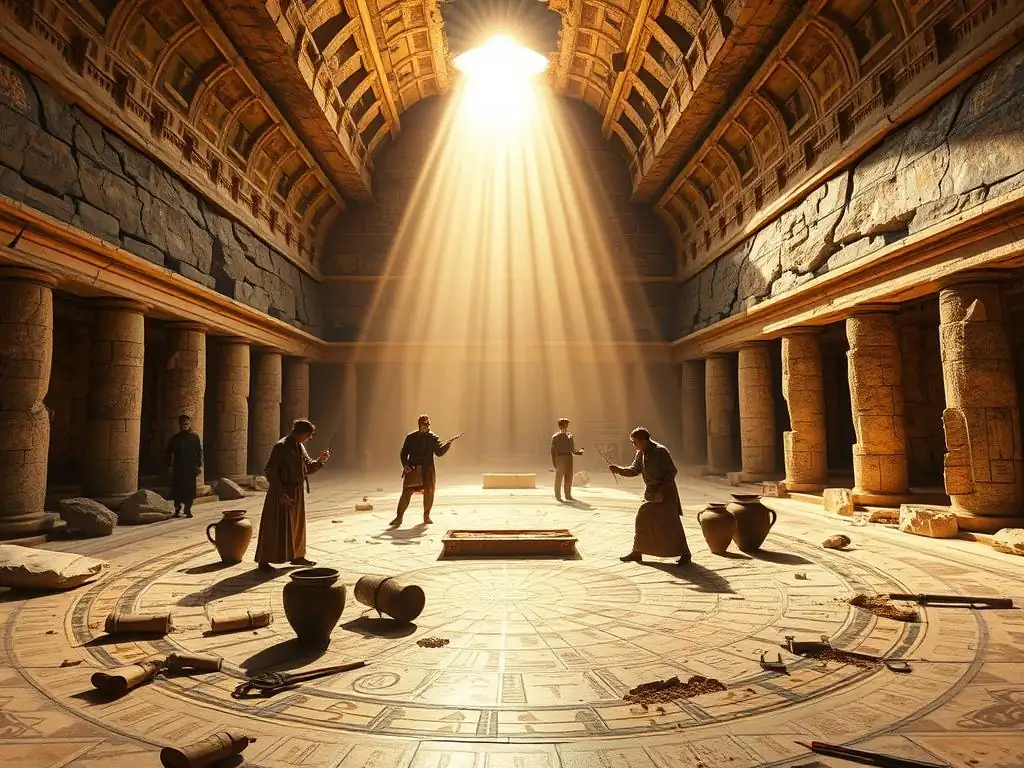
Welcome to ArchaeologyHub.org, your gateway to unraveling the mysteries of the past. Imagine a city where knowledge flourished, where groundbreaking discoveries reshaped our understanding of the world. This article delves into the remarkable story of Ptolemaic Alexandria, a beacon of innovation. But what exactly made this ancient metropolis such a fertile ground for scientific advancements? Discover the groundbreaking work of Euclid, Eratosthenes, and the dawn of advanced medicine in one of history's most influential cities. Dive in and explore the legacy!
- Introduction: Ptolemaic Alexandria - A Hub of Ancient Scientific Innovation
- Euclidean Geometry: Foundational Mathematics in Ptolemaic Alexandria
- Eratosthenes: Measuring the Earth in Ptolemaic Alexandria
-
Advancements in Medicine and Healthcare during the Ptolemaic Period
- The Alexandrian Medical School: Herophilus, Erasistratus, and Anatomical Discoveries
- Pioneering Anatomical Studies and Surgical Techniques in Alexandria
- Pharmaceutical Knowledge and Herbal Remedies in Ptolemaic Egyptian Medicine
- The Library of Alexandria's Role in Preserving and Expanding Medical Knowledge
- The Library of Alexandria: A Repository of Scientific Knowledge
- Ptolemaic Alexandria's Scientific Legacy: Impact and Influence
- Archaeology of Science: Discovering Evidence of Ptolemaic Scientific Practices
- Conclusion: Ptolemaic Alexandria - A Cradle of Scientific Revolution
-
Frequently Asked Questions
- How did Ptolemaic Alexandria contribute to the field of mathematics?
- What was Eratosthenes' major achievement in Ptolemaic Alexandria?
- How did the Library of Alexandria impact scientific progress during the Ptolemaic period?
- What were some notable advancements in medicine during the Ptolemaic period in Alexandria?
- Why is Ptolemaic Alexandria considered a significant center for scientific development?
- Final Reflection: Echoes of Alexandria's Brilliance
- Unearth Alexandria's Secrets: Become a Modern Explorer!
Introduction: Ptolemaic Alexandria - A Hub of Ancient Scientific Innovation
The Rise of Alexandria Under the Ptolemies and its Impact on Science
Following Alexander the Great's death in 323 BCE, his general Ptolemy I Soter established the Ptolemaic dynasty, choosing Alexandria as its capital. This strategically located city, at the crossroads of three continents, rapidly grew into a bustling port and a major intellectual and economic center. The Ptolemies, particularly Ptolemy I and his son Ptolemy II Philadelphus, consciously fostered an environment conducive to learning, attracting scholars, scientists, and artists from across the Hellenistic world with royal patronage and unparalleled resources. This deliberate policy laid the groundwork for an era of significant scientific advancements in Ptolemaic Alexandria.
The establishment of foundational institutions such as the Mouseion (a temple to the Muses, functioning as a research institute) and the Great Library of Alexandria provided the essential infrastructure for scientific inquiry. Scholars were salaried, enjoyed free board, and had access to an immense collection of texts, fostering an unprecedented environment for intellectual pursuit. This state-sponsored intellectual ecosystem was critical in shaping the remarkable scientific advancements history of Ptolemaic Alexandria, allowing for specialized research and interdisciplinary collaboration that was largely unparalleled in the ancient world.
The Serapeum of Alexandria: Uncovering Alexandria's Scientific Legacy
The Serapeum of Alexandria, primarily a temple dedicated to the syncretic deity Serapis, also played a significant role as an intellectual satellite to the Great Library. Often referred to as its "daughter library," it housed a substantial collection of scrolls and served as another locus for scholarly activity. While its primary function was religious, its association with the broader Alexandrian intellectual framework suggests it may have facilitated astronomical observations, philosophical debates, or even medical consultations, integrating the sacred with the pursuit of knowledge.
Archaeological investigations in Alexandria have provided tantalizing glimpses into the Serapeum's layout and its potential intellectual contributions, although direct evidence of specific scientific practices within its walls remains scarce. Discoveries of its grand architectural scale and the sheer volume of its associated artifacts underscore its importance within the city's religious and cultural landscape. While definitive links to specific scientific breakthroughs are challenging to establish, the Serapeum's existence reinforces the image of Ptolemaic Alexandria as a city where knowledge was deeply valued and pursued across various domains, contributing to its rich scientific advancements history.
Euclidean Geometry: Foundational Mathematics in Ptolemaic Alexandria
Euclid's Elements: The Cornerstone of Geometry and its Influence
Euclid, a Greek mathematician active in Alexandria during the reign of Ptolemy I (c. 300 BCE), authored The Elements, a monumental work comprising 13 books that systematized geometry, number theory, and irrational numbers. This treatise is celebrated for its rigorous axiomatic approach, beginning with definitions, postulates (such as "all right angles are equal to one another"), and common notions, from which all subsequent theorems are logically deduced. The Elements became, and remained for over two millennia, the most influential mathematical textbook ever written, shaping the understanding of space and quantity.
The profound influence of The Elements extended far beyond mathematics, establishing a paradigm for logical deduction that permeated Western thought and scientific methodology. Its emphasis on proof and rigorous argumentation became the gold standard for scientific inquiry, influencing thinkers from Archimedes and Isaac Newton to Albert Einstein. This foundational work from Ptolemaic Alexandria was instrumental in defining the very nature of mathematical and scientific reasoning, marking a pivotal moment in the scientific advancements history.
The Alexandrian School of Mathematics and Euclid's Lasting Contribution
The "Alexandrian School" of mathematics refers to the vibrant intellectual community that flourished in Ptolemaic Alexandria, drawing mathematicians from across the Hellenistic world. Although Euclid's exact biography is elusive, his presence in Alexandria under Ptolemy I positioned him at the heart of this intellectual ferment. His singular achievement was not necessarily inventing all the geometric theorems but rather compiling, refining, and logically organizing existing mathematical knowledge, alongside his own original contributions, into a coherent and comprehensive system.
Euclid's Elements served as the primary curriculum for successive generations of mathematicians and scholars studying in Alexandria and throughout the ancient world. Its clarity, consistency, and logical rigor ensured that future mathematical endeavors, including those by later Alexandrian luminaries like Apollonius of Perga (on conic sections) and Diophantus (on algebra), were built upon a solid, universally accepted foundation. This enduring legacy underscores Euclid's indelible mark on the scientific advancements in Ptolemaic Alexandria and global mathematics.
Applications of Euclidean Principles in Ancient Egyptian Architecture and Engineering
While The Elements is a theoretical work, its underlying geometric principles were indispensable for practical applications, particularly in architecture and engineering across ancient Egypt, including during the Ptolemaic period. Even before Euclid, Egyptian builders intuitively understood and applied geometric concepts, such as using the 3-4-5 triangle to establish perfect right angles in construction. Euclid's work provided the formal, systematic framework for these practices, elevating them from empirical rules to demonstrable theorems.
In Ptolemaic Egypt, the construction of grand temples, elaborate irrigation systems, and complex urban infrastructure undoubtedly relied on precise geometric understanding. Surveying tools like the groma and the dioptra, used for laying out straight lines and measuring angles and elevations, operated on principles later formalized by Euclidean geometry. The accuracy evident in the surviving architectural remains from this era, such as the Temple of Edfu (begun 237 BCE), stands as a testament to the sophisticated application of geometric knowledge, showcasing the practical dimension of scientific advancements in Ptolemaic Alexandria.
Eratosthenes: Measuring the Earth in Ptolemaic Alexandria
Eratosthenes' Method for Calculating Earth's Circumference
Eratosthenes of Cyrene, the third chief librarian of the Library of Alexandria (from approximately 240 BCE), is renowned for his remarkably accurate calculation of the Earth's circumference. His ingenious method involved observing the Sun's angle at noon on the summer solstice in two different locations: Syene (modern Aswan), where the Sun's rays fell directly into a well, indicating it was directly overhead, and Alexandria, located approximately 800 kilometers (5,000 stadia) to the north. In Alexandria, a vertical stick cast a shadow, indicating the Sun was not directly overhead.
By measuring the angle of the shadow in Alexandria, Eratosthenes found it to be about 7.2 degrees, which is approximately 1/50th of a full circle (360 degrees). Assuming the Sun's rays were parallel and the Earth was a sphere, he reasoned that this angle represented the difference in latitude between Syene and Alexandria. Therefore, the distance between the two cities must be 1/50th of the Earth's total circumference.
Multiplying the known distance (5,000 stadia) by 50, he arrived at a circumference of 250,000 stadia. This elegant application of geometry and astronomy exemplifies the pinnacle of scientific advancements in Ptolemaic Alexandria.
Accuracy and Significance of Eratosthenes' Geodetic Achievements
Eratosthenes' calculation of 250,000 stadia was remarkably close to the Earth's actual circumference. If he used the Egyptian stadium, which measured approximately 157.5 meters, his result translates to about 39,375 kilometers, an error of less than 2% compared to the actual polar circumference of roughly 40,000 kilometers. Even if he used the Attic stadium (around 185 meters), his calculation, while less precise, was still a monumental achievement given the rudimentary tools available. This accuracy highlights the sophistication of Alexandrian science and its empirical rigor.
The significance of Eratosthenes' work cannot be overstated. It was the first truly scientific and empirically sound measurement of the Earth's size, providing concrete evidence for its spherical nature and challenging earlier flat-earth concepts. This achievement not only contributed fundamentally to geodesy but also provided essential data for cartography and navigation, laying the groundwork for future geographical exploration. His method remained influential for centuries, cementing his place as a giant in the scientific advancements history.
Eratosthenes' Contributions to Geography and Cartography in the Ancient World
Beyond his famous circumference calculation, Eratosthenes made profound contributions to the nascent field of geography, even coining the term itself. His magnum opus, Geographika (Geography), was a comprehensive three-volume work that attempted to map the entire known world. He introduced a system of latitude and longitude, drawing lines parallel to the equator and perpendicular to a prime meridian running through Alexandria, a revolutionary concept for systematic cartography.
Eratosthenes also compiled a more accurate world map by integrating astronomical observations, reports from travelers, and existing geographical data. He divided the Earth into five climatic zones—a torrid zone, two frigid zones, and two temperate zones—and argued for the existence of a continuous ocean surrounding the known landmasses. His systematic approach and empirical methodology elevated geography from mere descriptive accounts to a more scientific discipline, showcasing the breadth of scientific advancements in Ptolemaic Alexandria.
Advancements in Medicine and Healthcare during the Ptolemaic Period
The Alexandrian Medical School: Herophilus, Erasistratus, and Anatomical Discoveries
Ptolemaic Alexandria became the preeminent center for medical research and practice in the ancient world, largely due to the unprecedented freedom granted to physicians for anatomical study. The Alexandrian Medical School flourished, with Herophilus of Chalcedon (c. 335–280 BCE) and Erasistratus of Ceos (c. 304–250 BCE) as its most celebrated figures. These pioneers were reportedly permitted, and perhaps even encouraged, to perform human dissection and, controversially, vivisection on condemned criminals, a practice largely forbidden elsewhere in the ancient world.
Herophilus, often called the "Father of Anatomy," made groundbreaking distinctions between nerves and tendons, recognized the brain as the center of intelligence, and described numerous organs, including the duodenum, prostate gland, and the human eye's structure. Erasistratus, a contemporary, focused on the circulatory system, accurately distinguishing between arteries and veins and understanding the heart's function as a pump, though he incorrectly believed arteries carried pneuma (air) rather than blood. Their detailed investigations significantly advanced the scientific understanding of the human body, marking a critical period in Ptolemaic Alexandria scientific advancements history.
Pioneering Anatomical Studies and Surgical Techniques in Alexandria
The ability to systematically dissect human cadavers provided Alexandrian physicians with an unparalleled opportunity to study internal anatomy directly. This direct observation led to highly detailed descriptions of organs, muscles, bones, and the nervous system that surpassed all previous Greek medical knowledge. These anatomical insights formed the bedrock for more informed medical diagnoses and treatments.
This deeper understanding of the human body directly informed surgical practices. While archaeological evidence of specific surgical instruments from this period can be limited, textual accounts from later writers like Celsus (who drew heavily on Alexandrian knowledge) describe complex surgical procedures. These likely included advanced methods for setting fractures, treating wounds, and even more intricate operations, all based on the revolutionary anatomical knowledge gained through dissection. The emphasis on empirical observation and systematic study made Ptolemaic Alexandria a hub for significant surgical innovation.
Pharmaceutical Knowledge and Herbal Remedies in Ptolemaic Egyptian Medicine
The cosmopolitan nature of Alexandria fostered a unique synthesis of traditional Egyptian herbal medicine with Hellenistic pharmacological knowledge. Scholars and physicians in Alexandria compiled extensive pharmacopoeias, systematically cataloging medicinal plants, their properties, and methods of preparation. This interdisciplinary approach led to a broader and more effective range of remedies.
Examples of pharmaceutical knowledge included the sophisticated use of opium for pain relief, various purgatives, and an array of herbal concoctions for digestive, respiratory, and skin ailments. The emphasis was on empirical observation of effects, leading to a more rational and scientific approach to drug therapy. The systematic collection and analysis of botanical knowledge contributed significantly to the holistic scientific advancements in Ptolemaic Alexandria, impacting everyday healthcare.
The Library of Alexandria's Role in Preserving and Expanding Medical Knowledge
The Great Library of Alexandria played an indispensable role in the flourishing of medical science. It served as a vast repository for medical texts from across the ancient world, including works by Hippocrates, ancient Egyptian papyri (like the Ebers Papyrus), and treatises from other Hellenistic traditions. This immense collection allowed physicians and scholars to compare, analyze, and synthesize diverse medical theories and practices.
Moreover, the Library was not merely a passive archive; it was an active center for scholarship. Physicians and medical researchers, often associated with the Mouseion, produced new medical treatises, commentaries on existing works, and systematic compilations of knowledge. This dynamic environment fostered critical thinking, debate, and the constant expansion of medical understanding, making the Library integral to the scientific advancements of Ptolemaic Alexandria.
The Library of Alexandria: A Repository of Scientific Knowledge

The Library as a Center for Research and Intellectual Exchange
The Library of Alexandria, along with the associated Mouseion, was far more than a mere collection of scrolls; it was a pioneering research institution, a proto-university of its time. Under the direct patronage of the Ptolemaic kings, it housed and salaried leading scholars from across the Greek world, providing them with unparalleled resources and freedom to conduct research, teach, and write. This state-supported academic community fostered an environment of intense intellectual activity and collaboration.
The presence of diverse scholars from various fields—mathematicians, astronomers, physicians, engineers, poets, and philosophers—facilitated an extraordinary level of intellectual exchange. Debates, shared discoveries, and interdisciplinary collaborations were commonplace, accelerating the pace of scientific discovery and innovation. This vibrant intellectual ecosystem was a primary driver of the scientific advancements in Ptolemaic Alexandria, creating a unique synergy between various branches of knowledge.
The Collection and Preservation of Ancient Texts on Science and Medicine
The Library's acquisition policy was famously ambitious: to collect every book in the known world. Ptolemaic agents actively sought out, purchased, or even forcibly borrowed scrolls, meticulously copying them before returning the originals (though sometimes keeping the originals and returning the copies). Estimates of its collection range from 400,000 to 700,000 scrolls, making it the largest and most comprehensive archive of ancient knowledge.
This vast collection included a wealth of texts on mathematics, astronomy, physics, engineering, natural history, and, crucially, medicine. Scribes, editors, and librarians diligently organized, cataloged, and preserved these texts, ensuring that knowledge that might otherwise have been lost to history was maintained. This systematic preservation formed the bedrock upon which new scientific advancements in Ptolemaic Alexandria could be built, as scholars had access to the cumulative wisdom of previous generations.
The Library's Influence on Subsequent Scientific Developments
The Library's comprehensive collection and its active scholarly community profoundly influenced subsequent scientific developments throughout the ancient world and beyond. Scholars like Archimedes, though primarily based in Syracuse, spent time studying in Alexandria and likely drew upon the Library's resources. The ability to access and synthesize diverse theories and experimental findings allowed for more rapid progress than would have been possible elsewhere.
While the eventual destruction or decline of the Library was a tragic loss, its legacy persisted. Many of its contents were copied and disseminated, influencing later Roman scholars and, critically, being translated into Arabic during the Islamic Golden Age. These translations served as vital conduits for the transmission of ancient Greek scientific knowledge to medieval Europe, thereby profoundly impacting the Renaissance and the eventual Scientific Revolution. The Library's role in the scientific advancements history is thus enduring and global.
Ptolemaic Alexandria's Scientific Legacy: Impact and Influence
Dissemination of Alexandrian Science to the Roman World
The scientific advancements made in Ptolemaic Alexandria were not confined to Egypt but spread throughout the Hellenistic world and, crucially, to the emerging Roman Empire. While Roman culture was often more focused on practical applications and engineering, the theoretical foundations for many of their achievements were rooted in Hellenistic science, particularly that of Alexandria. Roman scholars and engineers, such as Vitruvius, explicitly referenced and drew upon Alexandrian principles in their works on architecture, urban planning, and mechanical devices.
The transmission of Alexandrian scientific texts, whether through direct study by Roman intellectuals or through translations into Latin, ensured that this knowledge permeated Roman society. This intellectual transfer influenced Roman infrastructure projects, military technologies, and public health practices. The enduring legacy of Ptolemaic Alexandria's scientific advancements history can be seen in the Roman adoption of advanced geometric principles for construction and their understanding of medicine.
Lasting Impact on Modern Mathematics, Geography, and Medicine
The direct lineage from Ptolemaic Alexandria to modern science is undeniable. Euclid's Elements, for instance, remained the standard textbook for geometry in Western education for over two thousand years, until the early 20th century, profoundly shaping mathematical thought. Eratosthenes' geodetic methods, though refined by modern technology, laid the conceptual groundwork for the science of measuring and mapping the Earth, forming the basis for modern cartography and geodesy.
In medicine, the Alexandrian Medical School's emphasis on empirical anatomy and dissection, pioneered by Herophilus and Erasistratus, established a crucial precedent. Although much of this knowledge was lost during subsequent periods of decline, the spirit of systematic inquiry and the scientific approach to understanding the human body re-emerged during the Renaissance and Enlightenment. The foundational work in Ptolemaic Alexandria thus cast a long shadow, directly influencing the trajectory of modern mathematics, geography, and medicine, solidifying its place in the scientific advancements history.
Comparison with Scientific Centers of Ancient Athens
While ancient Athens is celebrated as the birthplace of philosophy and theoretical inquiry, producing intellectual giants like Plato and Aristotle, Ptolemaic Alexandria distinguished itself by fostering a more empirical, experimental, and specialized approach to science. Athenian intellectualism often prioritized abstract reasoning and philosophical debate; Alexandrian scholarship, by contrast, focused on systematic observation, measurement, and practical application.
Institutionally, the difference was stark: Athens had philosophical academies and private schools, while Alexandria boasted the state-sponsored Library and Mouseion, providing salaried positions and dedicated research facilities. This shift from privately funded philosophical discourse to a publicly supported, collaborative research institution was a crucial factor in the unique trajectory of scientific advancements in Ptolemaic Alexandria. It allowed for a level of specialization and resource allocation that was unprecedented, leading to concrete scientific breakthroughs rather than solely theoretical propositions.
Archaeology of Science: Discovering Evidence of Ptolemaic Scientific Practices
Direct archaeological evidence of specific ancient scientific instruments from Ptolemaic Alexandria is remarkably rare. Many instruments were made of perishable materials like wood, or from metals that were later melted down and repurposed. However, indirect evidence and certain types of finds can hint at the widespread scientific practices. Discoveries of precision weights and measures, for instance, suggest a standardized system that would have been essential for commerce and, by extension, for scientific experimentation.
Furthermore, excavations within Alexandria have uncovered workshops related to crafts like glassmaking, metallurgy, and pottery, which inherently required a practical understanding of chemistry, physics, and material science. While not "scientific instruments" in the modern sense, the tools and waste products from these workshops indicate a sophisticated level of practical knowledge and empirical experimentation that underpinned the broader scientific advancements in Ptolemaic Alexandria. The urban layout itself, with its planned grid and advanced water systems, speaks to a strong command of engineering principles.
Examples of Excavations Revealing Medical Tools in Kom El-Dikka
Kom El-Dikka, a prominent archaeological site in central Alexandria, has yielded significant insights into the city's Ptolemaic and Roman periods, though direct evidence of medical schools or specific anatomical labs remains elusive. However, excavations have unearthed residential complexes, bathhouses, and public buildings that paint a picture of daily life and the urban fabric that supported the intellectual elite. While rare, finds of certain artifacts can be interpreted as related to medical practices.
These potential medical artifacts might include small bronze scalpels, probes, bone drills, cupping vessels, or various mortars and pestles used for preparing pharmaceutical remedies. For example, while not definitively from a medical school context, the presence of such tools in domestic or public settings indicates the ongoing practice of medicine within the city. These scattered finds, though not as dramatic as a preserved laboratory, provide tangible links to the sophisticated medical scientific advancements in Ptolemaic Alexandria.
Challenges in Interpreting Archaeological Evidence of Ancient Science
Interpreting archaeological evidence for ancient scientific practices presents significant challenges. Many scientific activities, particularly in mathematics, astronomy, and theoretical medicine, leave no direct physical trace. A geometric proof or an astronomical calculation is an abstract concept, not a material artifact. Furthermore, many ancient scientific instruments were multipurpose or so simple that distinguishing them from everyday tools is difficult.
The extensive destruction and subsequent rebuilding of ancient Alexandria over millennia have also buried or obliterated much of the direct physical evidence of its intellectual centers, including the precise locations of the Library and Mouseion. Consequently, much of our understanding of Ptolemaic Alexandria scientific advancements history relies heavily on textual sources from ancient writers rather than direct archaeological discovery. Archaeology primarily serves to confirm the context, urban environment, and material culture that facilitated these remarkable intellectual achievements.
Conclusion: Ptolemaic Alexandria - A Cradle of Scientific Revolution
The Enduring Significance of Ptolemaic Alexandria's Scientific Contributions
Ptolemaic Alexandria stands as an unparalleled beacon of scientific innovation in the ancient world. It was here that Euclid systematized geometry, creating a logical framework that endured for millennia. It was here that Eratosthenes meticulously measured the Earth's circumference with astonishing accuracy, fundamentally reshaping geographical understanding. And it was here that Herophilus and Erasistratus pioneered human anatomical studies, laying the groundwork for modern medicine. These were not isolated achievements but products of a vibrant, state-supported intellectual ecosystem centered around the Library and Mouseion.
The collective scientific advancements in Ptolemaic Alexandria formed a critical bridge, absorbing earlier Greek theoretical philosophy and transforming it into empirical, systematic inquiry. This knowledge was then disseminated to the Roman world and, crucially, preserved and expanded upon by scholars of the Islamic Golden Age, eventually fueling the European Renaissance. Alexandria was indeed a crucible for scientific revolution, leaving an indelible mark on the scientific advancements history of humanity.
Further Research and Exploration of Alexandria's Scientific Heritage
Despite centuries of study, much of ancient Alexandria's scientific heritage remains to be fully uncovered. Ongoing archaeological efforts, particularly underwater archaeology in the city's submerged harbor and land-based excavations in areas like Kom El-Dikka, continue to yield fascinating insights into the city's layout, daily life, and intellectual pursuits. These ongoing investigations hold the potential to reveal more about the physical spaces where Alexandrian scholars worked and lived.
The precise locations of the Great Library and Mouseion remain among the most significant archaeological mysteries. Future discoveries related to these legendary institutions could provide unprecedented insights into the organization of ancient scholarship, the daily lives of the scholars, and the specific mechanisms that supported the remarkable scientific advancements in Ptolemaic Alexandria. Such finds would undoubtedly deepen our understanding of this pivotal era.
Future Directions in the Archaeological Study of Science in Ptolemaic Alexandria
Future archaeological studies of science in Ptolemaic Alexandria will benefit immensely from increasingly interdisciplinary approaches. Combining traditional archaeological excavation with advanced techniques such as remote sensing, digital reconstruction, and material science analysis can yield new insights. For instance, analyzing residues on ancient medical tools or studying the composition of building materials could reveal more about ancient scientific understanding of properties and processes.
Furthermore, a holistic approach that integrates archaeological findings with textual analysis, historical context, and an understanding of the broader urban fabric will be crucial. Understanding the social structures, economic conditions, and royal patronage that enabled such significant scientific progress will deepen our appreciation of Alexandria's unique environment. This comprehensive perspective will continue to illuminate the complex and remarkable scientific advancements in Ptolemaic Alexandria, ensuring its legacy is continually re-evaluated and understood.
Frequently Asked Questions
How did Ptolemaic Alexandria contribute to the field of mathematics?
Ptolemaic Alexandria was a hub for mathematical innovation. Euclid's Elements revolutionized geometry, providing a systematic framework for mathematical reasoning and influencing scientific thought for centuries.
What was Eratosthenes' major achievement in Ptolemaic Alexandria?
Eratosthenes is best known for his remarkably accurate calculation of the circumference of the Earth. This feat demonstrated the advanced understanding of geometry and astronomy present in Ptolemaic Alexandria.
How did the Library of Alexandria impact scientific progress during the Ptolemaic period?
The Library served as a repository of knowledge, attracting scholars and facilitating the exchange of ideas. This fostered scientific inquiry and allowed for the preservation and dissemination of important texts.
What were some notable advancements in medicine during the Ptolemaic period in Alexandria?
Alexandrian physicians made strides in anatomical understanding, sometimes through controversial practices like dissection. They also developed new surgical techniques and pharmacological remedies.
Why is Ptolemaic Alexandria considered a significant center for scientific development?
Ptolemaic Alexandria's royal patronage, the Library, and the presence of brilliant minds like Euclid and Eratosthenes created a unique environment. This environment fostered innovation across mathematics, astronomy, and medicine, leaving a lasting impact on scientific history.
Final Reflection: Echoes of Alexandria's Brilliance
The legacy of Ptolemaic Alexandria, as explored throughout this article, isn't just a historical footnote; it's a vibrant testament to the power of human curiosity and collaborative innovation. The scientific advancements forged in that ancient city continue to resonate today, shaping our understanding of mathematics, geography, and medicine. From Euclid's foundational geometry to Eratosthenes' remarkably accurate calculation of the Earth's circumference, the intellectual seeds sown in Alexandria continue to blossom in modern scientific pursuits.
The spirit of inquiry that permeated Ptolemaic Alexandria serves as a powerful reminder of the importance of intellectual freedom and cross-cultural exchange. The dedication to knowledge, regardless of its origin, fostered an environment where groundbreaking discoveries were possible. This commitment to understanding the world around us, even with limited resources, is a lesson that remains profoundly relevant in our own time. The mind is not a vessel to be filled, but a fire to be kindled.
- Plutarch, a sentiment that perfectly encapsulates the Alexandrian pursuit of knowledge.
As we reflect on the scientific advancements of Ptolemaic Alexandria, let us be inspired to cultivate our own intellectual curiosity and embrace the spirit of innovation. Let us strive to create environments where knowledge is valued, collaboration is encouraged, and the pursuit of understanding is paramount. Consider how you can contribute to the ongoing quest for knowledge, drawing inspiration from the brilliance that once illuminated the shores of Alexandria.
Unearth Alexandria's Secrets: Become a Modern Explorer!
Thank you for delving into the world of Ptolemaic Alexandria and its groundbreaking scientific advancements. You've just journeyed through the intellectual powerhouse of the ancient world. Now, it's time to carry that inspiration forward.
What's next?
- Recreate Eratosthenes' experiment: Use basic tools to estimate the Earth’s circumference and share your findings online.
- Share this article with a friend fascinated by ancient history and spark a conversation about the enduring legacy of Alexandria.
- Explore your local library or online resources for lesser-known figures from Alexandria's scientific community and unveil their forgotten contributions.
What unexpected discovery from Alexandria will you bring to light today?