
La Venta: Ritual Architecture and Sacred Spaces of the Olmec

Welcome to ArchaeologyHub.org, your portal to the past!
Delve into the mysteries of ancient civilizations and unearth the secrets hidden beneath our feet. Are you ready to explore the monumental legacy of the Olmec civilization? This journey begins with La Venta, a pivotal site that reveals fascinating insights into Olmec ritual architecture in Mexico. Join us as we uncover the sacred spaces and symbolic meanings embedded within this ancient city. What secrets will we find? Read on to discover more...
- Introduction to La Venta: A Major Olmec Center
- The Architectural Layout of La Venta: A Planned Ceremonial Center
- Major Architectural Features of La Venta: Exploring the Site
- La Venta's Sacred Spaces: Rituals and Beliefs Reflected in Architecture
- Monumental Sculpture and Olmec Ideology at La Venta
- The Decline of La Venta: Theories and Evidence
- Interpreting La Venta: Current Archaeological Research and Debates
- Conclusion: La Venta's Enduring Importance to Olmec and Mesoamerican Studies
-
Frequently Asked Questions
- How did the Olmec civilization utilize La Venta for ritual purposes?
- What are some key features of Olmec ritual architecture at La Venta?
- What role did offerings play in Olmec ritual practices at La Venta?
- How does the architecture of La Venta reflect Olmec cosmology and worldview?
- What can archaeological discoveries at La Venta tell us about Olmec society and religious beliefs?
- Final Reflection: Echoes of Ancient Rituals
- Unveil the Secrets: Embark on Your Olmec Adventure!
Introduction to La Venta: A Major Olmec Center
Locating La Venta: Geographic Context and Resources
La Venta, a pre-Columbian archaeological site, is situated on a low-lying island within a vast swamp system near the Tonalá River in the present-day Mexican state of Tabasco. This strategic location, approximately 15 kilometers inland from the Gulf Coast, provided the Olmec inhabitants with abundant natural resources crucial for their sustenance and cultural development.
The surrounding wetlands offered a rich bounty of fish, shellfish, and waterfowl, while the fertile alluvial soils supported intensive maize cultivation, a staple of the Mesoamerican diet. Furthermore, the riverine network facilitated long-distance trade, allowing the Olmec to acquire exotic materials such as jade, serpentine, obsidian, and basalt, which were essential for their sophisticated artistry and Olmec ritual architecture Mexico.
The environment also presented challenges, particularly seasonal flooding, which the Olmec ingeniously managed through advanced hydraulic engineering. Despite its seemingly remote setting, La Venta was centrally located within the Olmec heartland, serving as a pivotal administrative and ceremonial hub. Its access to navigable waterways connected it to highland sources of stone and distant trade routes, underscoring its importance not just as a local center but as a nexus of regional interaction and influence in early Mesoamerica.
La Venta as a Key Site for Understanding Olmec Urbanism and Ritual Architecture
La Venta flourished during the Middle Formative period (c. 900–400 BCE), representing the zenith of Olmec civilization. Unlike later Mesoamerican urban centers characterized by dense residential zones, La Venta's "urbanism" was primarily defined by its monumental ceremonial core, reflecting a society organized around religious and political authority. The site's layout, massive earthworks, and sophisticated stone monuments provide invaluable insights into the social structure, cosmological beliefs, and technological capabilities of the Olmec. It stands as a prime example of early complex societies in Mesoamerica, demonstrating a remarkable capacity for large-scale labor organization and sophisticated planning.
The sheer scale of its constructions, particularly the Great Pyramid and extensive platform mounds, reveals a profound understanding of engineering and a deep commitment to religious expression. The intricate arrangement of these structures, along with the buried offerings and colossal sculptures, defines a distinctive style of Olmec ritual architecture Mexico that profoundly influenced subsequent Mesoamerican cultures. Studying La Venta allows archaeologists to trace the origins of many foundational Mesoamerican cultural traits, from pyramid building and ceremonial plazas to specific iconographic motifs and the concept of sacred kingship, making it a cornerstone for understanding the region's ancient past.
The Architectural Layout of La Venta: A Planned Ceremonial Center
Axial Layout and Monumental Construction at La Venta
The architectural design of La Venta is characterized by a striking axial layout, meticulously oriented approximately 8 degrees west of true north. This precise orientation, observed across the site's major complexes, suggests a deliberate cosmological or astronomical alignment, a hallmark of early Olmec ritual architecture Mexico. The core of the site consists of a series of large, rectangular earth mounds and plazas, arranged along this central axis, stretching for over 1.5 kilometers. These monumental constructions, primarily built from compacted earth and clay, required an immense investment of labor, indicating a highly organized society capable of coordinating massive public works.
Complex A, located north of the Great Pyramid, served as a primary ritual precinct, featuring a series of buried offerings and elaborate tombs. South of the Great Pyramid, Complex B comprises large platforms and plazas, likely serving as areas for public gatherings and ceremonies.
The sheer volume of material moved to construct these features, estimated in the millions of cubic meters, underscores the Olmec's engineering prowess and their ability to mobilize a large workforce for projects central to their religious and political life. This planned arrangement of space facilitated specific ritual processions and public displays, reinforcing the authority of the elite and the communal nature of religious practices.
Orientation and Astronomical Alignment in La Venta Architectural Design
The consistent orientation of La Venta's principal structures along an axis slightly west of north is not coincidental but reflects a deliberate design choice, possibly linked to astronomical observations or cosmological principles. While the exact purpose of this specific alignment remains a subject of archaeological debate, similar orientations are found in later Mesoamerican sites, suggesting an early Olmec precedent for integrating celestial movements into Olmec ritual architecture Mexico. This precision implies a sophisticated understanding of surveying and possibly rudimentary astronomical knowledge, allowing the builders to align their monumental constructions with significant celestial events or directions.
One theory suggests the alignment might correspond to the setting position of a specific star or constellation at a particular time of year, perhaps marking an important agricultural cycle or a key religious festival. Another posits a connection to the cardinal directions, albeit slightly offset, imbuing the ceremonial center with sacred directional symbolism. Regardless of the precise celestial referent, the careful orientation of La Venta's core structures establishes a profound connection between the terrestrial realm and the cosmos, transforming the constructed environment into a sacred landscape designed to facilitate communication with the divine and reinforce the Olmec worldview.
Major Architectural Features of La Venta: Exploring the Site
Complex C: The Great Pyramid and Its Significance
Complex C, dominated by the Great Pyramid (also known as Mound C-1), stands as the most imposing structure at La Venta and one of the earliest large-scale pyramids in Mesoamerica. Rising approximately 34 meters (112 feet) above the surrounding plain, this massive earthen mound is distinctive for its fluted, conical shape, resembling a volcanic cone or a pleated skirt, rather than the stepped pyramids characteristic of later Mesoamerican cultures.
Its construction, primarily from compacted clay, demonstrates the Olmec's innovative use of available materials and their ability to create monumental forms without the use of stone masonry for the primary structure. The pyramid likely served as the focal point for major public rituals and ceremonies, providing a dramatic backdrop for the display of elite power and religious devotion.
Archaeological investigations have revealed that the Great Pyramid's unique form was intentionally designed, not merely the result of erosion. Its carefully engineered shape, along with the sheer volume of earth moved for its construction (estimated at 100,000 cubic meters), underscores its importance as a central element of Olmec ritual architecture Mexico. While no burial chamber has been found within the pyramid itself, its commanding presence at the southern end of the site's axial layout strongly suggests its role as a symbolic mountain or a sacred portal, connecting the earthly realm with the celestial or underworld domains.
Complex A: A Ritual Burial and Offering Complex
Complex A, situated north of the Great Pyramid, represents a highly significant ritual precinct at La Venta, characterized by a series of meticulously arranged mounds, plazas, and most notably, an extraordinary collection of buried offerings and elaborate tombs. This complex served as the primary locus for ceremonies involving the interment of precious materials and possibly high-status individuals.
Among its most famous features are the "Massive Offerings," immense caches of serpentine blocks, some forming intricate mosaic pavements depicting abstract jaguar masks, buried deep beneath the surface. These offerings, requiring thousands of tons of imported stone, represent an unparalleled act of conspicuous consumption and devotion, highlighting the wealth and organizational capacity of the Olmec elite.
Within Complex A, archaeologists have also uncovered several elaborate tombs, constructed from basalt columns, containing the remains of individuals accompanied by rich grave goods, including jade figurines, pendants, and earspools. These burials, such as Tomb A-2, provide crucial insights into Olmec mortuary practices, social hierarchy, and their belief in an afterlife. The careful placement and concealment of these offerings and burials within Complex A underscore its profound sacred significance, making it a central component of Olmec ritual architecture Mexico dedicated to ancestor veneration and profound religious expression.
Complex B and D: Platforms, Plazas, and Residential Areas
Complex B, located immediately south of the Great Pyramid, forms a expansive platform area that likely served as the primary public plaza at La Venta. This vast, open space, bordered by smaller mounds and platforms, would have been the setting for large-scale communal gatherings, religious processions, and ceremonies attended by a significant portion of the population.
The design of Complex B, with its wide-open spaces, contrasts with the more restricted and intensely ritualistic Complex A, suggesting a functional differentiation within the ceremonial core of La Venta. Its role as a focal point for collective rituals reinforces the communal aspect of Olmec ritual architecture Mexico, where the populace participated in or witnessed important state-sponsored religious events.
Further south, Complex D comprises a series of smaller mounds and platforms that are thought to represent residential areas for the Olmec elite or administrative buildings. While not as grand as the central ceremonial architecture, these structures provide evidence of the daily life and organizational structure of the ruling class.
Excavations in these areas have yielded domestic artifacts alongside more specialized items, indicating that these spaces served both practical and possibly minor ceremonial functions. The proximity of these presumed residential zones to the main ceremonial core highlights the close integration of political and religious authority in Olmec society, with the elite living within the very heart of their sacred landscape.
La Venta's Sacred Spaces: Rituals and Beliefs Reflected in Architecture
The Significance of Jade and Serpentine in Olmec Rituals
Jade and serpentine held immense symbolic and ritualistic significance for the Olmec, far beyond their aesthetic appeal. These precious green stones, sourced from distant regions like the Motagua River Valley in Guatemala, were central to Olmec ritual architecture Mexico and artistic expression. At La Venta, large quantities of jade and serpentine were meticulously carved into figurines, celts (axe-shaped objects), pendants, and beads, many of which were deposited as offerings in the ceremonial complexes, particularly Complex A.
The "Massive Offerings" within Complex A, consisting of thousands of tons of serpentine blocks arranged into mosaic pavements, exemplify the extraordinary effort and resources dedicated to these materials. These offerings were not merely decorative; they were acts of profound spiritual devotion, intended to honor deities, ensure agricultural fertility, or legitimize the authority of rulers.
The value placed on these stones stemmed from their perceived connection to water, fertility, and the life-giving forces of the earth, often associated with maize and the color green. Jade, in particular, was believed to embody sacred properties, serving as a conduit between the human and divine realms. Its hardness and lustrous quality, coupled with the difficulty of acquiring and working it, elevated its status to a material reserved for the most sacred objects and elite regalia, solidifying its role in the cosmological and political framework of Olmec society.
Water Management and Basalt Stone Drainage at La Venta
Given La Venta's location within a low-lying, swampy environment prone to seasonal flooding, effective water management was crucial for the site's habitability and the preservation of its monumental Olmec ritual architecture Mexico. Archaeological investigations have revealed sophisticated hydraulic engineering systems designed to control and channel water within the ceremonial core. One of the most remarkable examples is a complex system of U-shaped basalt troughs and channels found in Complex A. These carefully carved stone conduits, some over 3 meters long, were arranged to form an elaborate drainage network, directing rainwater away from important ritual areas and preventing inundation.
This intricate system not only demonstrates the Olmec's advanced understanding of hydrology and engineering but also suggests a symbolic connection to water in their rituals. The controlled flow of water through these channels might have been part of specific ceremonies, perhaps mimicking natural springs or rivers, or symbolizing the life-giving properties of water itself. The use of imported basalt, a difficult material to transport and carve, for these utilitarian yet ritually significant features underscores the importance of water management in both the practical and spiritual dimensions of La Venta's design.
La Venta's Plazas: Spaces for Public Gatherings and Ceremonies
The expansive plazas at La Venta, particularly the large platform areas within Complex B and surrounding the Great Pyramid, served as vital public spaces for communal gatherings and grand ceremonies. These open areas, carefully leveled and maintained, were integral to the functioning of Olmec ritual architecture Mexico, providing the stage for public displays of power, religious festivals, and possibly market activities. The sheer size of these plazas suggests that a significant portion of the population could gather to witness or participate in important events, reinforcing social cohesion and the authority of the ruling elite.
The arrangement of the plazas relative to the monumental architecture, such as the Great Pyramid and the various platforms, created a dramatic setting for ritual processions and performances. These spaces facilitated the visual impact of the colossal heads and stelae, which were strategically positioned to be seen by large audiences. The communal aspect of these plazas highlights that Olmec religious and political life was not confined to elite-only spaces but involved the active participation or observation of the wider community, fostering a shared cultural identity and reinforcing the collective understanding of their cosmology.
Monumental Sculpture and Olmec Ideology at La Venta
Representations of Deities and Rulers in Monumental Sculpture
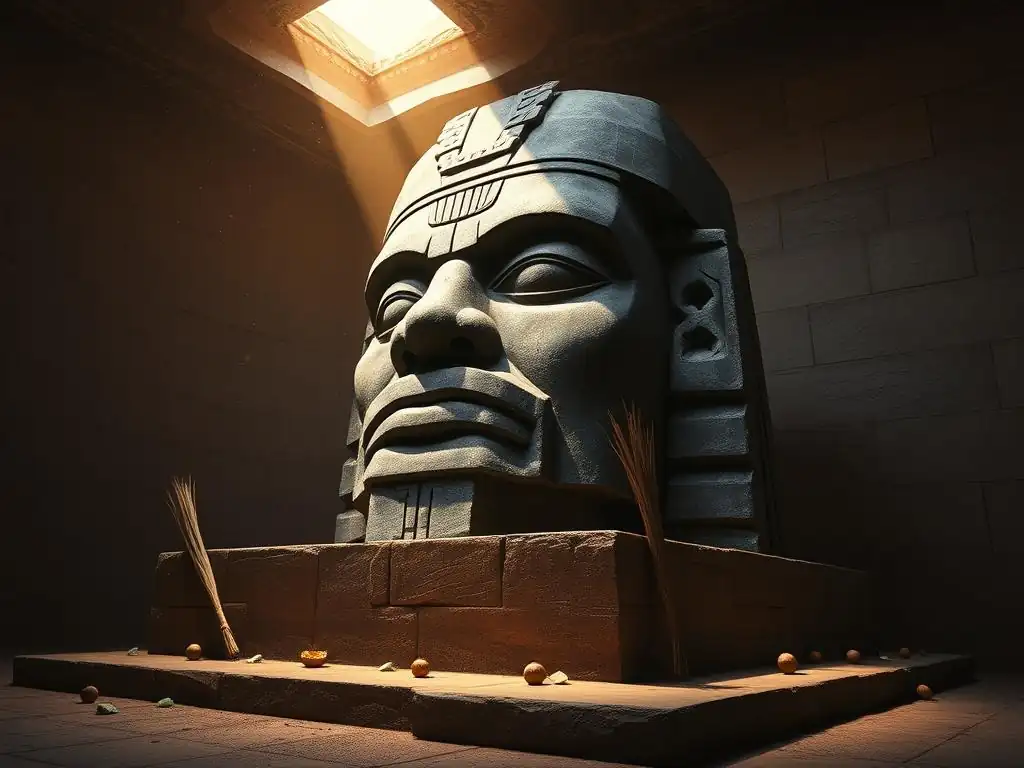
La Venta is renowned for its extraordinary collection of monumental sculptures, which are central to understanding Olmec ideology and their concepts of rulership and divinity. These massive basalt carvings, including the iconic colossal heads, stelae, altars, and freestanding sculptures, were strategically placed throughout the ceremonial core of the site, forming an integral part of Olmec ritual architecture Mexico.
The colossal heads, weighing up to 20 tons and standing over 3 meters tall, are widely interpreted as portraits of individual Olmec rulers, distinguished by their unique facial features and helmet-like headgear. Their presence at La Venta speaks to the emergence of powerful, individualized leadership and the glorification of rulers as central figures in both political and religious life.
Beyond the colossal heads, other sculptures depict anthropomorphic figures, often combining human and jaguar features, which are believed to represent deities or shamanic transformations. Altars, such as Altar 4, portray rulers emerging from or interacting with supernatural beings, underscoring their divine mandate and their role as intermediaries between the human and spirit worlds. Stelae, like Stela 2, present more complex narrative scenes, possibly commemorating historical events or important ritual acts performed by rulers. These sculptures served as powerful visual propaganda, conveying the legitimacy, power, and divine connections of the Olmec elite to the populace.
The monumental art and elaborate offerings at La Venta provide compelling evidence of a highly stratified Olmec society. The resources required to quarry, transport, and carve the massive basalt stones for the colossal heads and altars, some of which came from quarries over 100 kilometers away, indicate a sophisticated level of labor organization and economic control.
Only a powerful elite could command such an immense mobilization of human and material resources. The precious materials used in the buried offerings, such as thousands of tons of serpentine and jade from distant sources, further underscore the wealth and ritual power concentrated in the hands of the ruling class.
The elaborate tombs found within Complex A, containing rich grave goods like jade figurines and pendants, clearly differentiate the burial practices of the elite from those of the common populace, whose burials were likely simpler and less elaborate. Furthermore, the iconography on the stelae and altars frequently depicts rulers adorned with elaborate regalia, interacting with supernatural entities, visually reinforcing their elevated status and divine connections. This combination of monumental Olmec ritual architecture Mexico, exotic material consumption, and iconographic representation vividly illustrates the deep social divisions and the concentration of power within the Olmec elite at La Venta.
The Interplay Between Sculpture and Architecture in Conveying Olmec Power
At La Venta, monumental sculpture and architecture were not separate artistic expressions but were deeply intertwined, forming a cohesive visual and symbolic landscape designed to convey Olmec power and ideology. The strategic placement of colossal heads, altars, and stelae within the ceremonial plazas and along processional routes transformed the built environment into a narrative of authority and religious belief.
For instance, the colossal heads, likely representing powerful rulers, were positioned at key entry points or within prominent plazas, acting as imposing guardians or visible affirmations of dynastic power. This integration meant that as one moved through the site's Olmec ritual architecture Mexico, they were constantly confronted with messages of elite legitimacy and supernatural connection.
The altars, often depicting rulers emerging from or interacting with mythical beings, were placed in central ceremonial areas, transforming the architectural space into a stage for the performance and legitimization of ritual authority. Similarly, stelae, with their carved narratives, functioned as permanent records of historical events or ritual acts, embedded within the sacred precinct. This deliberate synergy between massive earthworks and monumental stone art created an immersive environment that reinforced the Olmec worldview, celebrated their rulers, and communicated the profound sacredness of La Venta as a center of political and religious power.
The Decline of La Venta: Theories and Evidence
Evidence for Ritual Mutilation and Abandonment
The abandonment of La Venta around 400 BCE marks the end of its prominence as a major Olmec center. Unlike some later Mesoamerican sites that show clear evidence of violent destruction, the decline of La Venta appears to have been a more complex process, with strong indications of ritual mutilation and gradual abandonment rather than catastrophic warfare.
Archaeological findings reveal that many of the colossal heads and altars were deliberately defaced or "mutilated" – often involving the breaking off of noses or ears, or the overturning of monuments – prior to the site's final abandonment. This systematic defacement is interpreted not as an act of conquest by external enemies, but rather as an internal ritual act, possibly signaling the end of a dynastic line, a change in religious ideology, or a deliberate desacralization of the site by its own people.
The careful burial of some monuments, coupled with the mutilation of others, suggests a deliberate closing down of the sacred spaces and the ritual Olmec ritual architecture Mexico. Following these acts, there is evidence of a gradual decline in population and the cessation of monumental construction. While environmental factors such as shifting river courses or resource depletion may have played a role, the ritualized nature of the monument destruction strongly points to internal social or political shifts as a primary driver of La Venta's decline as a major center.
The Legacy of La Venta: Influence on Later Mesoamerican Civilizations
Despite its eventual abandonment, La Venta left an indelible mark on the trajectory of Mesoamerican civilizations, serving as a "mother culture" that pioneered many of the foundational elements later adopted and elaborated upon by subsequent societies. The site's monumental Olmec ritual architecture Mexico, characterized by its axial planning, massive earthen mounds, and the concept of ceremonial plazas, became a template for urban design across the region. The Great Pyramid at La Venta, one of the earliest large pyramids, set a precedent for the monumental constructions that would define later cultures like the Maya and Teotihuacan.
Beyond architectural forms, La Venta's influence is evident in shared iconographic motifs, such as the jaguar-human composite figure, the concept of sacred kingship, and the development of a complex cosmology. The Olmec's sophisticated calendrical and writing systems, though rudimentary compared to later developments, laid the groundwork for the advanced intellectual achievements of the Maya and Zapotec.
Even the long-distance trade networks established by the Olmec for acquiring precious materials like jade and obsidian continued to facilitate cultural exchange for millennia. Thus, La Venta's innovations in art, religion, social organization, and monumental construction provided the bedrock upon which the rich tapestry of Mesoamerican civilization was built.
Interpreting La Venta: Current Archaeological Research and Debates
Dating La Venta: Chronological Frameworks and Radiocarbon Analysis
The chronological placement of La Venta within the Mesoamerican timeline is primarily established through radiocarbon dating of organic materials recovered from archaeological contexts, supplemented by ceramic typology and stylistic analysis of artifacts. Current research places La Venta's main period of occupation and monumental construction during the Middle Formative period, roughly from 900 BCE to 400 BCE.
This period witnessed the site's florescence, characterized by the construction of its major earthen mounds, the creation of colossal sculptures, and the deposition of elaborate offerings. Precise dating of specific architectural phases and ritual deposits is crucial for understanding the sequence of development at the site and the evolution of Olmec ritual architecture Mexico.
While radiocarbon dating provides a robust framework, ongoing debates often center on the exact start and end dates of specific construction phases, the contemporaneity of different features, and the precise timing of the site's abandonment. New radiocarbon samples and more refined calibration curves continue to refine these chronological frameworks, offering increasingly precise insights into the pace of Olmec cultural development and the timing of their interactions with other early Mesoamerican groups. These chronological refinements are vital for accurate historical reconstruction and for tracing the influences of Olmec civilization.
Ongoing Excavations and New Discoveries at the Site
Archaeological research at La Venta is an ongoing process, with new excavations and analyses continually shedding light on this foundational Olmec site. Modern archaeological techniques, including remote sensing (such as LiDAR), geophysical surveys, and systematic stratigraphic excavations, are revealing previously unknown features and providing more nuanced interpretations of known structures.
Recent discoveries have included additional buried offerings, extensions of existing architectural complexes, and insights into the hydraulic systems that managed water flow across the site. These new findings often challenge or refine earlier assumptions about the scale of Olmec labor, their engineering capabilities, and the full extent of their ritual practices.
For instance, detailed mapping and core sampling have provided a clearer picture of the construction sequence of the Great Pyramid and other mounds, revealing complex layering and intentional design elements. Explorations in peripheral areas are also beginning to uncover more about the residential patterns of the general populace, offering a more complete view of La Venta beyond its ceremonial core. These continued efforts are essential for a deeper understanding of Olmec ritual architecture Mexico and the daily life of its inhabitants, contributing significantly to our knowledge of early complex societies in Mesoamerica.
The Future of La Venta: Preservation and Archaeological Tourism
The future of La Venta hinges on a delicate balance between preservation efforts and the development of responsible archaeological tourism. As a site primarily composed of earthen mounds, La Venta is particularly vulnerable to erosion, vegetation encroachment, and the impact of climate change, especially rising sea levels and increased storm intensity in the Gulf Coast region.
Conservation initiatives focus on stabilizing the mounds, managing vegetation, and protecting the fragile archaeological deposits. Many of the original colossal sculptures have been moved to the Parque-Museo La Venta in Villahermosa, Tabasco, for better preservation and public display, with replicas often placed at the original site to convey the scale and context of the Olmec ritual architecture Mexico.
Developing sustainable archaeological tourism is crucial for generating resources for preservation and for educating the public about the significance of the Olmec. This involves creating visitor infrastructure that minimizes impact on the site, providing informative interpretive materials, and engaging local communities in heritage management. Balancing access for visitors with the long-term protection of the site's integrity is a continuous challenge, but essential for ensuring that La Venta remains a valuable resource for both scientific study and public appreciation for generations to come.
Conclusion: La Venta's Enduring Importance to Olmec and Mesoamerican Studies
La Venta as a Window into Olmec Ritual and Urban Life
La Venta stands as an unparalleled window into the ritual and urban life of the Olmec, the earliest complex civilization in Mesoamerica. Its meticulously planned ceremonial center, dominated by the unique Great Pyramid and expansive plazas, reveals a profound understanding of monumental Olmec ritual architecture Mexico and social organization.
The site's layout, precise orientation, and the sheer scale of its earthworks demonstrate an advanced capacity for engineering and the mobilization of vast labor resources, indicating a highly stratified society led by powerful elites. The numerous buried offerings, including massive caches of serpentine and precious jade artifacts, along with elaborate basalt tombs, provide invaluable insights into Olmec cosmology, mortuary practices, and their deep reverence for specific materials.
Furthermore, the monumental sculptures, particularly the iconic colossal heads and intricate altars, serve as enduring testaments to Olmec artistic prowess and their concepts of divine rulership. These sculptural elements, integrated seamlessly into the architectural landscape, communicated powerful messages of authority and supernatural connection. La Venta thus provides a comprehensive understanding of how the Olmec structured their sacred spaces, conducted their rituals, and articulated their beliefs, laying many of the foundational elements that would characterize subsequent Mesoamerican civilizations. Its study remains central to tracing the origins of urbanism, state formation, and complex religious systems in the Americas.
Frequently Asked Questions
How did the Olmec civilization utilize La Venta for ritual purposes?
La Venta was a major Olmec center used for ceremonial rituals and political displays. The complex layout and monumental architecture facilitated public gatherings and reinforced social hierarchies.
What are some key features of Olmec ritual architecture at La Venta?
Notable features include the Great Pyramid, likely a symbolic mountain, as well as sunken plazas, massive basalt heads, and elaborate buried offerings. These elements create a powerful sacred landscape.
What role did offerings play in Olmec ritual practices at La Venta?
Offerings, including jade figurines, serpentine mosaics, and other valuable materials, were buried at La Venta to appease deities and ensure cosmic balance. These deposits provide valuable insights into Olmec beliefs.
How does the architecture of La Venta reflect Olmec cosmology and worldview?
The north-south orientation and axial layout of La Venta may symbolize the Olmec understanding of the cosmos and their place within it. The pyramid's form is believed to represent a sacred mountain.
What can archaeological discoveries at La Venta tell us about Olmec society and religious beliefs?
Excavations at La Venta reveal a complex and hierarchical society with a sophisticated understanding of art, engineering, and religion. The site provides crucial information about Olmec ritual practices and elite power structures.
Final Reflection: Echoes of Ancient Rituals
The exploration of La Venta and its Olmec ritual architecture in Mexico reveals more than just archaeological findings; it unveils a profound connection to the past that resonates deeply in our understanding of human spirituality and societal organization. The intricate planning and symbolic significance embedded within these ancient spaces offer invaluable insights into the minds of a civilization that shaped the cultural landscape of Mesoamerica. The echoes of their rituals continue to inform our appreciation for the power of sacred spaces and the enduring human need for connection to something greater than ourselves.
The enduring influence of Olmec ritual architecture is undeniable, shaping not only subsequent Mesoamerican cultures but also our modern understanding of symbolic expression and community building. Witnessing the scale and intentionality of La Venta's construction evokes a sense of awe and a deeper appreciation for the ingenuity and spiritual depth of the Olmec people. Architecture should speak of its time and place, but yearn for timelessness.
- Frank Gehry. This quote perfectly encapsulates the essence of La Venta; while rooted in its specific historical context, its impact transcends time, reminding us of the universal human drive to create meaningful spaces.
As we conclude this journey through the sacred spaces of La Venta, let us carry forward the lessons learned from the Olmec civilization. Consider how you can create your own sacred spaces, both physical and metaphorical, that foster connection, reflection, and a deeper understanding of your place in the world. Embrace the spirit of innovation and intentionality that defined the Olmecs, and strive to build a future where ritual and meaning are interwoven into the fabric of our lives.
Unveil the Secrets: Embark on Your Olmec Adventure!
Thank you for diving into the fascinating world of La Venta and the Olmec civilization. Now that you've explored their ritual architecture and sacred spaces, let's bring that knowledge to life.
Here's how you can continue your Olmec journey:
- Plan Your Virtual Pilgrimage: Imagine yourself walking among the pyramids and plazas. Use online resources like Google Arts & Culture to explore digitized Olmec artifacts and create a mood board for your dream archaeological trip (even if it's just in your imagination! ).
- Research modern interpretations: many Indigenous Mexican tribes are thought to be related to the Olmec civilization. Read about interpretations of the Olmec civilization by contemporary groups.
- Share your newfound insights! Start a discussion about the Olmecs' legacy on social media or in your local community. What aspects of their culture resonate with you the most?
What other lost civilizations are you eager to explore next?