
Roman Perceptions of the Huns: Ammianus Marcellinus and Priscus of Panium

Welcome to ArchaeologyHub.org!
Delve into the past with us as we unravel the mysteries of ancient civilizations. Ever wondered how the Romans truly viewed the Huns, those formidable warriors who reshaped the map of Europe? This article explores Roman perceptions of the Huns, specifically through the insightful writings of Ammianus Marcellinus and Priscus of Panium.
What did these eyewitness accounts reveal about the Hunnic culture, their military prowess, and the Roman response to their arrival? Join us as we dissect these historical texts and uncover a nuanced understanding of a pivotal period in history, categorized under Civilizations & Cultures (Detailed Studies). Prepare to explore!
- Introduction: The Hunnic Threat Through Roman Eyes
- The Huns in the Late Roman Imagination: A Study in Fear and Fascination
- Ammianus Marcellinus: A Roman Soldier's Perspective on the Hunnic People
- Priscus of Panium: A Diplomat's Encounter with the Hunnic Court
- Comparing Ammianus and Priscus: Two Roman Lenses on the Hunnic Identity
- The Impact of Hunnic Perceptions on Roman Policy and Strategy
- Hunnic Archaeology and the Written Record: Reconciling Evidence
- Conclusion: The Enduring Significance of Roman Accounts of the Huns
-
Frequently Asked Questions
- How did Ammianus Marcellinus describe the Huns, and why is his account significant?
- What were some of the key differences in how Roman authors like Ammianus Marcellinus and Priscus of Panium viewed the Huns?
- How did Roman perceptions of the Huns influence Roman foreign policy and military strategies?
- What biases might have influenced Ammianus Marcellinus's portrayal of the Huns?
- How does ArchaeologyHub.org contribute to our understanding of Roman-Hunnic interactions beyond historical texts?
- Final Reflection: Echoes of Fear and Fascination
- Unveil the Secrets: Become a Hunnic History Explorer!
Introduction: The Hunnic Threat Through Roman Eyes
ArchaeologyHub's Exploration of Roman-Hunnic Encounters
ArchaeologyHub.org regularly delves into the intricate historical tapestry of ancient civilizations, and few periods offer as dramatic a clash of cultures as the late Roman Empire's encounter with the Huns. This period, spanning roughly from the late 4th to the mid-5th centuries CE, marked a pivotal shift in the geopolitical landscape of Europe, largely driven by the sudden and formidable appearance of the Hunnic confederation. Understanding the Roman perceptions of the Huns is crucial, as these views not only shaped Roman policy but also profoundly influenced subsequent Western historical narratives about these nomadic warriors.
Our exploration here will navigate the complex layers of fear, fascination, and strategic assessment that characterized the Roman perspective. This involves examining how Roman writers, often with their own biases and agendas, articulated the Hunnic threat and, at times, their grudging respect for a powerful new force. The accounts offer invaluable insights into how a settled, highly organized empire grappled with a mobile, decentralized power that seemed to emerge from the "barbaric" East.
Defining the Scope: Ammianus Marcellinus and Priscus of Panium as Key Sources
To truly comprehend the nuanced Roman Huns perceptions, we turn to two of the most significant Roman historians of the era: Ammianus Marcellinus and Priscus of Panium. Ammianus, a soldier and historian writing in the late 4th century, provides one of the earliest and most vivid, albeit ethnocentric, descriptions of the Huns' initial impact on the Roman world. His account captures the shock and horror felt by Romans witnessing this new force.
In contrast, Priscus of Panium, a diplomat and historian from the mid-5th century, offers a unique insider's perspective from within Attila's court. His narrative, derived from direct observation during an embassy, presents a more detailed and surprisingly less prejudiced view of Hunnic society and leadership. By comparing and contrasting the Roman Huns perceptions conveyed by Ammianus Marcellinus and Priscus, we gain a comprehensive understanding of the evolving Roman outlook on this formidable nomadic power.
The Huns in the Late Roman Imagination: A Study in Fear and Fascination
The Emergence of the Huns on the Roman Frontier
The Huns first burst onto the Roman consciousness around 370 CE, with their rapid westward movement across the Eurasian steppe triggering a cascade of migrations that destabilized the Roman frontier. Their sudden appearance, seemingly from beyond the known world, was initially met with profound bewilderment and terror by the Roman populace and military alike. This initial contact was not through direct confrontation with Roman legions but through the displacement of established Gothic and Alanic groups who, in turn, sought refuge within Roman imperial borders, notably leading to the Gothic War and the catastrophic Battle of Adrianople in 378 CE.
The Huns' arrival fundamentally reshaped the geopolitical landscape of the late 4th century. Their reputation for ferocity and military effectiveness preceded them, often through the terrified accounts of those they had conquered or displaced. This indirect influence established the Huns as a major, albeit mysterious, force that the Roman Empire would increasingly have to contend with, setting the stage for decades of complex interactions ranging from military conflict to strategic alliances and tribute payments.
Initial Roman Reactions: Disgust, Fear, and Military Apprehension
The early Roman perceptions of the Huns were overwhelmingly negative, steeped in a mixture of fear, disgust, and a sense of profound otherness. Roman writers, steeped in classical notions of civilization, struggled to categorize these nomadic peoples who seemed to defy conventional societal norms. They were often depicted as savage, uncivilized, and even subhuman, a stark contrast to the Romans' self-image as the pinnacle of order and culture. This rhetorical dehumanization served to justify Roman fear and potential military action against them.
Beyond the cultural revulsion, there was a deep-seated military apprehension. The Huns' unique fighting style, characterized by lightning-fast cavalry maneuvers, devastating archery, and a lack of traditional siege warfare, presented a novel challenge to the heavily armored, infantry-centric Roman legions. Their ability to cover vast distances rapidly and appear seemingly out of nowhere instilled a strategic fear that permeated Roman military planning for decades. The initial Roman Huns perceptions were thus colored by an existential threat to both their cultural identity and their territorial security.
Ammianus Marcellinus: A Roman Soldier's Perspective on the Hunnic People
Ammianus Marcellinus' Res Gestae: A Primary Source for Hunnic History
Ammianus Marcellinus, a Roman soldier of Greek origin who served in the imperial army, composed his monumental historical work, Res Gestae, in the late 4th century CE. Covering the period from 96 CE to 378 CE, the surviving books (14-31) provide an invaluable contemporary account of the Roman Empire during a period of intense transformation, including the first major encounters with the Huns. Ammianus's position as a military man, having served under Emperor Julian and participated in campaigns, lends his narrative a distinct soldier's perspective, focusing heavily on military affairs, imperial policy, and the threat posed by external "barbarians."
His detailed descriptions of the Huns, particularly in Book 31, are among the earliest and most influential Roman accounts. While often cited for their vividness, they must also be understood within the context of Ammianus's Roman worldview and his explicit aim to document the challenges facing the empire. His work thus provides a foundational, albeit biased, insight into early Roman Huns perceptions, shaping how subsequent generations of Romans and later historians would view these steppe nomads.
Describing the Huns: Ammianus' Ethnographic Observations
Ammianus's ethnographic observations of the Huns are characterized by a sense of exoticism and alarm, presenting them as a people utterly alien to Roman sensibilities. He describes them as possessing "monstrous" and "hideous" countenances, often attributing animalistic features to them, such as "squat bodies" and "thick necks." These physical descriptions were coupled with observations on their lifestyle, noting their lack of fixed dwellings, their nomadic existence on horseback, and their apparent indifference to agriculture or settled life.
He further details their unusual customs, such as eating raw meat (sometimes warmed by placing it between their thighs and their horses' backs) and wearing primitive clothing made from animal skins. These details, while perhaps exaggerated for dramatic effect, served to emphasize the Huns' perceived barbarity and distance from Roman civilization. Ammianus's portrayal significantly contributed to the early Roman Huns perceptions, painting a picture of a primitive yet terrifyingly effective people.
Physical Appearance and Customs: Ammianus' Depiction of Hunnic Warriors
Ammianus Marcellinus's description of the Huns' physical appearance is striking and often cited for its stark imagery. He writes, "By the uncouth style of their looks they are so frightful that you might take them for two-footed beasts, or for the stock from which the pontoon bridges are made, such as are roughly hewn into shape."
He elaborates on their perceived lack of beauty, noting their "squat bodies, strong limbs, and thick necks," and particularly their "flat faces," which he attributes to their practice of facial scarification in infancy. This emphasis on their "deformed" appearance served to underscore their foreignness and non-Roman nature.
Beyond physical traits, Ammianus dwells on their nomadic customs. He highlights their constant movement, stating they "are so addicted to riding that they never dismount by day or night." He describes their lack of permanent homes, living out their lives on horseback, conducting business, eating, and even sleeping mounted. Their diet, consisting of wild roots, half-raw meat, and a fermented drink, further alienated them from Roman dietary norms, reinforcing the image of a primitive, untamed people. These vivid details significantly shaped early Roman Huns perceptions, cementing their image as formidable and alien barbarians.
Military Tactics and Warfare: Ammianus' Analysis of Hunnic Strategies
Ammianus Marcellinus, as a former military officer, paid particular attention to the Huns' formidable military tactics, which he recognized as a significant threat to Roman forces. He emphasized their extraordinary mobility and speed, noting that "they are all so hardy and so active that they can ride on horseback for a very long time, without ever dismounting."
Their primary weapon was the composite bow, which they wielded with devastating accuracy from horseback, capable of inflicting heavy casualties from a distance while remaining elusive. Ammianus remarks on their ability to launch sudden, overwhelming attacks, often employing feigned retreats to draw opponents into ambushes.
He further highlights their lack of traditional siege warfare or reliance on fixed camps, stating they were "utterly ignorant of siege craft" and "never engage in battle in regular formation." Instead, their strength lay in their unpredictable movements, their ability to disperse and reform rapidly, and their relentless pursuit of a defeated enemy. This analysis of Hunnic military prowess, while tinged with Roman fear, was remarkably astute and heavily influenced Roman military planning and Roman Huns perceptions regarding their tactical superiority in certain terrains.
Ammianus' Bias and Limitations: Critically Evaluating His Account
While invaluable, Ammianus Marcellinus's account of the Huns is undeniably colored by his Roman perspective and the prevailing biases of his time. His descriptions are steeped in ethnocentricity, often presenting the Huns as the antithesis of Roman civilization—uncivilized, brutish, and lacking in any redeeming qualities. The emphasis on their "hideous" appearance and "savage" customs serves to dehumanize them, making them easier to portray as a monolithic threat. This rhetorical strategy was common in Roman writings about "barbarian" peoples, designed to reinforce Roman cultural superiority and justify military action.
Furthermore, Ammianus's knowledge of the Huns was largely indirect, gleaned from the terrified accounts of refugees and Roman soldiers who had encountered them on the fringes of the empire. He likely never lived among them or observed their society firsthand. This distance meant his narrative often relied on stereotypes and exaggerated tales, rather than deep ethnographic understanding. Therefore, while his Res Gestae is crucial for understanding early Roman Huns perceptions, it must be read critically, acknowledging its limitations as a purely objective historical record.
Priscus of Panium: A Diplomat's Encounter with the Hunnic Court
Priscus' Account: Insights from Within the Hunnic Realm
Priscus of Panium, a Roman diplomat and historian, offers a remarkably different lens through which to view the Huns, particularly their leader Attila. His fragmented but highly influential work, History, recounts his experiences as part of an Eastern Roman embassy to Attila's court in 449 CE. Unlike Ammianus, Priscus gained direct, albeit brief, exposure to Hunnic society from within, observing their customs, political structures, and daily life firsthand. This unique vantage point allowed him to provide a more nuanced and less overtly prejudiced account than earlier Roman writers.
Priscus's narrative provides invaluable details about Attila himself, his court, and the complex interactions between Romans and Huns. He describes the Hunnic capital as a sprawling encampment, not a city, yet one with a distinct order and hierarchy. His observations offer a crucial counterpoint to the more savage depictions, revealing a society capable of diplomacy, governance, and even a degree of cultural sophistication, profoundly altering Roman Huns perceptions for those who read his work.
Life Among the Huns: Priscus' Observations on Hunnic Society and Culture
Priscus's time at Attila's court provided him with a unique window into Hunnic society and culture, allowing him to challenge some of the more simplistic Roman stereotypes. He recounts details about their daily life, noting their diet which included millet and a fermented drink, distinct from the raw meat and wild roots described by Ammianus. He observed their hospitality, even towards their Roman guests, and the presence of a structured court with various officials and attendants. This suggests a more organized society than merely a collection of roving, undifferentiated barbarians.
His account also touches upon the social hierarchy and the role of women, noting that Attila had multiple wives and that women played a part in the domestic economy. While still viewing them through a Roman lens, Priscus's direct observations offered a more complex picture of Hunnic life, revealing elements of order, social custom, and even a certain pragmatic sophistication that contrasted sharply with earlier Roman Huns perceptions of pure savagery.
Hunnic Diplomacy and Political Structures: Priscus' Unique Perspective
Priscus's diplomatic mission provided him with unparalleled insight into the Hunnic political structures and their approach to international relations. He observed Attila not merely as a barbarian warlord but as a cunning and effective ruler who maintained a vast, albeit loosely organized, empire through a combination of military might, personal charisma, and sophisticated diplomacy. Priscus describes the formal nature of the Hunnic court, with Attila presiding over banquets and receiving emissaries, demonstrating a structured political environment.
He recounts instances of Hunnic officials engaging in complex negotiations, demonstrating a clear understanding of power dynamics and strategic objectives. The presence of Roman defectors and interpreters within Attila's inner circle further highlights the cross-cultural interactions and the Hunnic capacity to integrate foreign elements. This unique perspective from within the Hunnic realm significantly enriched Roman Huns perceptions, showing them as capable political actors rather than just destructive forces.
Contrasting Priscus' View with Roman Expectations
Priscus's account notably diverges from the prevalent Roman expectations of the Huns as wholly uncivilized and barbaric. While earlier writers like Ammianus emphasized their "bestial" nature and lack of settled customs, Priscus depicted a more complex reality. For instance, he details Attila's modest diet and wooden cup, contrasting sharply with the opulent displays of Roman emperors, yet he also notes the deference paid to Attila by his subordinates and the presence of a structured hierarchy. This suggests a form of leadership and social order, albeit one distinct from Roman norms.
Furthermore, Priscus’s narrative reveals a degree of cultural exchange and even assimilation. He encountered a Roman captive, Orestes, who had risen to prominence in Attila's service, and observed Roman delegates being treated with a semblance of diplomatic protocol. These observations challenged the rigid Roman dichotomy between "civilized" and "barbarian," suggesting that Hunnic society was more adaptable and multifaceted than earlier Roman Huns perceptions allowed for.
Priscus' Objectivity: Assessing the Reliability of His Testimony
Priscus of Panium's account is generally considered more objective than that of Ammianus Marcellinus, primarily due to his direct observation and diplomatic purpose. As a member of an official embassy, Priscus was tasked with reporting accurately on his findings, which encouraged a more factual and less overtly sensationalized narrative. His personal interactions with Huns, including Attila himself, allowed him to move beyond secondhand rumors and stereotypes, providing concrete details about their customs, political organization, and the personalities involved.
However, even Priscus's account is not entirely free of bias. As a Roman, he still viewed the Huns through the lens of his own culture and often expressed surprise or disapproval at practices that differed from Roman norms. His work was also a history intended for a Roman audience, potentially shaping his presentation to emphasize certain aspects or draw specific conclusions relevant to Roman policy. Nevertheless, compared to other contemporary sources, Priscus offers the most balanced and insightful Roman Huns perceptions from the very heart of the Hunnic Empire.
Comparing Ammianus and Priscus: Two Roman Lenses on the Hunnic Identity
Diverging Perspectives: Military vs. Diplomatic Views of the Huns
The accounts of Ammianus Marcellinus and Priscus of Panium offer starkly diverging perspectives on the Huns, largely shaped by their respective roles and experiences. Ammianus, a soldier witnessing the Huns' initial devastating impact on the Roman frontier, portrayed them as a terrifying, almost subhuman force of nature. His narrative emphasizes their primitive customs, their destructive military prowess, and their complete alienation from Roman civilization. This military lens focused on the immediate threat and the Huns' capacity for violence, contributing to a Roman Huns perceptions rooted in fear and disgust.
In contrast, Priscus, a diplomat engaging with the Hunnic court, presented a more nuanced view. His direct observations of Attila's political acumen, the internal workings of his court, and the complex diplomatic interactions revealed a structured society capable of governance and international relations. Priscus's diplomatic lens allowed him to see beyond the initial shock, highlighting the Huns' strategic intelligence and the potential for pragmatic engagement, thereby adding layers to the existing Roman Huns perceptions that went beyond mere savagery.
Common Threads: Overlapping Themes in Ammianus and Priscus' Accounts
Despite their divergent perspectives, Ammianus Marcellinus and Priscus of Panium share several common threads in their portrayal of the Huns. Both authors acknowledge the Huns' formidable military effectiveness and their unparalleled skill as horse archers. Ammianus describes their "lightning speed" and "deadly arrows," while Priscus, by detailing the fear Attila instilled in Rome, implicitly confirms their military might. Both also note the Huns' nomadic lifestyle and their preference for living in the open, even if their interpretations of its implications differed.
Furthermore, both accounts underscore the Huns' significant disruptive impact on the Roman world. Ammianus details the initial migrations and the terror they inspired, while Priscus records the substantial tribute payments extracted by Attila, demonstrating the Huns' enduring power to influence Roman policy. These overlapping themes, despite the different angles of observation, confirm the Huns as a major, transformative force in the late Roman Empire, shaping Roman Huns perceptions across various societal strata.
Analyzing the Differences: Context, Bias, and Purpose
The differences in Ammianus's and Priscus's accounts are best understood by considering their respective contexts, inherent biases, and the purposes of their writings. Ammianus wrote in the immediate aftermath of the Huns' initial appearance, when their impact was primarily felt through the displacement of other barbarian groups and the ensuing chaos on the Roman frontier. His purpose was to chronicle the decline of the empire and the threats it faced, making the Huns a prime example of external barbarity. His lack of direct interaction meant his narrative was largely based on fearful reports and Roman stereotypes of uncivilized peoples.
Priscus, on the other hand, wrote decades later, after the Huns had established a more stable, if still nomadic, empire under Attila. His personal experience as a diplomat at Attila's court provided firsthand observation, allowing him to record details of Hunnic governance, diplomacy, and daily life that Ammianus could not. Priscus's purpose was to provide a factual account of a specific embassy, leading to a more objective, though still Roman-centric, portrayal. Thus, their differing Roman Huns perceptions reflect not only their individual biases but also the evolving relationship between Rome and the Hunnic Empire over time.
The Impact of Hunnic Perceptions on Roman Policy and Strategy
Roman Military Responses to the Hunnic Threat: From Defeat to Accommodation
The initial Roman perceptions of the Huns as an unstoppable, terrifying force profoundly shaped their military responses. The devastating defeat at Adrianople in 378 CE, indirectly linked to the Hunnic push that forced Goths into Roman territory, highlighted the vulnerability of Roman legions to highly mobile, cavalry-based opponents. This led to a gradual shift in Roman military strategy, emphasizing the integration of more cavalry units and the increased reliance on federate troops, including Huns themselves, to counter the Hunnic threat.
Over time, Roman policy evolved from direct confrontation to a complex strategy of accommodation and deterrence. This included paying substantial tribute payments to Attila to prevent raids, utilizing Hunnic mercenaries in Roman campaigns (such as Aetius's use of Huns against Visigoths), and engaging in intricate diplomatic maneuvers. The Roman Huns perceptions shifted from pure fear to a pragmatic recognition of their power, necessitating flexible and often costly strategies to manage their presence on the empire's borders.
Political Implications: The Huns as a Factor in Roman Internal Affairs
The Hunnic threat had profound political implications within the Roman Empire, influencing imperial succession, military leadership, and the stability of the Western Roman state. The immense resources required to manage the Huns, whether through military campaigns or tribute, placed significant strain on the imperial treasury and administration. This pressure often exacerbated internal political rivalries, as factions vied for control over limited resources and debated the most effective strategies against the Huns.
Key figures like Aetius, the Western Roman general, famously cultivated a complex relationship with the Huns, leveraging his personal ties with Attila (having spent time as a hostage among them) to use Hunnic forces for Roman ends, such as the decisive victory against Attila at the Battle of the Catalaunian Plains in 451 CE. This period saw the Hunnic presence become a constant, influential factor in Roman internal politics, demonstrating how deeply Roman Huns perceptions influenced the very fabric of the empire's governance.
Long-Term Consequences: The Hunnic Legacy in the Late Roman Empire
The long-term consequences of the Hunnic presence and the associated Roman Huns perceptions were multifaceted and enduring for the late Roman Empire. The Huns contributed significantly to the weakening of Roman authority in border regions, particularly in the Balkans and along the Danube, as these areas bore the brunt of Hunnic raids and demands for tribute. This pressure led to depopulation, economic decline, and the eventual loss of direct Roman control over vast territories, paving the way for the establishment of new Germanic kingdoms.
Moreover, the Hunnic incursions accelerated the transformation of the Roman military, pushing it towards a greater reliance on barbarian federates and a more decentralized structure. The fear and respect for Hunnic military prowess lingered long after Attila's death, influencing subsequent Roman and Byzantine military thinking. The Hunnic legacy thus played a crucial role in the decline of the Western Roman Empire, fundamentally altering its geopolitical landscape and leaving an indelible mark on Roman Huns perceptions of external threats and the fragility of their own power.
Hunnic Archaeology and the Written Record: Reconciling Evidence
Complementary Sources: How Archaeology Enhances Our Understanding of the Huns
While the written accounts of Ammianus Marcellinus and Priscus of Panium are indispensable for understanding Roman Huns perceptions, archaeology provides a crucial, complementary lens, offering tangible evidence that can corroborate, challenge, or expand upon historical narratives. Archaeological findings from the Carpathian Basin, the Pannonian Plain, and other areas of Hunnic presence – such as distinctive burial mounds, warrior graves containing composite bows and characteristic arrowheads, and equestrian equipment – provide direct insights into their material culture, nomadic lifestyle, and military technology.
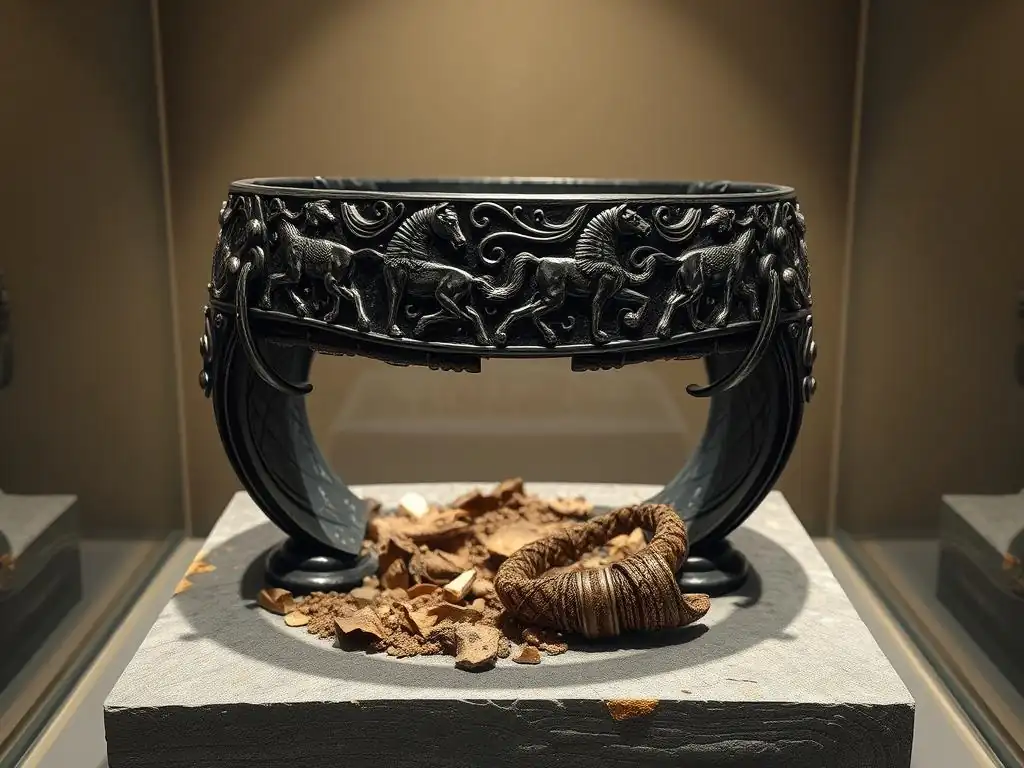
For example, the discovery of Hunnic-style cauldrons or specific types of gold jewelry (such as "polychrome" pieces) in archaeological contexts helps to trace their movements and cultural interactions across vast distances. These artifacts offer concrete data on their craftsmanship, trade networks, and even aspects of their social organization, enriching our understanding beyond the often-biased literary descriptions. Archaeology thus helps to build a more complete picture of the Huns, moving beyond the two-dimensional Roman Huns perceptions to reveal the complexity of their actual existence.
Unresolved Questions: Areas for Future Archaeological Research on Hunnic-Roman Interactions
Despite significant progress, many questions about Hunnic-Roman interactions remain unresolved, presenting fertile ground for future archaeological research. While written sources detail the military and diplomatic aspects of their relationship, archaeological evidence could shed more light on daily life, economic exchanges, and the extent of cultural diffusion between the two societies. For instance, more systematic excavation of frontier zones could reveal how Roman infrastructure adapted to Hunnic pressures, or the nature of settlements occupied or influenced by Huns.
Furthermore, identifying specific Hunnic cemeteries or settlements that show clear evidence of Roman trade goods or stylistic influences could provide tangible proof of the nuanced interactions beyond conflict and tribute. Understanding the full extent of Roman objects found in Hunnic contexts, or vice versa, could challenge or refine our Roman Huns perceptions by illustrating a more complex web of exchange and interdependence. Continued interdisciplinary research, combining textual analysis with advanced archaeological techniques, promises to further illuminate this pivotal historical period.
Conclusion: The Enduring Significance of Roman Accounts of the Huns
The Roman Legacy: Shaping Western Perceptions of the Huns
The Roman accounts of the Huns, particularly those by Ammianus Marcellinus and Priscus of Panium, have profoundly shaped Western perceptions of the Huns for centuries. Ammianus's vivid, albeit fearful, depiction of them as savage, almost inhuman invaders established a long-standing stereotype of the Huns as the quintessential "barbarian" scourge. This image, amplified by later chroniclers, often overshadowed any more nuanced understanding of their complex society or political acumen. The very name "Hun" became synonymous with destruction and uncivilized brutality in the popular imagination.
Even as more balanced historical analyses emerged, the initial Roman narrative continued to cast a long shadow, influencing everything from medieval chronicles to modern popular culture. The Roman Huns perceptions thus serve as a powerful example of how historical narratives, especially those written by the "victors" or the "civilized" against the "barbarians," can endure and profoundly influence subsequent interpretations, often obscuring the full reality of a historical people.
Ammianus Marcellinus and Priscus: Essential Texts for Understanding Roman-Hunnic History
The works of Ammianus Marcellinus and Priscus of Panium remain absolutely essential for anyone seeking to understand Roman-Hunnic history and, crucially, the evolving Roman Huns perceptions. Ammianus offers the raw, visceral reaction of a threatened empire, providing an invaluable glimpse into the initial shock and fear that gripped the Romans upon the Huns' arrival. His detailed, though biased, ethnographic observations established the earliest influential narrative.
Conversely, Priscus provides the unique perspective of a diplomat, offering a more intimate and less judgmental view from within Attila's court. His account reveals the Huns as complex political actors with a discernible social structure, challenging the monolithic image of pure savagery. Together, these two Roman voices provide a rich, albeit sometimes contradictory, tapestry of how the Romans perceived, reacted to, and ultimately grappled with the formidable presence of the Huns, making them indispensable sources for historical and archaeological inquiry into this transformative period.
Frequently Asked Questions
How did Ammianus Marcellinus describe the Huns, and why is his account significant?
Ammianus Marcellinus presented the Huns as a barbaric and savage people, emphasizing their nomadic lifestyle and lack of settled agriculture. His account is significant because it offers a primary source perspective from a Roman historian who lived during the period of Hunnic expansion into Europe.
While both acknowledged the Huns' military prowess, Priscus of Panium, writing later, showed a more nuanced view, acknowledging their political structure and diplomacy. Ammianus focused more on their perceived cultural deficiencies and brutality.
How did Roman perceptions of the Huns influence Roman foreign policy and military strategies?
Negative perceptions of the Huns as uncivilized barbarians likely fueled a sense of us vs. them, influencing strategies towards containment or conflict. Roman diplomacy often sought to exploit divisions among Hunnic tribes.
What biases might have influenced Ammianus Marcellinus's portrayal of the Huns?
Ammianus, as a Roman, likely viewed the Huns through a lens of Roman cultural superiority. His account may have been colored by propaganda designed to rally support against a perceived existential threat.
How does ArchaeologyHub.org contribute to our understanding of Roman-Hunnic interactions beyond historical texts?
ArchaeologyHub.org can provide archaeological evidence that supplements and challenges the written accounts of Ammianus and Priscus. Artifacts, settlements, and burial sites can offer a more complete picture of Hunnic culture and their interactions with the Roman world.
Final Reflection: Echoes of Fear and Fascination
The narratives of Ammianus Marcellinus and Priscus of Panium, though separated by time and perspective, reveal a consistent thread in Roman perceptions of the Huns: a complex blend of fear and fascination that continues to resonate today. The anxieties surrounding the "barbarian" at the gate, the "other" who challenges established order, are not unique to the late Roman Empire. We see echoes of these anxieties in contemporary debates about immigration, cultural identity, and the perceived threats to societal norms, making the study of these historical perceptions profoundly relevant to understanding our own biases and fears.
The enduring power of these historical accounts lies in their ability to illuminate the human tendency to demonize the unknown. The Huns, as portrayed by Ammianus and Priscus, become a canvas upon which the Romans projected their own anxieties about decline and change. This projection, this act of "othering," is a recurring theme throughout history, and understanding its mechanisms is crucial for fostering empathy and challenging prejudice. The Huns, who were quite unknown before, dwelt beyond the Maeotic marshes, where they bordered on the frozen ocean, and were a race outrageous beyond all others.
- Ammianus Marcellinus. This quote, and others like it, highlight the power of narrative in shaping perceptions and influencing actions.
As we close this exploration of Roman perceptions of the Huns, I invite you to reflect on the lessons learned. Consider how your own perceptions of "the other" are shaped by historical narratives, media representations, and personal experiences. Are you perpetuating stereotypes, or are you actively seeking to understand and empathize with those who are different from you? The past offers valuable insights into the present, and by critically examining our own biases, we can strive to build a more inclusive and understanding future, one where fear gives way to curiosity and respect.
Unveil the Secrets: Become a Hunnic History Explorer!
Thanks for diving into the fascinating world of Roman perceptions of the Huns! We hope you found a fresh perspective on this dynamic period of history. Ready to take your exploration further?
Here’s how:
- Dive deeper: Visit your local library or museum and search for primary source material from the time period that is not part of the article.:
- Share this article with a friend or colleague interested in ancient history and spark a discussion.
- Participate in online forums and archaeology hubs by sharing your thoughts and questions about Hunnic culture and their impact on the Roman Empire.
What other primary sources do you think shed light on the complex relationship between the Romans and the Huns?