
Music and Musical Instruments of the Saka: Archaeological Evidence and Reconstruction


Welcome to ArchaeologyHub.org, your portal to unlocking the secrets of the past. Delve into the intricate tapestry of ancient civilizations and explore groundbreaking archaeological discoveries. Prepare to be captivated as we unveil the fascinating world of the Saka people, focusing specifically on the intriguing archaeology of Saka musical instruments. What melodies echoed across the steppes? Discover the evidence and reconstructions that bring their music back to life, and unlock a deeper understanding of this vibrant culture. Let the exploration begin!
- Introduction: Unveiling the Sounds of the Saka Through Archaeology
- Archaeological Discoveries of Saka Musical Instruments
- Categorizing Saka Musical Instruments Based on Archaeological Finds
- Iconographic Evidence: Depictions of Music in Saka Art
- The Role of Music in Saka Society: Rituals, Warfare, and Daily Life
- Comparative Analysis: Saka Music in the Context of Steppe Cultures
- Challenges and Future Directions in Saka Music Archaeology
- Conclusion: Reconstructing the Lost Sounds of the Saka
-
Frequently Asked Questions
- How does ArchaeologyHub.org contribute to understanding Saka musical instruments?
- What types of archaeological evidence provide insights into Saka musical practices?
- What excavation techniques are particularly useful for recovering fragile musical instrument remains?
- Can the musical instruments of the Saka be reconstructed based on archaeological findings?
- How are Saka musical instrument findings organized within ArchaeologyHub.org's taxonomy?
- Final Reflection: Echoes of the Saka: A Symphony Across Time
- Unleash Your Inner Bard: Dive Deeper into Saka Music!
Introduction: Unveiling the Sounds of the Saka Through Archaeology
The Saka: A Glimpse into Steppe Culture and Musical Practices
The Saka, a diverse group of nomadic and semi-nomadic peoples flourishing across the Eurasian steppes from the 8th century BCE to the 3rd century CE, represent a significant branch of the broader Scythian cultural sphere. Their expansive territories stretched from the Black Sea to the Altai Mountains, encompassing vast swathes of Central Asia.
Renowned for their equestrian skills, distinctive "animal style" art, and elaborate kurgan (burial mound) complexes, the Saka left behind a rich material culture that offers profound insights into their lives, beliefs, and societal structures. While much is known about their material possessions, reconstructing ephemeral aspects like their music presents a unique archaeological challenge.
Despite the inherent difficulties in preserving organic materials over millennia, archaeological investigations have yielded tantalizing clues about the soundscapes of the Saka. These discoveries, ranging from fragmented instruments to vivid artistic depictions, suggest that music was not merely entertainment but a deeply embedded element of their spiritual practices, social gatherings, and possibly even military endeavors. Understanding the role of music provides a fuller picture of these formidable steppe dwellers and contributes significantly to the field of Saka musical instruments archaeology.
The Importance of Archaeological Evidence in Reconstructing Saka Music
Reconstructing the musical traditions of ancient civilizations like the Saka, who left no written musical notation, relies almost entirely on the careful interpretation of archaeological evidence. Direct evidence, such as the physical remains of musical instruments, offers the most concrete insights into their forms, materials, and potential sounds. However, due to the perishable nature of wood, animal hide, and gut strings, such finds are exceptionally rare, typically preserved only under extraordinary conditions like permafrost or extreme aridity.
Beyond the instruments themselves, archaeologists also rely on indirect evidence, including iconographic depictions in art, the context of instrument finds within burial sites, and comparative analysis with contemporary or neighboring cultures. Each fragment, every depiction, and every contextual clue contributes to a mosaic that helps scholars piece together the sonic world of the Saka. This meticulous process of "Saka musical instruments archaeology" is crucial for bridging the gap between silent artifacts and the vibrant, living culture they once represented.
Archaeological Discoveries of Saka Musical Instruments
Excavated Instruments: Evidence for Saka Musical Traditions
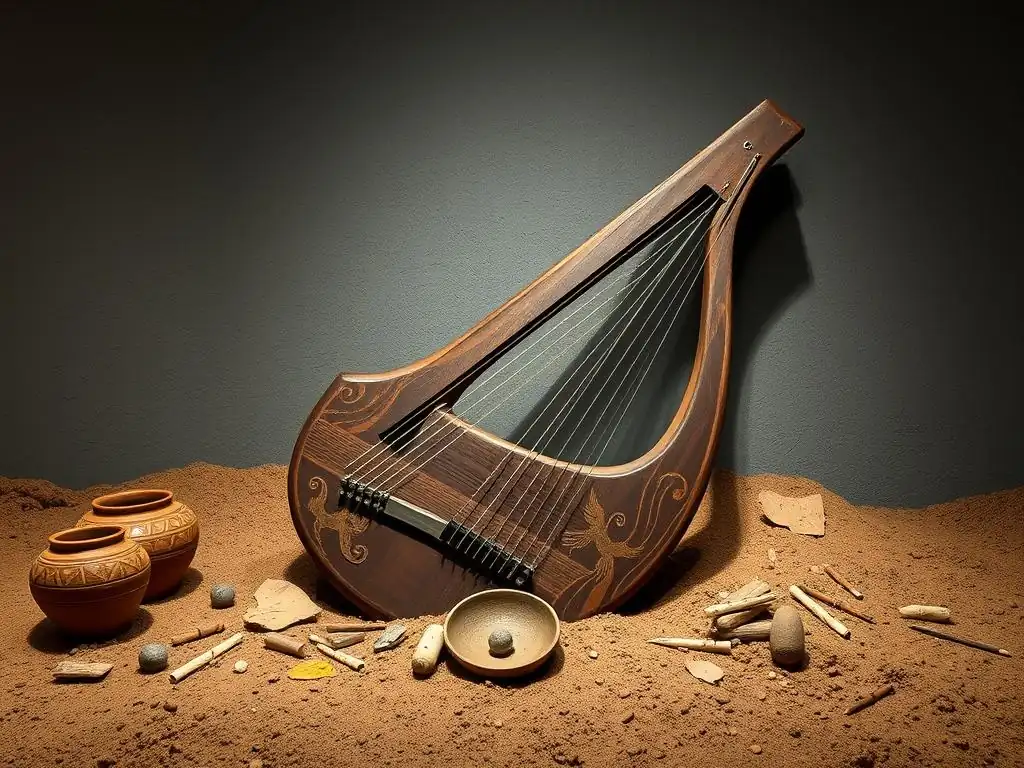
Among the most significant archaeological finds pertaining to Saka musical traditions are those unearthed from the Pazyryk kurgans in the Altai Mountains, dating to the 5th-4th centuries BCE. The permafrost conditions within these elite burial mounds provided exceptional preservation for organic materials that would otherwise have disintegrated. Notably, Kurgan 2 at Pazyryk yielded a remarkably well-preserved small harp-like instrument, crafted from larch wood. This instrument, measuring approximately 80 cm in length, features a hollowed-out resonating body and a soundboard, with evidence suggesting it once had at least five strings.
While the Pazyryk harp stands as a rare complete example, other Saka sites across Central Asia have provided more fragmentary but equally important evidence for musical instruments. These include small bone pipes, potential remnants of wooden flutes, and various percussive elements like bronze bells or rattles. These scattered finds, though often incomplete, collectively confirm the presence of diverse musical instruments within Saka material culture and are fundamental to the study of Saka musical instruments archaeology.
Distribution and Context of Saka Musical Finds in Central Asia
The archaeological evidence for Saka musical instruments is primarily concentrated within elite burial mounds, or kurgans, across their vast Central Asian territories. Key regions include the Altai Mountains (Pazyryk culture), eastern Kazakhstan (Issyk Kurgan, Besshatyr), and other sites in Kyrgyzstan and Uzbekistan. The Pazyryk finds, due to their unparalleled preservation, offer the most detailed insights into the construction and form of these instruments. The Pazyryk harp, for instance, was discovered within a burial chamber alongside other rich grave goods, indicating its status as a valuable possession, likely belonging to an elite individual.
The consistent presence of musical artifacts, even if fragmentary, within these high-status burials suggests that music played a significant role in the lives and possibly the afterlife beliefs of the Saka elite. The distribution of these finds across a wide geographical area also points to a shared, albeit regionally varied, musical heritage among different Saka groups. Each new discovery further refines our understanding of the geographical spread and cultural context of Saka musical instruments archaeology.
Examining Saka Musical Instruments: Materials, Construction, and Function
The Saka crafted their musical instruments from a range of readily available natural materials, reflecting their nomadic lifestyle and resourcefulness. Wood, particularly larch and birch, was utilized for the bodies of stringed instruments and flutes, as seen in the Pazyryk harp. Animal hides were likely stretched over frames to create drums, while bone, often from birds or small mammals, was fashioned into simple pipes or flutes. Metals like bronze were employed for smaller percussive elements such as bells or jingles.
The construction techniques were relatively straightforward but effective. The Pazyryk harp's body was hollowed out from a single piece of wood, with a separate soundboard attached. Strings, likely made from gut or twisted animal sinew, would have been fastened to tuning pegs and stretched across the soundboard. Bone pipes involved precise drilling of finger holes, while animal horns could be adapted into simple trumpets. Understanding these materials and construction methods is vital for experimental archaeology aimed at reconstructing the sounds of ancient Saka musical instruments archaeology.
Categorizing Saka Musical Instruments Based on Archaeological Finds
Stringed Instruments Among the Saka: Lyres, Harps, and Lutes
Identifying Chordophones in Saka Burial Mounds
The most compelling evidence for stringed instruments (chordophones) among the Saka comes from the Pazyryk kurgans. The famous Pazyryk harp, specifically, is a remarkable example of an ancient stringed instrument, distinguished by its boat-shaped wooden resonator. While its exact classification as a harp or a lyre is debated due to its unique features and the evolution of terminology, it clearly demonstrates the Saka's capacity for creating sophisticated melodic instruments. This particular instrument, found in Kurgan 2, dates to approximately 2,500 years ago and stands as one of the oldest known stringed instruments from Central Asia.
Beyond this singular, well-preserved find, fragments of other potential stringed instruments have been suggested from various Saka contexts, though they are often too incomplete for definitive identification. These rare occurrences emphasize the challenges faced in Saka musical instruments archaeology, as organic components like strings and bridge pieces rarely survive the ravages of time. Nevertheless, the Pazyryk discovery firmly establishes the presence of chordophones in their musical repertoire.
Stringed Instrument Fragments and Their Reconstruction
The Pazyryk harp, though largely intact, still presented challenges for full reconstruction. Archaeologists and musicologists have meticulously studied its dimensions, the placement of its tuning pegs, and the general shape to infer its original form and potential number of strings, often suggested to be five. Replicas have been crafted based on the archaeological data, allowing researchers to explore its possible acoustic properties and playing techniques. These reconstructions suggest a soft, resonant sound, likely suited for intimate settings or accompanying vocal performances.
While no other comparable complete stringed instruments have been found, the study of bone fragments and wooden pieces from other Saka sites sometimes reveals characteristics consistent with parts of stringed instruments, such as small bridge pieces or tuning pegs. The process of reconstructing these instruments involves not only meticulous archaeological analysis but also a significant degree of educated inference, drawing upon comparative ethnomusicology and historical accounts of neighboring cultures to breathe life into the silent remnants of Saka musical instruments archaeology.
Percussion Instruments in Saka Culture: Drums, Rattles, and Bells
Archaeological Evidence of Saka Percussion Instruments
Evidence for percussion instruments in Saka culture is more widespread, though often indirect. Drums, likely frame drums similar to those used by later Siberian shamans, are suggested by the presence of wooden frames and remnants of stretched animal hides, though complete drum finds are exceptionally rare due to preservation issues. However, smaller percussive elements like rattles and bells are more frequently encountered. Small bronze bells, often found in kurgan contexts, might have served various purposes, including horse trappings, clothing adornments, or direct musical instruments.
Archaeological digs have also uncovered bone or metal rattles, sometimes found as attachments on clothing or horse harnesses. For instance, small bronze jingles have been recovered from Saka sites in Kazakhstan, providing tangible proof of their existence. These finds indicate a diverse array of percussive elements, contributing to the rich soundscape explored in Saka musical instruments archaeology.
The Role of Percussion in Saka Rituals and Ceremonies
Percussion instruments likely played a central and powerful role in Saka rituals and ceremonies. Drums, with their deep, resonant beats, would have been ideal for inducing trance states during shamanistic rituals, facilitating communication with the spirit world. The rhythmic drumming could have accompanied dances, healing ceremonies, and communal gatherings, providing a unifying pulse for the community.
Rattles and bells, with their sharp, clanging sounds, could have been used for apotropaic purposes (warding off evil spirits), signaling, or as part of ceremonial attire, enhancing the visual and auditory spectacle of important events. The presence of these instruments in burial contexts suggests their significance in funerary rites, perhaps guiding the deceased or marking transitions. The percussive elements of Saka musical instruments archaeology were undoubtedly integral to their spiritual and social life.
Wind Instruments of the Saka: Flutes, Pipes, and Horns
Discovering Aerophones in Saka Archaeological Sites
Aerophones, or wind instruments, are also attested in Saka archaeological records, primarily in the form of bone flutes or pipes. These are typically crafted from the hollow bones of birds or small mammals, with simple finger holes drilled along the shaft. While less common than percussive elements, such bone pipes have been found in various steppe culture contexts across Central Asia, suggesting their widespread use among groups like the Saka. Larger wooden or reed pipes would have been even less likely to survive, making their archaeological discovery exceptionally rare.
In addition to flutes, animal horns, particularly those of sheep or bovines, could have served as natural trumpets or signaling instruments. While direct archaeological evidence for modified horns specifically used as musical instruments is scarce, the prevalence of these animals in Saka life makes their utilization a strong possibility. These finds, though modest, contribute vital information to the understanding of aerophones in Saka musical instruments archaeology.
Reconstructing the Sound of Saka Wind Instruments
Reconstructing the precise sound of Saka wind instruments involves careful analysis of the excavated bone pipes. The number, size, and spacing of the finger holes provide clues about the possible scales and melodic capabilities of these simple flutes. Experimental archaeology plays a crucial role here, with replicas being made from similar bone types to determine their acoustic range, timbre, and ease of playability. These experiments suggest that the bone pipes likely produced high-pitched, clear tones, suitable for solo performances or small ensembles.
While the sound of larger horns or wooden pipes remains more speculative, their potential use for signaling or creating loud, resonant sounds for ceremonial purposes is widely hypothesized. The study of these aerophones, through both direct archaeological examination and experimental reconstruction, allows us to imagine the unique sonic contributions of wind instruments to the broader tapestry of Saka musical instruments archaeology.
Iconographic Evidence: Depictions of Music in Saka Art
Musical Scenes in Saka Art: Rock Art, Metalwork, and Textiles
Beyond the physical remains of instruments, iconographic evidence provides invaluable insights into the role of music in Saka society. Rock art, found in locations such as Tamgaly-Tas in Kazakhstan, sometimes depicts human figures in what appear to be dance or ritualistic poses, occasionally holding objects that resemble musical instruments. While often stylized and open to interpretation, these petroglyphs offer a glimpse into communal musical activities.
Saka metalwork, particularly gold artifacts from elite burials (e.g., the Golden Man from Issyk Kurgan or pieces from the Siberian Gold collection), occasionally feature elaborate scenes, though direct depictions of musicians or instruments are rare. However, the intricate felt hangings and carpets from the Pazyryk kurgans, with their detailed scenes of daily life, rituals, and mythological narratives, may contain subtle hints of musical performance. These artistic representations, though challenging to decipher, are crucial for enriching our understanding of Saka musical instruments archaeology.
Interpreting Depictions of Saka Musicians and Their Instruments
Interpreting musical scenes in Saka art requires careful consideration of artistic conventions and the inherent ambiguity of ancient imagery. Figures might be depicted holding lute-like instruments, lyres, or drums, but their stylized nature often makes definitive identification difficult. The context of the depiction – whether it's part of a procession, a ritual dance, or a scene of daily life – helps to infer the social or ceremonial function of the music.
For instance, if a figure is shown playing an instrument during what appears to be a hunting scene, it might suggest music's role in coordinating the hunt or celebrating success. Conversely, a depiction in a funerary context could indicate music's role in mourning or guiding the deceased. While not providing the direct physical evidence of Saka musical instruments archaeology, iconography offers vital context and narrative.
The Significance of Musical Imagery in Saka Society
The presence of musical imagery, however subtle, in Saka art underscores music's significance within their society. It suggests that music was not merely a fleeting pastime but an integral part of their cultural identity, spiritual beliefs, and social cohesion. These depictions indicate that musicians held a recognized, perhaps even revered, status within the community, participating in important rituals and ceremonies.
Furthermore, musical imagery in art can reveal the types of instruments that were culturally significant, even if their physical remains have not survived. It points to the aesthetic value placed on music and its deep integration into their worldview, reflecting themes of power, ritual, and the connection between the human and spiritual realms. This artistic evidence complements the physical finds, providing a more holistic picture of Saka musical instruments archaeology.
The Role of Music in Saka Society: Rituals, Warfare, and Daily Life
Music and Ritual Practices of the Saka
Music was undoubtedly a cornerstone of Saka ritual practices. In shamanistic ceremonies, drums and rattles likely served as conduits to altered states of consciousness, enabling shamans to communicate with spirits, perform healing, and divine the future. The rhythmic, repetitive sounds would have facilitated trance, creating a powerful and immersive experience for participants. The presence of instruments like the Pazyryk harp in elite burials further suggests music's role in funerary rites, perhaps accompanying the deceased on their journey to the afterlife or serving as a symbol of their status.
Beyond shamanism, music would have been essential to other communal rituals, such as seasonal festivals, harvest celebrations, or rites of passage. The collective experience of music-making and listening would have reinforced social bonds and spiritual cohesion within the nomadic communities. The archaeological evidence, though sparse, strongly implies a profound connection between music and the sacred in Saka culture, a key aspect of Saka musical instruments archaeology.
Music's Function in Saka Warfare and Hunting
In a society renowned for its military prowess and equestrian skills, music likely played a functional role in warfare and hunting. Wind instruments, such as horns or simple trumpets, could have been used for signaling commands across vast steppe landscapes, coordinating movements during battle, or communicating during large-scale hunting expeditions. The loud, piercing sounds would have carried over long distances, providing effective communication for dispersed groups.
Furthermore, rhythmic drumming or chanting could have served to intimidate enemies, boosting the morale of Saka warriors before and during engagements. The psychological impact of collective sound cannot be underestimated in ancient warfare. While direct evidence is scarce, the practical needs of a nomadic warrior society suggest that music was not just for ceremony, but also a tool for strategic advantage, adding another layer to our understanding of Saka musical instruments archaeology.
Beyond its ritual and practical functions, music served as a vital form of social and cultural expression within Saka communities. It would have been central to entertainment during feasts and gatherings, providing a backdrop for storytelling, poetry, and dance. The nomadic lifestyle, characterized by long journeys and periods of encampment, would have fostered a deep appreciation for portable forms of entertainment like music.
Music also played a crucial role in maintaining social cohesion and transmitting cultural knowledge across generations. Songs could have preserved historical narratives, myths, and ancestral traditions, acting as an oral library for a non-literate society. The shared experience of music would have reinforced group identity, fostering a sense of belonging among the disparate Saka clans. Ultimately, music was a fundamental thread woven into the fabric of daily Saka life, reflecting their unique connection to their environment and their rich cultural heritage, as illuminated by Saka musical instruments archaeology.
Comparative Analysis: Saka Music in the Context of Steppe Cultures
Similarities and Differences Between Saka and Scythian Musical Practices
The Saka peoples are often considered eastern branches of the broader Scythian cultural continuum, sharing many cultural traits with their western counterparts. Consequently, there are notable similarities in their musical practices. Both groups likely utilized portable instruments suited for a nomadic lifestyle, such as various forms of stringed instruments (e.g., lyres or harps), percussion (drums, rattles, bells), and wind instruments (bone pipes, horns). Archaeological finds from Scythian sites in Ukraine and Russia reveal similar instrument types, suggesting a shared steppe musical heritage.
However, regional variations and unique developments also existed. The Pazyryk harp, for instance, represents a distinctive form of stringed instrument that, while broadly related to lyres found elsewhere, possesses unique construction details and stylistic elements. These differences highlight regional adaptations and preferences within the vast Scythian-Saka world, offering nuanced insights into Saka musical instruments archaeology.
Influences on Saka Music from Neighboring Cultures
The Saka's strategic location along ancient trade routes, precursors to the Silk Road, exposed them to influences from various neighboring cultures. From the west, interactions with Achaemenid Persia and even distant Greek city-states could have introduced new instrument types or musical ideas. Persian lutes or lyres, for example, might have inspired local Saka instrument makers, or specific melodic modes could have been adopted.
To the east, the Saka interacted with early Chinese states and other nomadic groups, potentially leading to an exchange of musical traditions. While direct archaeological evidence for such influences on Saka musical instruments archaeology is often indirect and challenging to prove definitively, the dynamic nature of cultural exchange along these ancient pathways suggests a vibrant cross-pollination of musical ideas. This constant interaction undoubtedly shaped the unique characteristics of Saka music.
The Unique Characteristics of Saka Musical Traditions
Despite external influences and broad similarities with other steppe cultures, Saka musical traditions likely possessed unique characteristics reflecting their specific cultural identity and environment. Their deep connection to horses and the nomadic lifestyle would have favored portable instruments and music that could accompany riding or travel. The frequent use of animal products in instrument construction (bone, hide, horn) underscores this close relationship with their natural surroundings.
The Pazyryk harp, with its distinctive design and high level of craftsmanship, stands as a testament to the Saka's independent musical innovation. Furthermore, the integration of music into their specific spiritual beliefs, as evidenced by instruments found in elite burials, suggests a profound and unique role for music within their cosmology. These elements combine to define the particular flavor of Saka musical instruments archaeology.
Challenges and Future Directions in Saka Music Archaeology
Limitations of the Archaeological Record for Musical Reconstruction
The primary challenge in Saka musical instruments archaeology lies in the limitations of the archaeological record itself. Organic materials like wood, leather, and gut strings, which were crucial components of most ancient instruments, rarely survive the passage of millennia, except in exceptional preservation conditions like the Pazyryk permafrost. This preservation bias means that our understanding is heavily skewed towards instruments made of more durable materials like bone or metal, potentially underrepresenting the full range of instruments in use.
Furthermore, even when instruments are found, they are often fragmentary, making complete reconstruction difficult. The absence of any form of musical notation from the Saka period means that the actual melodies, rhythms, harmony, and performance practices remain largely speculative. Inferring the nuances of performance from silent artifacts is a complex task, requiring interdisciplinary approaches and a degree of educated guesswork.
Use of Experimental Archaeology and Acoustic Modeling
To overcome the limitations of the archaeological record, experimental archaeology and acoustic modeling have become indispensable tools in Saka musical instruments archaeology. Experimental archaeology involves the meticulous recreation of ancient instruments based on archaeological finds, using historically accurate materials and construction techniques. For instance, replicas of the Pazyryk harp have been built, allowing researchers to explore its potential sound, range, and playability. This hands-on approach provides invaluable insights into the practical aspects of ancient music-making.
Acoustic modeling, often employing advanced computer simulations, can predict the sound properties of instruments based on their reconstructed forms and materials. By combining these scientific approaches with ethnomusicological studies of contemporary nomadic cultures, scholars can develop more informed hypotheses about the lost soundscapes of the Saka. These methodologies are crucial for breathing life into the silent artifacts.
Future Research and Discoveries in Saka Music Archaeology
The future of Saka musical instruments archaeology holds immense promise, particularly with continued and expanded archaeological excavations in regions with favorable preservation conditions. New discoveries in permafrost zones or extremely arid environments could yield unprecedented insights into previously unknown instrument types or more complete examples of known ones. Advances in scientific analytical techniques, such as micro-CT scanning of buried objects or even DNA analysis of organic residues on artifacts, could reveal subtle details about materials and construction that are otherwise undetectable.
Moreover, interdisciplinary collaboration between archaeologists, ethnomusicologists, conservators, and even skilled artisans will be crucial. Re-evaluating existing museum collections with a specific focus on musical artifacts, some of which might have been previously overlooked or misidentified, also offers potential for new discoveries. These ongoing efforts are vital for continually refining our understanding of the rich musical heritage of the Saka.
Conclusion: Reconstructing the Lost Sounds of the Saka
The Enduring Legacy of Saka Music and its Cultural Significance
The journey into Saka musical instruments archaeology reveals a fascinating, albeit often silent, dimension of these ancient steppe peoples. Despite the formidable challenges posed by the perishable nature of musical instruments, archaeological discoveries, particularly the remarkable Pazyryk harp, along with iconographic evidence and comparative studies, collectively paint a picture of a culture deeply intertwined with music. From the percussive rhythms of ritual drums to the melodic tones of stringed instruments and flutes, music was an integral part of Saka daily life, spiritual practices, social cohesion, and even strategic communication.
The enduring legacy of Saka music lies not just in the rare artifacts themselves, but in what they tell us about human creativity, cultural expression, and the universal role of sound in shaping identity. These finds allow us to transcend the material and glimpse the intangible heritage of a powerful nomadic civilization, enriching our understanding of ancient Central Asian cultures and their profound artistic achievements.
The Importance of Cultural Heritage Preservation
The study of Saka musical instruments archaeology underscores the critical importance of cultural heritage preservation. Each excavated fragment, every piece of rock art, and every carefully preserved artifact represents an irreplaceable link to our shared human past. The fragility of these ancient musical instruments, often made from highly perishable organic materials, highlights the urgency of careful excavation, meticulous conservation, and sustained research efforts.
By safeguarding these precious remnants, we ensure that future generations can continue to learn from and connect with the ancient sounds and traditions of the Saka. Preservation not only protects the physical objects but also allows for ongoing scholarship, experimental archaeology, and public engagement, ensuring that the legacy of Saka music continues to resonate through time, long after their melodies have faded from the wind.
Frequently Asked Questions
How does ArchaeologyHub.org contribute to understanding Saka musical instruments?
ArchaeologyHub.org acts as a digital encyclopedia providing a platform to compile and organize archaeological discoveries related to Saka musical instruments. It facilitates access to detailed timelines, artifact profiles, and interpretive analyses of Saka culture.
What types of archaeological evidence provide insights into Saka musical practices?
Evidence includes the physical remains of instruments found in Saka burial mounds (kurgans), iconographic representations of musicians and instruments on artifacts, and written accounts from contemporary cultures that interacted with the Saka.
What excavation techniques are particularly useful for recovering fragile musical instrument remains?
Careful stratigraphic excavation is crucial, along with micro-excavation for delicate fragments. The use of specialized consolidants and protective packing materials helps preserve and transport fragile items for analysis.
Can the musical instruments of the Saka be reconstructed based on archaeological findings?
Yes, to some extent. Archaeologists use fragmentary remains, comparative analysis with similar instruments from other cultures, and experimental archaeology to create plausible reconstructions of Saka musical instruments and their sounds.
How are Saka musical instrument findings organized within ArchaeologyHub.org's taxonomy?
They are organized by geographic region (e.g., Central Asia, Southern Siberia), time period (e.g., Iron Age, Scythian period), and artifact type, allowing users to easily navigate and find relevant information about Saka musical instruments.
Final Reflection: Echoes of the Saka: A Symphony Across Time
The journey through archaeological evidence to reconstruct the lost melodies of the Saka reveals more than just ancient instruments; it unveils a vibrant cultural tapestry woven with sound. The echoes of their music, once resonating across the steppes, still whisper to us today, offering invaluable insights into their beliefs, rituals, and daily lives. This exploration underscores the power of archaeology to not only unearth artifacts but also to resurrect the intangible aspects of vanished civilizations.
This investigation into Saka musical instruments has profoundly shaped my understanding of how deeply intertwined music is with the human experience. It's humbling to realize that even across millennia, the desire to create and connect through sound remains a constant. Music is the universal language of mankind.
- Henry Wadsworth Longfellow. This quote resonates deeply when considering the Saka, whose music, though fragmented in the archaeological record, speaks volumes about their shared humanity and cultural identity.
As we conclude this exploration, I invite you to listen. Listen not just to the music of today, but to the imagined melodies of the past. Consider how the instruments and sounds of your own culture reflect your values and beliefs. Let the echoes of the Saka inspire you to appreciate the power of music to connect us across time and space, and to preserve the cultural heritage that enriches our world.
Unleash Your Inner Bard: Dive Deeper into Saka Music!
Thank you for exploring the fascinating world of Saka music with us! We hope you've enjoyed uncovering the echoes of melodies from millennia past. Now, it's time to bring that knowledge to life.
Here are a few ways to continue your journey:
- Experiment with Recreating Saka Instruments: Research materials and techniques used in Saka instrument construction and try to build a replica. Share your progress and discoveries with fellow music enthusiasts online!
- Explore related musical traditions: Delve into the music of other ancient Central Asian cultures, searching for connections and influences.
- Share this article: Help spread awareness of the rich musical heritage of the Saka by sharing this article with your friends, family, or colleagues.
What kind of music do you think the Saka played on their reconstructed instruments? Share your speculative compositions or interpretations in the comments below!