
Ahmose I's Military Campaigns: Securing Borders and Forging an Empire

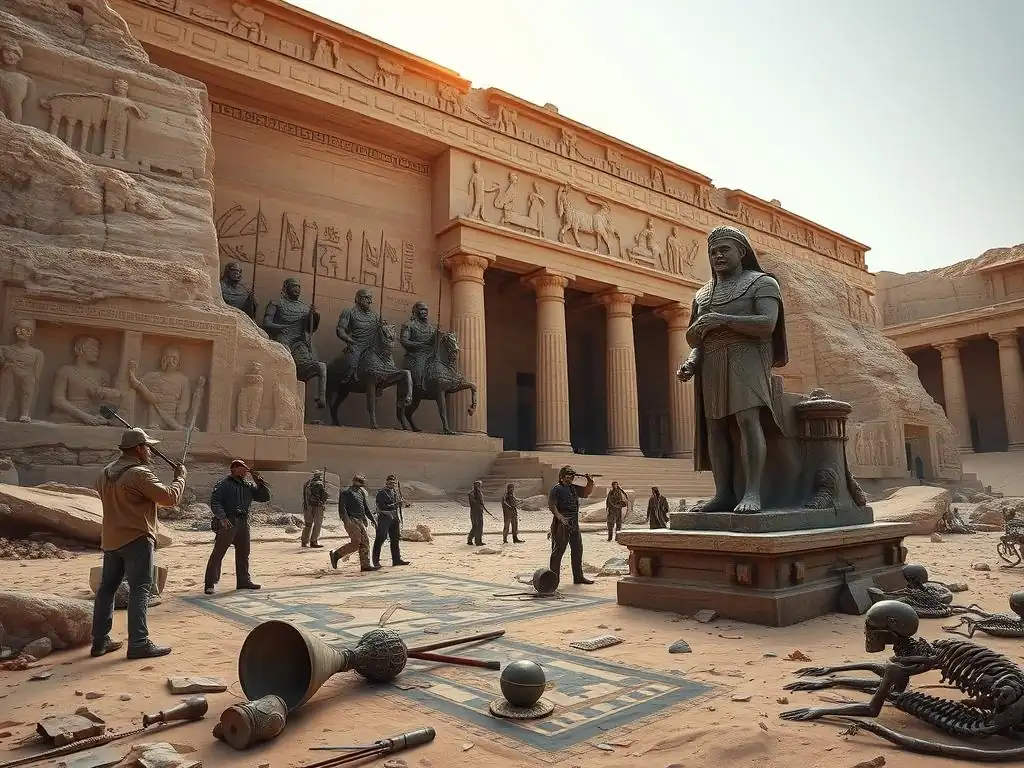
Welcome to ArchaeologyHub.org, your gateway to the past! What if the key to understanding a civilization lies not just in its monuments, but in the battles that forged it? Dive into the world of Ahmose I and uncover the strategies, challenges, and lasting impact of his Egyptian military campaigns. Explore how these conflicts secured borders and laid the foundation for an empire, and discover the artifacts that speak to a pivotal moment in history. Continue reading to unravel the story...
- Introduction: Ahmose I and the Dawn of the New Kingdom
- The Primary Objective: Expelling the Hyksos from Egypt
- Ahmose I's Military Campaigns in Nubia: Expanding Egyptian Influence
- Campaigns in the Levant: Asserting Egyptian Power in Western Asia
- Ahmose I's Military Innovations and Tactics
- Legacy of Ahmose I's Military Achievements
- Ahmose I's Military Campaigns: A Summary of His Contributions
-
Frequently Asked Questions
- ### What were the primary objectives of Ahmose I's military campaigns?
- ### What were some of the key battles or military actions undertaken by Ahmose I?
- ### How did Ahmose I's military successes contribute to the establishment of the New Kingdom?
- ### What archaeological evidence supports the historical accounts of Ahmose I's military campaigns?
- ### What impact did Ahmose I's military leadership have on the future of the Egyptian military?
- Final Reflection: Echoes of Ahmose's Legacy
- Unearth Your Inner Strategist: Continue the Expedition!
Introduction: Ahmose I and the Dawn of the New Kingdom
The Significance of Ahmose I in Egyptian History
Ahmose I stands as a pivotal figure in ancient Egyptian history, widely recognized as the founder of the illustrious Eighteenth Dynasty and the progenitor of the New Kingdom, one of Egypt's most prosperous and influential eras. His reign, spanning approximately 1550-1525 BCE, marked the definitive end of the tumultuous Second Intermediate Period, a time when Egypt was fragmented and partially occupied by foreign powers.
Through a series of decisive Ahmose I Egyptian military campaigns, he not only expelled the Hyksos invaders but also re-established a strong, unified central government, laying the foundational stone for an expansive empire that would dominate the Near East for centuries.
His strategic brilliance and leadership transformed Egypt from a divided land into a formidable regional power. The military campaigns of Ahmose I were not merely about reclaiming territory; they were about restoring Egyptian sovereignty, revitalizing its economy, and ushering in an unprecedented age of wealth, artistic achievement, and international prestige. Without his initial military successes and the subsequent consolidation of power, the subsequent glories of pharaohs like Thutmose III, Akhenaten, and Ramesses II might never have materialized.
Setting the Stage: The Second Intermediate Period and Hyksos Rule
The Second Intermediate Period (circa 1650-1550 BCE) was a challenging epoch for ancient Egypt, characterized by political fragmentation and foreign domination. Following the collapse of the Middle Kingdom, central authority weakened, leading to the emergence of multiple competing power centers. In the north, specifically the Nile Delta, a group of Semitic peoples known as the Hyksos (meaning "rulers of foreign lands") established their capital at Avaris (modern Tell el-Dab'a) and ruled much of Lower Egypt. They introduced new technologies, including the composite bow and the horse-drawn chariot, which would later be adopted and perfected by the Egyptians.
Meanwhile, in Upper Egypt, a native Egyptian dynasty based in Thebes maintained a precarious independence, often in conflict with the Hyksos. This period was marked by constant skirmishes, fluctuating borders, and a general decline in national prosperity and morale. It was from this fractured landscape that Ahmose I, son of Seqenenre Tao II and brother of Kamose, inherited the mantle of leadership, tasked with the monumental challenge of reuniting Egypt and expelling the foreign occupiers, a task that would define the early Ahmose I Egyptian military campaigns.
The Primary Objective: Expelling the Hyksos from Egypt
Initial Campaigns Against the Hyksos: A Struggle for Liberation
The liberation of Egypt from Hyksos rule was a protracted effort that began even before Ahmose I ascended the throne, with his father Seqenenre Tao II and brother Kamose initiating the conflict. Ahmose I, inheriting this struggle, launched a series of determined offensives from his base in Thebes. These initial Ahmose I Egyptian military campaigns focused on pushing the Hyksos northward, gradually reclaiming territory that had been under foreign control for over a century. Early skirmishes likely involved direct engagements in the region between Thebes and the Hyksos capital of Avaris, a distance of approximately 600 kilometers.
These early military actions demonstrated Ahmose I's strategic intent: to systematically dismantle Hyksos power. Records, such as the autobiography of Ahmose, son of Ebana (a naval officer who served under the pharaoh), provide glimpses into these early battles, mentioning the use of Egyptian forces, including a nascent navy on the Nile, to clear the riverine routes and secure supply lines as the army advanced. The relentless pressure applied by Ahmose I's forces began to wear down the Hyksos' northern strongholds, setting the stage for the decisive confrontation.
The Siege of Avaris: A Pivotal Moment in Ahmose I's Military Strategy
The culmination of Ahmose I's efforts to liberate Egypt was the momentous siege of Avaris, the heavily fortified Hyksos capital in the eastern Nile Delta. This was arguably the most critical of the Ahmose I Egyptian military campaigns. Located at modern Tell el-Dab'a, Avaris was a formidable stronghold, boasting extensive fortifications designed to withstand prolonged attacks. The siege was not a swift victory but a sustained military operation, requiring significant resources and strategic planning.
Historical accounts suggest that the siege of Avaris lasted for a period of several years, indicating the resilience of the Hyksos defense and the determination of Ahmose I. The autobiography of Ahmose, son of Ebana, details his participation in multiple engagements around the city, highlighting the intensity of the fighting. The fall of Avaris, around the 11th year of Ahmose I's reign, marked a decisive turning point, effectively breaking the back of Hyksos power within Egypt and restoring Egyptian sovereignty over the Delta region.
The Fall of Sharuhen: Consolidating Ahmose I's Victory Over the Hyksos
Following the capture of Avaris, Ahmose I pursued the retreating Hyksos forces into southern Canaan, laying siege to their last major stronghold, the city of Sharuhen. Located in modern-day southern Israel (possibly near Tell el-Farah South), Sharuhen was a strategic fortress that served as a final bastion for the Hyksos remnants. The pursuit and subsequent siege of Sharuhen underscored Ahmose I's commitment to eradicating any lingering threat from the Hyksos, ensuring they could not regroup and challenge Egyptian authority again.
The siege of Sharuhen was a prolonged affair, reportedly lasting for three to six years, a testament to the city's strong defenses and the desperate resistance of its defenders. This extended duration highlights the scale and difficulty of these Ahmose I Egyptian military campaigns. The eventual fall of Sharuhen conclusively ended the Hyksos presence as a significant political or military force in the region, firmly establishing Ahmose I as the undisputed ruler of a unified Egypt and paving the way for the territorial expansion characteristic of the New Kingdom.
Ahmose I's Military Campaigns in Nubia: Expanding Egyptian Influence
The Importance of Nubia to Ancient Egypt's Resources and Security
Nubia, located to Egypt's south, held immense strategic and economic importance for the ancient Egyptians. This region, often referred to as Kush, was a primary source of vital resources, most notably gold. The gold mines of Nubia, particularly in areas like Wadi Hammamat and the eastern desert, provided the vast wealth that fueled Egypt's economy, supported its monumental building projects, and enabled its diplomatic and military endeavors. Beyond gold, Nubia supplied other valuable commodities such as diorite, amethyst, copper, ivory, ebony, and exotic animal products.
Furthermore, Nubia served as a critical buffer zone, protecting Egypt's southern flank from potential invasions or incursions by southern tribes. Control over Nubia also secured important trade routes that extended deeper into Africa, facilitating the exchange of goods and ideas. The disruption of Egyptian control over Nubia during the Second Intermediate Period had severely impacted Egypt's economic stability and security, making its reassertion a top priority for Ahmose I's military campaigns.
Military Expeditions into Nubia Under Ahmose I: Securing the Southern Border
With the Hyksos threat neutralized, Ahmose I turned his attention southward to re-establish Egyptian hegemony over Nubia. Several Ahmose I Egyptian military campaigns were directed towards this region, aiming to reclaim lost territories and secure the lucrative gold mines. Records, including the biographical text of Ahmose, son of Ebana, detail his participation in these southern expeditions, mentioning the pursuit of a Nubian chief named Aata and the suppression of revolts.
One notable campaign involved quelling an uprising led by a certain Teti-an, which required Ahmose I to personally lead his forces into Nubia. These campaigns were crucial for reasserting Egyptian authority, which had waned significantly during the Second Intermediate Period. By pushing south, Ahmose I not only secured the valuable resources but also created a stable southern frontier, essential for the overall security and prosperity of the newly unified Egyptian state.
Establishing Egyptian Control: Fortifications and Administration in Nubia
To cement Egyptian control over Nubia, Ahmose I initiated a comprehensive strategy that went beyond mere military conquest. This involved the re-establishment and construction of a network of formidable fortresses along the Nile, designed to project Egyptian power and safeguard its interests. Key fortresses like Buhen, Semna, and Uronarti, which had fallen into disrepair or been abandoned during the Second Intermediate Period, were either restored or reinforced. These strongholds served as military garrisons, administrative centers, and trading posts.
In addition to fortifications, Ahmose I re-established a robust administrative structure in Nubia. He appointed a high-ranking official known as the "King's Son of Kush" (though the title might have been slightly different initially, it evolved into this during the New Kingdom), who acted as the viceroy responsible for governing the conquered territories on behalf of the pharaoh. This administrative oversight ensured the steady flow of resources, particularly gold, back to Egypt and maintained peace and order in the subjugated region, solidifying the gains from Ahmose I's military campaigns.
Campaigns in the Levant: Asserting Egyptian Power in Western Asia
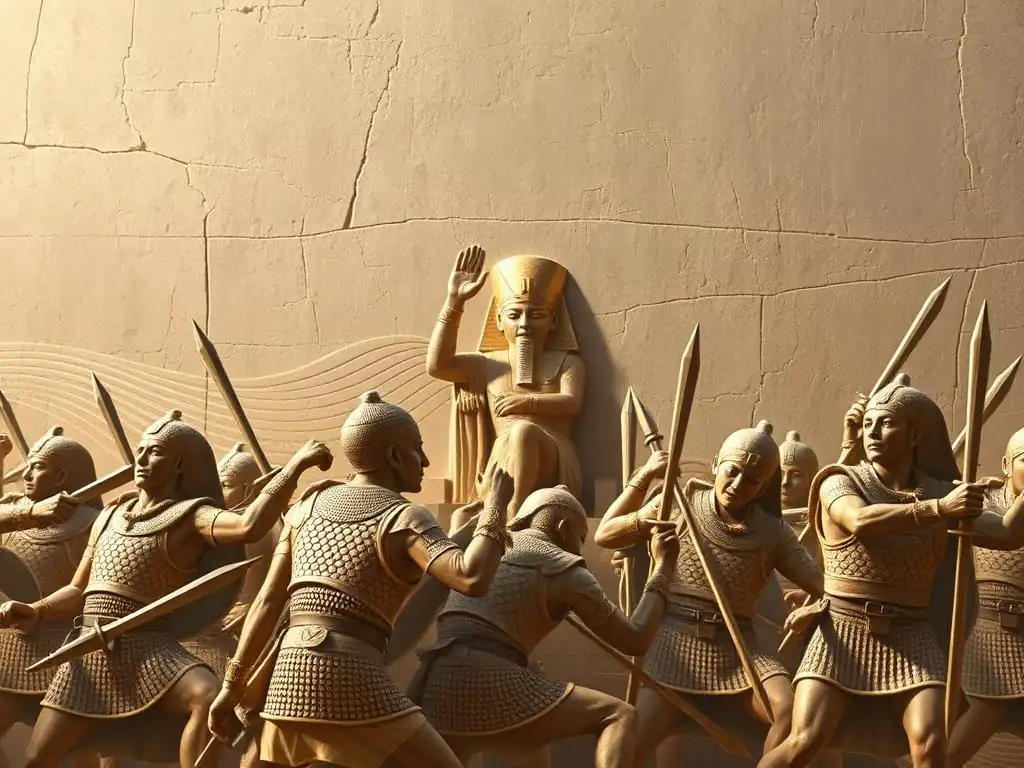
Evidence of Ahmose I's Military Activity in the Levant: Tell el-Dab'a Excavations
Following the expulsion of the Hyksos from Egypt and their final defeat at Sharuhen, Ahmose I extended his military reach into the Levant. While the primary objective was the complete eradication of the Hyksos threat, these incursions also served to assert Egyptian dominance in the region. Archaeological evidence, particularly from excavations at Tell el-Dab'a (ancient Avaris), sheds light on the connections between Egypt and the Levant during this period. Artifacts found at the site, including Mycenaean pottery and Cypriot wares, illustrate the extensive trade networks that characterized the region and which Egypt sought to control.
Furthermore, textual evidence, such as the autobiography of Ahmose, son of Ebana, explicitly mentions his participation in campaigns in Djahy (a region in southern Canaan/Syria). These accounts indicate that Ahmose I's military campaigns pursued the Hyksos beyond Egypt's traditional borders, engaging their remnants and perhaps local Canaanite rulers who had been allied with them. While the extent of permanent territorial control was limited, these actions clearly signaled Egypt's re-emergence as a major power in the Near East.
Strategic Importance of the Levant for Egypt's Trade and Security
The Levant, encompassing modern-day Israel, Palestine, Lebanon, and parts of Syria, was of immense strategic importance to ancient Egypt. Geographically, it served as a crucial land bridge connecting Egypt with the great civilizations of Mesopotamia and Anatolia. Control or influence over this region was vital for securing lucrative trade routes that brought valuable commodities like timber (especially cedar from Byblos), copper, silver, and other exotic goods into Egypt.
Beyond trade, the Levant acted as a crucial buffer zone against potential northern invaders. Maintaining a sphere of influence in this region was a preventive measure, allowing Egypt to project its power outwards and preemptively neutralize threats before they could reach its borders. The Ahmose I Egyptian military campaigns into the Levant, therefore, were not merely punitive but were foundational steps in establishing the broader foreign policy of the New Kingdom, which emphasized proactive defense and the projection of power far beyond the Nile Valley.
The Extent of Egyptian Control in the Levant During Ahmose I's Reign: Limited Raids and Influence
While Ahmose I's military campaigns in the Levant were significant for asserting Egyptian power, it is important to note that the extent of direct Egyptian control during his reign was relatively limited compared to the later empire-building efforts of pharaohs like Thutmose III. Ahmose I's incursions were primarily punitive raids and strategic engagements aimed at eliminating the Hyksos threat and demonstrating Egypt's renewed strength. He did not establish permanent garrisons or extensive administrative structures in the same way he did in Nubia.
Instead, the goal appears to have been to establish a sphere of influence and discourage future incursions from the north. The specific details of these engagements are sparse, but they likely involved skirmishes with local Canaanite city-states and the final routing of Hyksos remnants. These early Ahmose I Egyptian military campaigns laid the groundwork for the more systematic conquest and annexation of the Levant that would characterize the height of the New Kingdom, demonstrating Egypt's renewed capability to project power beyond its traditional borders.
Ahmose I's Military Innovations and Tactics
Reforming the Egyptian Army: Introduction of Chariots and Composite Bows
A key factor in the success of Ahmose I's military campaigns was his willingness to adapt and innovate, particularly by incorporating superior military technologies from his adversaries, the Hyksos. The most significant of these adoptions were the horse-drawn chariot and the composite bow. The chariot, a fast, maneuverable platform for archers and spearmen, revolutionized battlefield tactics, providing unparalleled mobility and shock value. Egyptian chariots, typically manned by a driver and an archer, allowed for swift flanking maneuvers and devastating charges, proving crucial in open-field engagements against the Hyksos.
The composite bow, also of Hyksos origin, represented a significant upgrade from the simpler self-bows previously used by the Egyptians. Constructed from layers of wood, horn, and sinew, it possessed greater power, range, and accuracy, capable of penetrating enemy armor more effectively. Ahmose I's military reforms included not only the adoption of these weapons but also the training of Egyptian soldiers in their use, transforming the Egyptian army into a more formidable and technologically advanced fighting force, capable of executing the ambitious Ahmose I Egyptian military campaigns.
While land battles often dominate the narrative of ancient warfare, naval power played a crucial, albeit often understated, role in Ahmose I's military campaigns. The Nile River was Egypt's primary artery, and control over it was essential for troop movements, logistics, and supply lines. Ahmose I utilized a fleet of ships, not only for transporting soldiers and equipment during his northward advance against the Hyksos but also for direct engagement. The autobiography of Ahmose, son of Ebana, explicitly mentions his service as a naval officer, indicating the existence and active deployment of an Egyptian navy.
During the siege of Avaris, the Egyptian navy likely played a role in blockading the city from the riverine side, cutting off supplies and reinforcements. Naval forces could also be used for amphibious landings or to provide fire support from the water. The ability to control riverine access points and project power across water bodies was a strategic advantage that contributed significantly to the success of Ahmose I's military endeavors, showcasing a comprehensive approach to warfare that extended beyond just land forces.
Siege Warfare Techniques Employed by Ahmose I: Scaling Ladders and Mining
The prolonged sieges of major Hyksos strongholds like Avaris and Sharuhen necessitated sophisticated siege warfare techniques, indicating a level of military engineering and strategy beyond simple frontal assaults. Ahmose I's forces employed systematic methods to overcome heavily fortified cities. While detailed accounts are scarce, common siege tactics of the era likely included the construction of siege ramps to allow troops to assault walls, and the use of scaling ladders to breach defenses.
Perhaps more advanced was the potential use of mining or sapping, where tunnels were dug beneath city walls to undermine their foundations, causing sections to collapse. This tactic would have been particularly effective against mud-brick fortifications common in the region. The sheer duration of the sieges, lasting several years in some cases, suggests that Ahmose I's army was well-versed in sustained siege operations, employing a combination of direct assault, blockade, and engineering to systematically wear down and eventually breach enemy defenses, critical for the success of these challenging Ahmose I Egyptian military campaigns.
Legacy of Ahmose I's Military Achievements
The Foundation of the Egyptian Empire: Ahmose I's Contribution
The most profound legacy of Ahmose I's military achievements is his pivotal role in laying the foundation for the Egyptian Empire, which would reach its zenith in the subsequent centuries of the New Kingdom. By expelling the Hyksos and reunifying Egypt under a strong central authority, he transformed a fragmented, inward-looking state into a powerful, outward-looking entity. His successful Ahmose I Egyptian military campaigns established a precedent for aggressive foreign policy, shifting Egypt's posture from defensive to offensive.
He created the stability and security necessary for future pharaohs to embark on ambitious imperial expansion into the Levant and further into Nubia. The wealth generated from the re-secured gold mines of Nubia, coupled with the renewed control over trade routes, provided the economic backbone for Egypt's imperial ambitions, funding monumental construction projects and maintaining a large, professional army. Ahmose I's military success was not just about winning battles; it was about establishing the very framework for Egypt's imperial age.
Ahmose I's Impact on Egyptian Art and Propaganda: Depictions of Victory
The glorious military campaigns of Ahmose I had a significant impact on Egyptian art and propaganda, which served to legitimize his rule and celebrate his victories. The New Kingdom era saw a resurgence in monumental art, often depicting the pharaoh as a triumphant warrior, a theme that undoubtedly drew inspiration from Ahmose I's successes. While direct depictions of Ahmose I's specific battles are somewhat rare compared to later pharaohs, the general motif of the victorious king smiting his enemies became a prominent feature in temples and tombs.
The autobiographical tomb inscription of Ahmose, son of Ebana, is a prime example of how military achievements were immortalized. This text, carved in his tomb at Elkab, details his participation in the Ahmose I Egyptian military campaigns, including the sieges of Avaris and Sharuhen, and his service in Nubia. Such narratives served as powerful propaganda, reinforcing the pharaoh's image as a divine ruler chosen to restore order and prosperity, and inspiring loyalty among the populace and the military elite.
Ahmose I as a Pharaoh: His Image and Representation of Power
Ahmose I's military triumphs fundamentally shaped his image and representation of power as a pharaoh. He was hailed as the "liberator of Egypt" and the "unifier of the Two Lands," epithets that underscored his pivotal role in ending foreign domination and restoring national pride. His reign marked a conscious break from the weakness of the Second Intermediate Period, establishing a new paradigm of strong, centralized rule.
The iconography associated with Ahmose I and his successors emphasized his martial prowess and divine mandate. He was depicted as a powerful king who had restored Ma'at (cosmic order) to Egypt after a period of chaos. His success in the Ahmose I Egyptian military campaigns set a high standard for subsequent pharaohs, who sought to emulate his achievements and expand the empire further. Ahmose I's reign thus laid the ideological and practical groundwork for the New Kingdom's imperial ambitions, cementing his place as one of Egypt's most transformative rulers.
Ahmose I's Military Campaigns: A Summary of His Contributions
Ahmose I's Role in Unifying Egypt and Establishing the New Kingdom
Ahmose I's military campaigns were the driving force behind the reunification of Egypt and the definitive establishment of the New Kingdom. Through a relentless and strategic series of offensives, he successfully expelled the Hyksos from the Nile Delta and pursued them into the Levant, dismantling their power base entirely. This monumental achievement ended over a century of fragmentation and foreign rule, restoring a unified Egyptian state with its capital firmly re-established at Thebes.
His success created the political stability necessary for a renaissance in Egyptian culture, economy, and administration. The reintegration of Lower Egypt and the reassertion of control over Nubia brought immense wealth and resources back into the royal treasury, enabling the pharaohs of the Eighteenth Dynasty to embark on unprecedented building projects and maintain a powerful professional army. The Ahmose I Egyptian military campaigns were not just about conquest; they were about national restoration and the foundation of a new era of Egyptian greatness.
The Lasting Impact of Ahmose I's Military Actions on Egypt's Future
The lasting impact of Ahmose I's military actions on Egypt's future cannot be overstated. By securing Egypt's borders in the north (Levant) and south (Nubia), he created a secure and prosperous realm that would flourish for over 400 years. His adoption of new military technologies, such as the chariot and composite bow, and his development of sophisticated siege tactics, fundamentally transformed the Egyptian army into a formidable imperial force. This modernized military allowed his successors to expand Egypt's influence into a vast empire, stretching from the Fourth Cataract of the Nile in Nubia to the Euphrates River in Syria.
Economically, the re-establishment of control over Nubian gold mines and strategic trade routes provided the immense wealth that underpinned the New Kingdom's prosperity, funding its lavish temples, tombs, and diplomatic endeavors. Socially, his victories fostered a renewed sense of national identity and pride, cementing the pharaoh's role as a divine warrior-king. The blueprint for empire-building and the projection of power, so characteristic of the New Kingdom, was meticulously drawn by Ahmose I through his decisive and transformative Ahmose I Egyptian military campaigns.
Frequently Asked Questions
### What were the primary objectives of Ahmose I's military campaigns?
Ahmose I's campaigns were primarily aimed at expelling the Hyksos from Egypt, reunifying the country, and securing its borders against future invasions.
### What were some of the key battles or military actions undertaken by Ahmose I?
Key actions included the Siege of Avaris, the capture of Sharuhen in Canaan, and campaigns in Nubia to expand Egyptian control.
### How did Ahmose I's military successes contribute to the establishment of the New Kingdom?
His victories ended the Second Intermediate Period, established a strong centralized government, and laid the foundation for the expansion and prosperity of the New Kingdom.
### What archaeological evidence supports the historical accounts of Ahmose I's military campaigns?
Inscriptions on stelae and tomb walls, along with weaponry and fortifications discovered at sites like Avaris, provide evidence of the campaigns detailed in historical texts.
### What impact did Ahmose I's military leadership have on the future of the Egyptian military?
Ahmose I reformed the Egyptian army, improved its organization and tactics, and set a precedent for future pharaohs to use military power to expand and defend Egypt.
Final Reflection: Echoes of Ahmose's Legacy
The narrative of Ahmose I's military campaigns, as we've explored, isn't merely a historical account; it's a powerful reminder of the enduring impact of decisive leadership and strategic vision. The expulsion of the Hyksos and the subsequent consolidation of Egyptian power under Ahmose laid the foundation for the New Kingdom, a period of unprecedented prosperity and cultural flourishing. Understanding these campaigns provides invaluable insight into the complexities of nation-building and the enduring relevance of strong borders in a volatile world.
The echoes of Ahmose's victories resonate even today, influencing our understanding of ancient warfare and the formation of empires. His dedication to securing Egypt's future, even in the face of seemingly insurmountable odds, serves as a timeless inspiration. The bravest are surely those who have the clearest vision of what is before them, glory and danger alike, and yet notwithstanding, go out to meet it.
- Thucydides. This quote, though not directly about Ahmose, perfectly encapsulates the spirit of courage and calculated risk that defined his military leadership and continues to shape our perception of effective governance.
As we conclude this exploration of Ahmose I's military campaigns, consider the lessons gleaned from his strategic brilliance and unwavering resolve. How can we apply his principles of decisive action and long-term vision to the challenges we face today? Let us draw inspiration from Ahmose's legacy, striving to build a future as secure and prosperous as the empire he forged, remembering that even the most daunting obstacles can be overcome with courage, strategy, and an unwavering commitment to a greater purpose.
Unearth Your Inner Strategist: Continue the Expedition!
Thank you for exploring the world of Ahmose I and his incredible military campaigns. Now that you’ve journeyed through his strategies and victories, it’s time to translate that knowledge into action!
- Dive deeper by researching one specific battle or military innovation from Ahmose I’s reign. Expand your understanding beyond this article and share your findings with a friend!
- Explore a map of Ancient Egypt and trace Ahmose I’s military routes. Imagine the challenges he faced and the lands he conquered.
- Share this article with history enthusiasts in your network and start a discussion: What modern military lessons can we learn from Ahmose I's campaigns?