
The Enigmatic Eyes of Nok Terracottas: A Stylistic Signature


Welcome to ArchaeologyHub.org, your gateway to the past!
Delve into the fascinating world of archaeological discoveries, where ancient civilizations whisper their secrets. Ever wondered about the meaning behind the captivating gaze of ancient art? Prepare to be intrigued as we explore the subtle yet powerful symbolism behind the Nok terracotta eye symbolism. Join us as we unravel the mysteries encoded within these iconic sculptures, sparking a deeper understanding of this remarkable culture. Explore the full article below to discover what lies beyond the surface, and embark on your journey through time!
- Introduction: Unveiling the Nok Culture and its Artistic Legacy
- The Distinctive Eye Styles in Nok Terracottas: An Overview
- Nok Terracotta Eye Symbolism: Exploring Interpretations
- The Evolution of Nok Eye Design Over Time
- Comparative Analysis: Nok Terracotta Eyes Versus Other Ancient Sculptural Eyes
- Techniques Used in Creating Nok Terracotta Eyes
- Case Studies: Examining Specific Nok Terracotta Heads with Notable Eyes
- Nok Terracotta Eye Symbolism: Concluding Thoughts and Future Research
-
Frequently Asked Questions
- What is the significance of the Nok terracotta culture in the context of West African archaeology?
- Why are the eyes of Nok terracotta figures considered a " stylistic signature"?
- What materials and techniques were likely used to create the Nok terracotta sculptures, particularly focusing on the eyes?
- What are some of the proposed interpretations of the eye symbolism in Nok terracotta figures?
- Where can I find more information about the Nok culture and its artifacts, including the significance of the eyes?
- Final Reflection: Gazing into the Past, Shaping the Future
- Unveil Your Inner Archaeologist!
Introduction: Unveiling the Nok Culture and its Artistic Legacy
The Ancient History of the Nok Culture in Nigeria
The Nok culture, flourishing in what is now central Nigeria, represents one of West Africa's earliest and most sophisticated iron-producing societies. Its existence spanned an impressive period, from approximately 1500 BCE to 500 CE, predating many other complex societies in the region by centuries. Archaeological evidence, primarily in the form of distinctive terracotta sculptures and iron implements, suggests a highly organized society with advanced technological capabilities for its time. The geographical spread of Nok artifacts covers an area of roughly 78,000 square kilometers, indicating a significant cultural sphere of influence across the Jos Plateau and beyond.
During its zenith, the Nok people developed innovative techniques for iron smelting, mastering the process of extracting iron from ore and forging it into tools and weapons. This mastery of metallurgy likely played a crucial role in their agricultural practices and possibly their social structure. Despite extensive research since the initial discoveries in 1928, many aspects of Nok daily life, political organization, and religious beliefs remain subjects of ongoing archaeological investigation. The precise reasons for the culture's eventual decline around 500 CE are also not fully understood, though environmental changes and shifting trade routes are among the hypotheses considered.
The Discovery and Significance of Nok Terracotta Sculptures
The first accidental discovery of Nok terracotta sculptures occurred in 1928 near the village of Nok, during tin mining operations. However, it was not until the systematic excavations led by Bernard Fagg in the 1940s and 1950s that the true archaeological significance of these artifacts became apparent. Thousands of fragments, along with hundreds of identifiable heads and figures, have since been unearthed, primarily from alluvial deposits. These sculptures are the earliest known examples of terracotta art in Sub-Saharan Africa, offering invaluable insights into the artistic and spiritual lives of the Nok people.
The significance of these terracotta pieces extends beyond their artistic merit; they serve as a primary source of information about a culture that left no written records. The sculptures depict human and animal figures, often adorned with elaborate hairstyles, jewelry, and postures that suggest ritualistic or symbolic meanings.
Their widespread distribution across the Nok cultural zone indicates a shared artistic tradition and possibly a common set of beliefs or social structures. The durability of terracotta has allowed these fragile artworks to survive for millennia, providing a unique window into an ancient African civilization and profoundly influencing our understanding of early African art history.
Focusing on a Defining Feature: The Eyes of Nok Terracottas
Among the myriad stylistic elements that define Nok terracotta sculptures, the depiction of the eyes stands out as particularly distinctive and enigmatic. These ocular representations are not merely anatomical features but are highly stylized, often exaggerated, and convey a profound sense of presence and introspection. The characteristic eye forms typically include triangular, D-shaped, or almond-shaped outlines, often deeply incised or perforated for the pupils. This unique stylistic choice is a hallmark of Nok artistry, setting it apart from contemporary and later art traditions.
The consistent and deliberate rendering of these eyes across various sculptures suggests a significant cultural or symbolic meaning embedded within their design. Researchers often refer to the "Nok terracotta eye symbolism" as a key area of study, hypothesizing that these stylized eyes were not just aesthetic choices but served to communicate specific ideas about vision, spiritual awareness, or the connection between the earthly and supernatural realms. Understanding the nuances of these eye depictions is crucial for deciphering the broader narrative and purpose behind Nok terracotta art.
The Distinctive Eye Styles in Nok Terracottas: An Overview
Common Eye Shapes and Forms Found in Nok Sculptures
The visual consistency in Nok terracotta eyes, despite individual variations, points to a shared artistic convention. The most prevalent shapes observed are the triangular and D-shaped eyes, often with a flattened or slightly bulging surface. These forms are frequently defined by deep incisions for the eyelids, creating a pronounced, heavy-lidded appearance. In many instances, the pupils are represented by circular or oval perforations, allowing light to pass through and create a striking, almost haunting gaze. This technique adds depth and a sense of life to the otherwise static clay figures.
Another common form involves almond-shaped eyes, sometimes with a more elongated or slit-like appearance, particularly in figures thought to represent animals or hybrid beings. These variations, while distinct, still maintain the characteristic emphasis on the outline and the often-perforated pupil. The precision and repetition of these forms across hundreds of excavated pieces underscore their importance within the Nok artistic canon. This consistent application of specific eye shapes is a vital clue for archaeologists attempting to reconstruct the visual language and artistic rules that governed Nok sculptors.
Variations in Eye Size, Placement, and Expression
While certain shapes dominate, significant variations exist in the size and placement of eyes within Nok terracotta sculptures. Some figures feature relatively small, recessed eyes that appear almost contemplative, while others boast large, prominent eyes that dominate the facial features, suggesting an intense or all-seeing gaze. The placement of the eyes within the face also varies; some are set wide apart, contributing to a broad facial structure, while others are closer together, creating a more concentrated expression. These subtle differences in dimension and positioning contribute to the diverse array of expressions conveyed by the sculptures.
Furthermore, the "expression" conveyed by Nok eyes, though stylized, is remarkably varied. Some eyes appear serene and calm, others convey solemnity, and a few even suggest a sense of apprehension or wonder. This is achieved not through realistic musculature but through the interplay of the deep incisions, the angle of the eyelids, and the shape of the pupil perforations.
For instance, a downward-sloping upper eyelid combined with a deep, circular pupil can evoke a pensive mood, while a more open D-shape might suggest alertness. These variations highlight the sophisticated artistic control exercised by Nok sculptors, allowing for nuanced emotional and symbolic communication through highly stylized forms.
The Role of Artistic Convention in Nok Eye Depictions
The remarkable uniformity in the stylistic rendering of eyes across the Nok terracotta corpus strongly indicates the presence of established artistic conventions. These conventions likely served as a visual language, ensuring that the sculptures communicated consistent meanings within the Nok society. The emphasis on specific geometric shapes—triangles, D-shapes, and circles for pupils—suggests a deliberate abstraction rather than an attempt at strict anatomical realism. This abstraction may have been rooted in spiritual beliefs or ritualistic practices, where the essence of vision or perception was more important than its literal depiction.
This adherence to convention also speaks to the existence of a shared cultural understanding among Nok artists and their audience regarding the "Nok terracotta eye symbolism." It implies that there were specific rules or guidelines for how eyes should be represented, perhaps passed down through generations of artisans. Such conventions are common in societies where art serves a significant religious or social function, ensuring that sacred or important messages are conveyed clearly and consistently. The enduring presence of these eye characteristics across centuries of Nok production underscores their fundamental role in the culture's artistic identity and potential ritualistic purpose.
Nok Terracotta Eye Symbolism: Exploring Interpretations
Potential Meanings Behind the "Eyes" in Courtship Displays
While the term "courtship displays" typically refers to animal behavior, in the context of Nok terracottas, the "eyes" are often interpreted as conveying a form of profound communication or spiritual connection, rather than literal courtship. The prominent and often piercing gaze of many Nok figures suggests a deliberate emphasis on sight, perception, or spiritual awareness.
One prevailing hypothesis regarding Nok terracotta eye symbolism is that these eyes represent a connection to the ancestral realm or the world of spirits. The open, often hollowed pupils might symbolize a portal between the physical and metaphysical, allowing the figures to "see" beyond the mundane or to receive spiritual insights.
Furthermore, the intense gaze of some sculptures could signify a protective or watchful presence. It is plausible that these figures were placed in specific locations, perhaps shrines or burial sites, to guard against malevolent forces or to oversee rituals. The stylistic exaggeration of the eyes might have been intended to amplify this protective power, making the figures appear more imposing or vigilant. This interpretation aligns with the general understanding of many ancient African art forms, where the eyes are often considered windows to the soul and powerful conduits for spiritual energy.
The Significance of Eye Placement and Gaze Direction
The placement of the eyes within the facial structure and the implied direction of their gaze are crucial elements in understanding Nok terracotta eye symbolism. In many figures, the eyes are set high on the face or positioned to create a direct, unblinking stare forward. This direct gaze often conveys a sense of authority, wisdom, or unwavering focus, suggesting that the figures represent important individuals, deities, or ancestors. An unswerving forward gaze could also imply a constant vigilance or a connection to a specific point of interest, perhaps a sacred space or a ritualistic focal point.
Conversely, some Nok figures exhibit a slightly downward or inward gaze, which might suggest introspection, contemplation, or a focus on an internal state rather than an external one. This nuanced positioning could indicate a different role for such figures, perhaps as meditators or conduits for inner spiritual journeys. The subtle variations in eye direction, combined with the distinctive shapes, contribute significantly to the overall expressive power of the sculptures and their potential symbolic messages within Nok society.
The distinct eye styles in Nok terracottas are often hypothesized to be deeply intertwined with the spiritual beliefs and social structures of the culture. One prominent theory suggests that the exaggerated, often hollowed eyes might represent a state of trance or heightened spiritual awareness, characteristic of shamans or religious practitioners. The ability to "see" into the spirit world or communicate with ancestors would have been a highly valued attribute, and these sculptures could have served as effigies or representations of such powerful individuals. The "Nok terracotta eye symbolism" in this context points to a profound spiritual dimension.
Another hypothesis posits that certain eye styles or the overall prominence of the eyes could have denoted social status or specific roles within the Nok hierarchy. Figures with particularly elaborate or imposing eyes might represent chiefs, elders, or other figures of authority, whose wisdom and foresight were paramount. While direct archaeological evidence to confirm these specific interpretations is scarce, the consistent and unique rendering of the eyes across the Nok corpus strongly suggests a deliberate symbolic language that communicated complex ideas about vision, power, and the sacred.
The Evolution of Nok Eye Design Over Time
Examining Changes in Eye Patterns Across Different Nok Periods
While the overall stylistic signature of Nok terracotta eyes remained remarkably consistent throughout the culture's long span (c. 1500 BCE to 500 CE), subtle evolutionary shifts can be observed across different archaeological periods. Early Nok pieces, often dated to the second millennium BCE, sometimes exhibit a more rudimentary or less refined execution of the eye forms, with deeper, more angular incisions.
As the culture progressed into the first millennium BCE and the early centuries CE, there appears to be a greater sophistication in the rendering, with smoother lines, more precise perforations, and a wider variety of D-shaped or triangular forms.
This evolution is not a radical departure but rather a refinement and elaboration within the established stylistic framework. For instance, the transition from simple, deeply cut slits to more intricate, multi-layered eyelids can be noted in later pieces. These subtle changes suggest a continuous development of artistic techniques and possibly an evolving understanding of the "Nok terracotta eye symbolism" or its ritualistic application. Identifying these chronological variations helps archaeologists to better date undated finds and to trace the trajectory of artistic innovation within the Nok tradition.
Influences on Eye Design: Genetic Drift and Sexual Selection
The concept of "genetic drift and sexual selection," while directly applicable to biological evolution, can be metaphorically considered when discussing the stylistic evolution of art forms like Nok terracotta eyes. In this context, "genetic drift" might represent the accidental or spontaneous variations introduced by individual artists or regional workshops that, over time, become more common. For example, a particular sculptor's preferred way of rendering a D-shaped eye might be adopted by apprentices, leading to a subtle shift in the dominant style within a localized area. These small, non-directed changes can accumulate over centuries.
"Sexual selection" in an artistic context could be paralleled by the "cultural selection" of certain aesthetic preferences. If a particular eye style was deemed more effective for ritualistic purposes, more visually appealing, or more socially impactful, it would likely be replicated more frequently and widely. This "selection pressure" would favor the propagation of certain eye designs, leading to their prevalence over others. While not a biological process, this analogy helps to conceptualize how certain "Nok terracotta eye symbolism" expressions might have become dominant or evolved based on societal preference and artistic transmission.
The Legacy of Nok Eye Iconography in Later West African Art
The distinctive eye iconography of Nok terracottas is widely recognized as a foundational element in the history of West African art, influencing later traditions across the region. While direct linear descent is difficult to prove definitively for all cultures, stylistic echoes can be observed in the art of subsequent Nigerian civilizations, such as the Igbo-Ukwu, Ife, and Benin cultures. The emphasis on stylized, often prominent eyes, sometimes with a similar sense of intense gaze, recurs in later sculptural forms, suggesting a lingering aesthetic or symbolic resonance.
For example, the naturalistic bronze and terracotta heads of Ife (c. 12th-15th century CE), though vastly different in overall style, sometimes feature a subtle emphasis on the eyes that can be seen as a distant echo of Nok's preoccupation with ocular representation. More overtly, some of the highly stylized figures from later periods in the region retain a sense of the abstract or geometric eye forms seen in Nok art.
This enduring legacy underscores the profound impact of Nok artistic conventions, particularly its unique "Nok terracotta eye symbolism," on the broader artistic landscape of West Africa, shaping visual traditions for over a millennium after its decline.
Comparative Analysis: Nok Terracotta Eyes Versus Other Ancient Sculptural Eyes
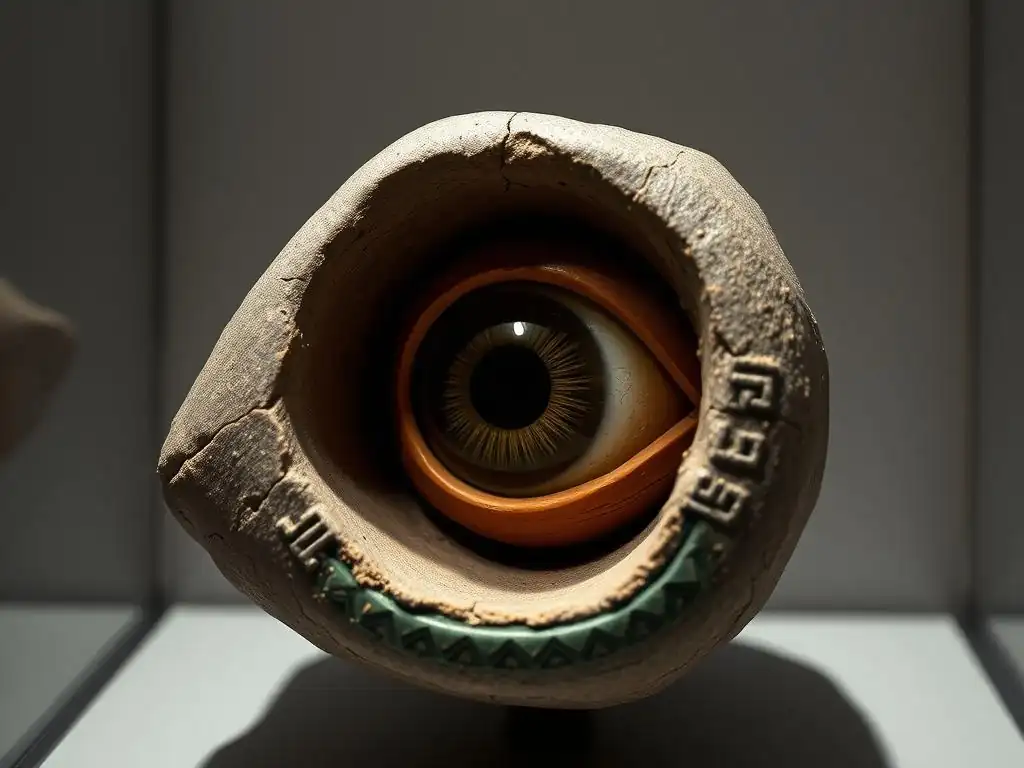
Contrasting Nok Eyes with those of Ancient Egyptian Sculptures
When comparing Nok terracotta eyes with those found in ancient Egyptian sculptures, striking differences in artistic intent and execution become apparent. Egyptian art, particularly during the Old and Middle Kingdoms, often aimed for a more idealized and naturalistic representation of the human form, albeit within strict canonical rules.
Eyes in Egyptian sculptures were frequently almond-shaped, highly detailed, and often inlaid with precious materials like obsidian, quartz, or copper to simulate the iris and pupil, giving them a lifelike, glistening quality. The goal was to imbue the statue with a sense of eternal presence and vitality, reflecting the Egyptian belief in the Ka (life-force) inhabiting the statue.
In contrast, Nok terracotta eyes, with their characteristic triangular, D-shaped, or perforated forms, prioritize stylization and abstraction over naturalism. They rarely incorporate inlays and instead rely on deep incisions and perforations to define the features. While Egyptian eyes were designed to appear "seeing" in a realistic sense, Nok eyes evoke a different kind of vision—perhaps an inner sight, a spiritual perception, or a symbolic gaze. This fundamental difference highlights how "Nok terracotta eye symbolism" diverges from the Egyptian focus on eternal realism, reflecting distinct cultural and spiritual priorities.
Comparing Nok Eyes to Eye Spots in Insects [e.g., Butterflies]
While a direct comparison between human-made art and natural biological phenomena like insect eye spots (ocelli) might seem unconventional, it can offer a unique perspective on the concept of "eye-like" forms. Butterfly ocelli are primarily for mimicry and defense, acting as false eyes to deter predators or to direct attacks away from vital body parts. They are typically concentric circles of varying colors, designed to create an illusion of a larger, threatening eye. Their function is purely pragmatic and evolutionary.
Nok terracotta eyes, however, are deliberate artistic creations with deep cultural and symbolic meaning. While they share the "eye-like" appearance and a potential for deterrence or spiritual presence, their purpose is not biological survival but cultural expression and possibly ritualistic communication. The "Nok terracotta eye symbolism" is about conveying complex human ideas—such as spiritual insight, ancestral connection, or social status—through abstract form.
Unlike insect eye spots, which are fixed biological traits, Nok eyes are products of human creativity, reflecting the beliefs and values of an ancient society. This distinction underscores the profound difference between natural mimicry and intentional artistic symbolism.
Unique Characteristics of Nok Eye Communication
The unique characteristics of Nok terracotta eyes lie in their powerful blend of abstraction, stylization, and implied spiritual depth. Unlike many other ancient cultures that sought to replicate the human eye with a degree of naturalism, Nok artists deliberately distorted and simplified the form to create a highly recognizable and potent visual motif. The consistent use of triangular, D-shaped, or perforated pupils is a stylistic signature that carries significant communicative weight, even if its precise meaning remains debated. This stylistic consistency suggests a deeply ingrained "Nok terracotta eye symbolism" that was widely understood within the culture.
Moreover, the communicative power of Nok eyes often stems from their ability to convey a sense of introspection or otherworldliness without relying on realistic facial expressions. The deep-set, often unblinking gaze suggests a profound spiritual connection or a state of heightened awareness. This distinct approach to ocular representation allowed Nok art to communicate complex ideas about vision, perception, and the sacred, setting it apart from other art traditions and cementing its place as a unique and influential artistic legacy in West Africa.
Techniques Used in Creating Nok Terracotta Eyes
The Craftsmanship Behind the Eye Formation
The creation of Nok terracotta eyes involved a sophisticated level of craftsmanship, indicative of skilled artisans. The general method for Nok sculptures was coiling and pinching, where clay was built up in layers. For the eyes, sculptors would meticulously shape the clay to create the characteristic triangular, D-shaped, or almond-shaped forms.
These shapes were often formed by applying small, carefully molded pieces of clay onto the main facial structure, then smoothing and integrating them. The deep-set nature of many Nok eyes suggests that the eyelids were formed by pushing the clay inward and then building up the brow and cheekbones around them.
The pupils were typically created by perforating the clay, either by pushing a round stick or finger through the still-pliable material. This perforation was not merely functional (allowing for even drying and firing) but also a deliberate artistic choice, contributing significantly to the "Nok terracotta eye symbolism" by creating a haunting, hollow gaze. The precision required to maintain consistency in eye shape and size across numerous sculptures, using only rudimentary tools, speaks volumes about the mastery of these ancient potters.
Materials and Tools Used in Nok Terracotta Production
The primary material for Nok sculptures was local clay, likely sourced from riverbeds or other geological deposits within the Jos Plateau region. This clay was carefully prepared, possibly by washing and levigating to remove impurities, ensuring a fine, workable consistency. While specific clay types varied across different sites, the general quality allowed for the intricate details seen in the sculptures, including the delicate eye features. The clay was then fired at relatively low temperatures, estimated to be between 400°C and 600°C, in open bonfires or simple kilns, which is remarkable given the size and complexity of some pieces.
The tools used by Nok sculptors were likely simple and made from readily available materials. Wooden sticks, bone implements, or even fingers could have been used to incise the eyelids, shape the eye contours, and create the perforated pupils. Smooth stones or pieces of gourd might have been employed for burnishing the surfaces, giving them a slight sheen before firing. The absence of complex metal tools for fine detail work further emphasizes the skill and ingenuity of the Nok artisans in manipulating the raw clay to achieve such distinctive and enduring artistic forms, including their iconic eye depictions.
Preserving and Studying Nok Terracottas Today
The preservation of Nok terracottas, particularly their delicate eye features, presents significant challenges due to their age and the conditions of their discovery. Many pieces are found fragmented in alluvial deposits, having been washed out of their original contexts over millennia. Modern archaeological practices prioritize careful excavation, documentation, and stabilization to prevent further deterioration. Once recovered, the fragments are meticulously cleaned and, where possible, reassembled by conservators, often using advanced adhesives and fillers that are reversible and chemically stable.
Contemporary study of Nok terracottas employs a range of scientific techniques to gain deeper insights. Non-invasive methods like X-ray fluorescence (XRF) and petrography are used to analyze the clay composition, helping to identify source locations and workshop practices. Thermoluminescence (TL) dating is crucial for establishing precise chronologies of the artifacts, including those with unique "Nok terracotta eye symbolism."
Furthermore, 3D scanning and digital modeling allow researchers to create virtual reconstructions of fragmented pieces, providing new perspectives on the original appearance and potential functions of these enigmatic sculptures. This ongoing research is vital for understanding the full scope of Nok artistry and its cultural significance.
Case Studies: Examining Specific Nok Terracotta Heads with Notable Eyes
Case Study 1: The Jemaa Head - An Analysis of its Eye Complexity
The Jemaa Head, one of the most complete and iconic Nok terracotta sculptures, offers a prime example of the complexity and artistry of Nok eye depiction. Discovered near the village of Jemaa, this head features large, deeply incised, D-shaped eyes with prominent, hollowed pupils. The eyelids are thick and carefully sculpted, creating a powerful, almost contemplative gaze that dominates the facial features.
The precision of the incisions and the smooth finish around the eyes suggest a high level of artistic skill. The "Nok terracotta eye symbolism" in this piece is particularly striking, conveying a sense of profound introspection or perhaps a connection to a spiritual realm.
The complexity of the Jemaa Head's eyes also lies in their subtle asymmetry and the way they interact with the overall facial structure. While maintaining the characteristic D-shape, there are slight variations in the depth and angle of the incisions, giving the face a more lifelike, albeit stylized, quality. The hollowed pupils, in particular, create a dramatic play of light and shadow, making the eyes appear to follow the viewer. This piece is frequently cited in discussions about the communicative power of Nok art, specifically how the eyes are central to conveying the figure's enigmatic presence.
Case Study 2: The Sokoto Head - Exploring the Eye Arrangement
The Sokoto Head, another significant Nok find, showcases a slightly different yet equally compelling approach to eye arrangement. While still adhering to the D-shaped or triangular eye form characteristic of Nok art, the eyes on this head are often depicted as more elongated and set further apart than those on the Jemaa Head. This wider placement contributes to a broader facial structure and a sense of expansive vision. The pupils are typically perforated, maintaining the signature hollow gaze, but the overall impression is one of alertness and perhaps a more outward-looking perspective.
The eye arrangement on the Sokoto Head also demonstrates variations in the prominence of the eyelids. In some interpretations of this head, the upper eyelids are particularly heavy, almost obscuring the pupil, which could suggest a sense of wisdom or a meditative state. The stylistic nuances in the Sokoto Head's eyes contribute to the ongoing scholarly debate about regional variations within Nok art and how different communities might have interpreted or emphasized aspects of "Nok terracotta eye symbolism." Its distinctive eye placement makes it a valuable comparative piece for understanding the diversity within Nok's otherwise consistent artistic canon.
Case Study 3: The Katsina Head - Contextualizing the Eye Design
The Katsina Head, known for its relatively naturalistic features compared to some other Nok pieces, provides an intriguing context for its eye design. While still stylized, the eyes on the Katsina Head often appear more rounded or almond-shaped than the typical D-shapes, and the overall facial proportions are somewhat less exaggerated.
Despite this subtle shift towards naturalism, the fundamental "Nok terracotta eye symbolism" remains evident through the deep-set nature of the eyes and the characteristic perforation of the pupils. This head suggests a potential regional or chronological variation where artists experimented with slightly different forms while retaining core Nok stylistic elements.
The eye design on the Katsina Head, with its more rounded contours, might imply a slightly different emphasis in its symbolic meaning, perhaps a gentler gaze or a more direct representation of an individual. However, the consistent use of hollowed pupils still points to a connection with the spiritual realm or a symbolic form of vision. This piece highlights the adaptability of Nok artistic conventions and how the core elements of eye design could be subtly reinterpreted within different artistic expressions, while still being unmistakably Nok in character and conveying a similar sense of enigmatic presence.
Nok Terracotta Eye Symbolism: Concluding Thoughts and Future Research
Summary of Key Findings Regarding Nok Terracotta Eye Patterns
The study of Nok terracotta eye patterns reveals a consistent and highly stylized artistic signature that spans centuries of the culture's existence. Key findings include the prevalence of triangular, D-shaped, and almond-shaped eyes, often characterized by deep incisions for eyelids and perforated pupils. These features are not merely anatomical but are deliberate artistic choices that imbue the sculptures with a unique and enigmatic gaze.
Variations in size, placement, and subtle expressions suggest a sophisticated artistic tradition capable of conveying nuanced meanings. The consistent "Nok terracotta eye symbolism" across the vast geographic spread of the culture points to a shared visual language and cultural understanding.
These distinctive eye patterns are central to understanding the potential spiritual and social functions of Nok terracottas, possibly representing connections to ancestors, spiritual insight, or authority. The evolution of these patterns over time, though subtle, indicates a continuous refinement of artistic techniques and possibly shifts in symbolic emphasis. When compared to other ancient art traditions, Nok eyes stand out for their deliberate abstraction and focus on conveying an inner or spiritual vision rather than strict naturalism, solidifying their unique place in the history of global art.
The Importance of Further Research into Nok Artistic Practices and Beliefs
Despite decades of archaeological work, much remains to be uncovered about Nok artistic practices and the underlying beliefs that shaped their unique "Nok terracotta eye symbolism." Future research should focus on more systematic excavations of undisturbed Nok sites, which could provide crucial contextual information about where these sculptures were placed and how they were used. This would help to move beyond hypotheses and establish more definitive interpretations of their function and meaning. Advanced dating techniques on newly discovered materials could also refine the chronological sequence of stylistic developments, particularly concerning eye forms.
Furthermore, interdisciplinary approaches, combining archaeology with ethnoarchaeology and comparative studies of contemporary African belief systems, could offer valuable insights into the possible spiritual and ritualistic significance of the eye motifs. Analyzing the chemical composition of the clay from various sites might also reveal trade networks or shared workshops, shedding light on the transmission of artistic knowledge and the consistency of eye symbolism across different regions. Continued research is essential to fully appreciate the complexity and ingenuity of the Nok culture and to unlock the secrets embedded within their enigmatic terracotta eyes.
The Enduring Allure of the Enigmatic Eyes of Nok Terracottas
The enigmatic eyes of Nok terracottas continue to captivate archaeologists, art historians, and the public alike, cementing their status as one of Africa's most compelling artistic legacies. Their stylized forms, profound gaze, and consistent "Nok terracotta eye symbolism" offer a powerful glimpse into the worldview of an ancient civilization that flourished for over a millennium. These eyes transcend mere representation; they are portals to a distant past, inviting contemplation on the nature of vision, spirituality, and human expression.
The enduring allure of these eyes lies not only in their artistic beauty but also in the questions they continue to pose about the beliefs and practices of the Nok people. As fragments of a lost world, they serve as a testament to the sophistication of early African art and its profound capacity for symbolic communication. The ongoing study and preservation of Nok terracottas ensure that these silent, watchful eyes will continue to tell their story, inspiring new generations to explore the rich tapestry of human history and creativity.
Frequently Asked Questions
What is the significance of the Nok terracotta culture in the context of West African archaeology?
The Nok culture is significant because it represents one of the earliest known instances of terracotta sculpture in sub-Saharan Africa, dating back to around 1500 BCE. This makes it crucial for understanding the development of art and society in the region.
Why are the eyes of Nok terracotta figures considered a " stylistic signature"?
The eyes are often characterized by their distinctive triangular or D-shaped form and pierced pupils. This unique stylistic feature is highly recognizable and helps identify artifacts as belonging to the Nok culture.
What materials and techniques were likely used to create the Nok terracotta sculptures, particularly focusing on the eyes?
The sculptures were made from locally sourced clay, likely fired in open kilns. The eyes were probably shaped by hand and details added with simple tools before firing.
What are some of the proposed interpretations of the eye symbolism in Nok terracotta figures?
Interpretations range from representing spiritual insight or heightened awareness to serving as a marker of social status or lineage affiliation. The exact meaning remains a subject of ongoing research.
Where can I find more information about the Nok culture and its artifacts, including the significance of the eyes?
ArchaeologyHub.org offers detailed timelines, artifact profiles, and interpretive analyses of ancient civilizations, including the Nok culture. Search for "Nok culture" or "Nok terracotta" on the website.
Final Reflection: Gazing into the Past, Shaping the Future
The journey through the enigmatic eyes of Nok terracottas reveals more than just ancient artistry; it unveils a profound connection to the beliefs and values of a civilization long past, a connection that resonates even today. Understanding the stylistic signature of these eyes, their unique form and expression, provides a crucial lens through which we can appreciate the depth and complexity of Nok culture and its enduring legacy.
The meticulous analysis of these artistic choices allows us to glimpse into the spiritual and social fabric of a society that flourished centuries ago, reminding us that art is always a reflection of its time.
The enduring allure of Nok terracottas, particularly their captivating eyes, lies in their ability to transcend time and connect us to a shared human experience. This exploration has deepened my appreciation for the power of art to communicate across millennia, revealing the universal human desire to express identity, belief, and connection to the spiritual realm. Art washes away from the soul the dust of everyday life.
- Pablo Picasso. This quote perfectly encapsulates the power of these ancient artifacts to cleanse our modern perspectives and remind us of the timeless beauty and wisdom embedded within human creativity.
As we close this exploration of Nok terracotta eye symbolism, let us not simply admire these artifacts from afar, but rather allow them to inspire a deeper understanding of ourselves and our own cultural expressions. Consider how the symbols and artistic choices of our own time will be interpreted by future generations. What stories will our art tell? Let the enigmatic eyes of Nok terracottas serve as a reminder of the enduring power of art to connect us to the past, inform the present, and shape the future.
Unveil Your Inner Archaeologist!
Thank you for delving into the fascinating world of Nok terracottas and their captivating eyes. We hope you've enjoyed exploring the stylistic signatures of these ancient sculptures. Now, it's your turn to connect with this rich history!
Here are a few ways to further engage with the legacy of Nok:
- Embark on a virtual museum tour: Many museums worldwide showcase Nok terracottas online. Dedicate some time to explore their collections virtually, noticing the variations in eye styles and other features.
- Share your newfound knowledge. Discuss an idea from this article with a friend or on your favorite social media platform, sparking conversation about Nok and its culture.
- Dive deeper into the broader context of West African art. Check out similar pieces of work online or at a library, compare their techniques, and consider their place in history.
What unique aspect of the Nok terracottas' eyes piqued your interest the most, and how might you incorporate this artistic detail into your own creative endeavors?