
The Stag Rhyton of the Schimmel Collection: Masterpiece of Hittite Metalwork


Welcome to ArchaeologyHub.org, your gateway to unraveling the mysteries of the past! Prepare to delve into the rich tapestry of human history, where every artifact whispers tales of forgotten civilizations. Today, we embark on a journey to explore the fascinating world of the Hittites and the remarkable significance of Hittite metalwork rhytons, beginning with a detailed analysis of the extraordinary Stag Rhyton from the Schimmel Collection. What secrets does this exquisite piece hold about the Hittite culture and their sophisticated craftsmanship? Join us as we unearth its story and uncover the depths of its meaning.
- Introduction to Hittite Metalwork and the Schimmel Collection Stag Rhyton
- Detailed Examination of the Stag Rhyton
- Iconography and Symbolism in Hittite Stag Rhytons
- Art Historical Context: Hittite Metalworking Techniques
- Significance of the Stag Rhyton in Understanding Hittite Culture
- Preservation and Display of the Schimmel Collection's Stag Rhyton
- Hittite Metalwork Rhyton Significance: Conclusion
-
Frequently Asked Questions
- What is a rhyton, and why is the Stag Rhyton of the Schimmel Collection considered significant?
- Where does the Stag Rhyton of the Schimmel Collection originate from, and what is its historical context?
- What materials were used to create the Stag Rhyton, and how does this contribute to its importance?
- What does the stag symbolism represent in the context of Hittite culture and religion?
- How does the Stag Rhyton contribute to our understanding of Hittite metalwork techniques?
- Final Reflection: Echoes of Hittite Majesty
- Unearth Your Inner Archaeologist!
Introduction to Hittite Metalwork and the Schimmel Collection Stag Rhyton
The Significance of Hittite Metalwork in the Bronze Age
The Bronze Age was a period defined by humanity's mastery over metals, and the Hittites, a major power in Anatolia, stood at the forefront of this technological revolution. Their kingdom, flourishing from approximately 1600 to 1178 BCE, controlled vital trade routes and possessed significant expertise in metallurgy, particularly in the working of bronze and, notably, early iron. This advanced Hittite metalwork was not merely for utilitarian purposes; it played a crucial role in their military might, economic prosperity, and sophisticated cultural expression.
Beyond weaponry and tools, Hittite artisans produced an array of intricate bronze artifacts, including ceremonial axes, elaborate pins, and cultic figurines. Excavations at sites like Boğazköy (ancient Hattusa, the Hittite capital) and Alaca Höyük have yielded numerous examples that demonstrate their sophisticated casting and finishing techniques. This widespread and high-quality production of metal objects underscored the Hittite Empire's technological prowess and its ability to harness resources for both practical and symbolic ends, making their metalwork a cornerstone of their civilization.
Unveiling the Schimmel Collection's Prized Rhyton
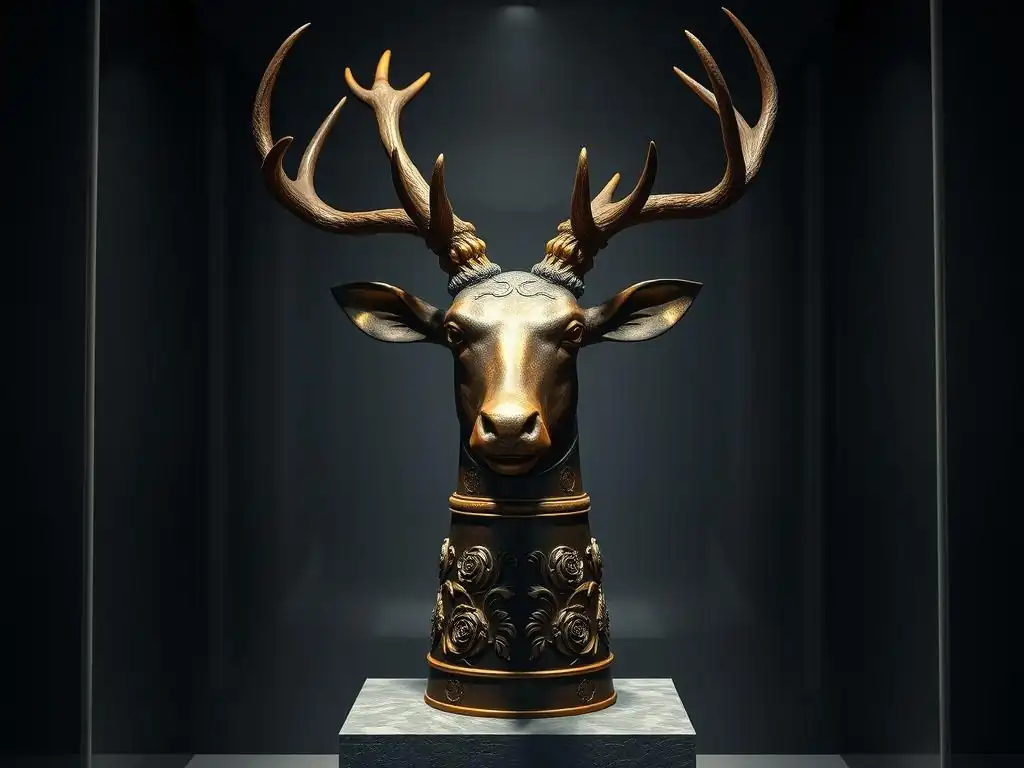
Among the most celebrated examples of ancient Near Eastern art is the Stag Rhyton from the Norbert Schimmel Collection, an extraordinary artifact of Hittite origin. Dating back to the New Hittite Kingdom, likely between 1400 and 1200 BCE, this vessel stands as a testament to the unparalleled artistry and technical skill of Hittite metalworkers. Its striking depiction of a kneeling stag, rendered with remarkable naturalism and detail, immediately captures attention and places it among the finest surviving pieces from this period.
A rhyton is a type of drinking vessel, often zoomorphic, used in ancient rituals or banquets. The Schimmel Stag Rhyton, with its precious materials and meticulous craftsmanship, is far more than a simple container; it is a complex artistic and cultural statement. Its exceptional state of preservation and aesthetic brilliance make this specific Hittite metalwork rhyton a pivotal object for understanding the broader Hittite metalwork rhyton significance within the context of their religious practices, elite culture, and artistic achievements.
Detailed Examination of the Stag Rhyton
Provenance and Discovery of the Hittite Stag Rhyton
The exact archaeological provenance of the Schimmel Stag Rhyton remains largely unknown, a common challenge for artifacts that have entered private collections without documented excavation records. While its precise find spot is unconfirmed, such pieces typically originate from central Anatolia, the heartland of the Hittite Empire, potentially from sites near major Hittite centers like Hattusa or secondary cities that housed elite residences or cultic complexes. The rhyton became part of the distinguished Norbert Schimmel Collection and has since been frequently exhibited at prominent institutions, most notably the Metropolitan Museum of Art in New York.
The lack of controlled archaeological context means that crucial information about its original setting—such as associated artifacts, architectural remains, or specific depositional layers—is unavailable. This absence complicates a full understanding of its immediate function and its precise role within a specific ritual or domestic environment. Nevertheless, its stylistic characteristics and material composition firmly establish it as an authentic and highly significant example of ancient Hittite metalwork, providing invaluable insights despite its undocumented discovery.
Material Composition and Craftsmanship Analysis
The Stag Rhyton is primarily fashioned from silver, a precious metal highly valued in the ancient world, with intricate details rendered in gold overlay or inlay. This combination of precious metals underscores the object's elite status and its probable use in significant ceremonial contexts. The rhyton stands approximately 29 cm (about 11.4 inches) tall, with the stag forming the main body and an opening at the back for pouring, typical of such vessels.
The craftsmanship evident in the rhyton is truly exceptional, showcasing a profound mastery of various metalworking techniques. The main form of the stag was likely created using repoussé, where the silver sheet was hammered from the reverse side to push out the relief, forming the animal's body and musculature. Fine details, such as the stag's fur, eyes, and antlers, were then meticulously added through chasing and engraving on the front surface.
Gold was skillfully applied to highlight specific features, possibly the antlers or elements of the vessel's rim, demonstrating sophisticated soldering and inlay techniques. This intricate work exemplifies the pinnacle of Hittite metalwork during the late Bronze Age.
Iconography and Symbolism in Hittite Stag Rhytons
The Symbolic Meaning of the Stag in Hittite Culture
The stag held profound symbolic significance within Hittite culture, frequently appearing in their art, religious texts, and iconography. It was often associated with powerful deities, most prominently the Stag God, sometimes identified with Rundasia, a protector deity of the hunt and wild animals, or even linked to the Storm God Teshub in certain contexts. The stag's attributes—its strength, majestic antlers, vitality, and connection to the wild—made it a potent symbol of natural power and fertility.
Evidence of the stag's importance is widespread, appearing on seal impressions, monumental rock reliefs (such as those at Yazılıkaya), and other cultic objects. For instance, the cultic standards from Alaca Höyük, though earlier, also feature prominent stag figures, suggesting a long-standing reverence for the animal. In the context of the Stag Rhyton, the animal's depiction transcends mere representation; it embodies divine presence or serves as an offering vehicle to these powerful forces, emphasizing the Hittite metalwork rhyton significance as a conduit for spiritual connection.
Comparative Analysis with Other Hittite Animal Rhytons
While the Stag Rhyton is arguably the most famous, the Hittites produced a variety of zoomorphic rhytons depicting other animals, including lions, bulls, birds, and even composite creatures. These diverse animal forms suggest a rich pantheon of animal deities or symbolic associations that were deemed appropriate for ritualistic drinking vessels. Each animal likely carried specific connotations related to its attributes or its association with particular gods.
Despite the variety in animal choice, commonalities exist across these Hittite animal rhytons. Many share a similar overall form, often depicting the animal in a kneeling or standing pose, with an opening for libations.
The consistent use of precious metals like silver and gold, and the application of sophisticated techniques such as lost-wax casting for more complex forms or repoussé for sheet metal, indicate a shared high-status function. This consistent emphasis on zoomorphic forms highlights a broader ritualistic practice where the vessel itself became an embodiment of the sacred, reinforcing the unique Hittite metalwork rhyton significance within their cultic practices.
Religious and Ritual Contexts of Hittite Rhytons
Rhytons, particularly those crafted from precious metals and adorned with symbolic imagery like the Stag Rhyton, were integral to Hittite religious and ritualistic practices. They were likely used in libation ceremonies, where liquids (such as wine, beer, or water) were poured as offerings to deities. Such acts of "drinking to the gods" were fundamental to Hittite worship, intended to honor the divine, seek blessings, or solidify covenants.
These rituals would have taken place in sacred spaces, including temples, cultic sites, or perhaps within the royal palace during state ceremonies. The use of an exquisitely crafted Hittite metalwork rhyton like the stag vessel would have elevated the sanctity of the ritual, signifying the profound importance of the offering and the high status of the participants, whether priests, kings, or other elite figures. The rhyton thus served not only as a functional object but also as a powerful cultic instrument, mediating between the human and divine realms and solidifying its Hittite metalwork rhyton significance in religious life.
Art Historical Context: Hittite Metalworking Techniques
Lost-Wax Casting and Other Hittite Metalworking Techniques
Hittite metalworkers employed a sophisticated repertoire of techniques, chief among them being the lost-wax (cire perdue) casting method, especially for complex, three-dimensional bronze figures. This process involved sculpting a model in wax, encasing it in clay, heating the mold to melt out the wax, and then pouring molten metal into the cavity. Once cooled, the clay mold was broken, revealing the metal object. This technique allowed for remarkable detail and intricate forms that would be impossible to achieve through hammering.
In addition to casting, Hittite artisans were adept at various forms of sheet metal working. Techniques such as repoussé, as seen in the Stag Rhyton, involved hammering a metal sheet from the reverse side to create a raised design, while chasing and engraving were used for adding fine details to the front surface. Soldering, riveting, and inlaying (as with the gold on the silver rhyton) further demonstrate their advanced metallurgical knowledge and skill in joining different components and materials, showcasing the high level of technical mastery in Hittite metalwork.
Influences and Parallels in Ancient Near Eastern Metalwork
Hittite metalwork did not develop in isolation; it was part of a vibrant network of artistic exchange across the ancient Near East. Anatolian artisans were exposed to traditions from Mesopotamia, Syria, Egypt, and the Aegean, absorbing and adapting foreign elements while maintaining a distinct Hittite identity. For instance, the use of zoomorphic vessels was common in many Bronze Age cultures, and some stylistic traits might echo Syrian or Mitannian artistic conventions, which were prominent in regions bordering the Hittite Empire.
However, Hittite metalwork also developed unique characteristics that set it apart. Their distinctive representations of animals, often powerful and stylized yet with a touch of naturalism, and their focus on specific cultic and royal themes, reflect a unique Anatolian aesthetic. While influences from regions like Assyria or Syro-Palestinian areas can be observed in certain motifs or forms, the overall stylistic coherence and the specific iconography of pieces like the Stag Rhyton firmly establish a recognizable Hittite artistic tradition, thus contributing to the unique Hittite metalwork rhyton significance within the broader art historical landscape.
The Role of Metalwork in Hittite Society and Economy
Metalwork played a foundational role in the Hittite economy and social structure. The Hittite Empire controlled significant sources of raw materials, including copper from Cyprus, silver from the Taurus Mountains, and crucially, early iron from central Anatolia, which they guarded as a strategic resource. This control over metals and their sophisticated processing capabilities contributed immensely to their economic power, fueling trade and providing essential resources for agriculture and warfare.
Socially, the production of precious metal objects like the Stag Rhyton was a highly specialized craft, likely undertaken by skilled artisans working under royal or temple patronage. These exquisite pieces were not widely distributed but were exclusive possessions of the elite—kings, queens, high priests, and nobility—serving as potent symbols of wealth, status, and religious authority. The existence of such elaborate Hittite metalwork underscores a stratified society where artistic patronage was a means of reinforcing power and prestige.
Significance of the Stag Rhyton in Understanding Hittite Culture
Insights into Hittite Royal Power and Ideology
The Stag Rhyton offers invaluable insights into the nature of Hittite royal power and ideology. Objects of such extraordinary value and craftsmanship were almost certainly commissioned by or intended for the highest echelons of Hittite society, quite possibly the Great King himself. Their use in royal ceremonies or banquets would have underscored the monarch's wealth, his divine favor, and his central role in mediating between the human and divine realms.
The symbolic association of the stag with powerful deities like the Storm God or the God of the Wild could be strategically leveraged by the Hittite kings. By utilizing vessels adorned with such potent animal imagery, the king could subtly align himself with divine strength and protection, thereby legitimizing his rule and reinforcing his position as the earthly representative of the gods. This profound connection between artifact, deity, and monarch highlights the Hittite metalwork rhyton significance as an instrument of royal propaganda and spiritual authority.
The Stag Rhyton as a Reflection of Hittite Religious Beliefs
The Stag Rhyton serves as a tangible and compelling reflection of the intricate tapestry of Hittite religious beliefs. Its zoomorphic form points directly to the importance of animal deities and the reverence for nature in their polytheistic system. The careful rendering of the stag suggests not merely an artistic representation but a vessel imbued with sacral presence, perhaps even embodying the deity itself during ritualistic use.
The very act of using such a precious and symbolically charged vessel for libations underscores the deep piety and ritualistic complexity of Hittite worship. It provides direct archaeological evidence for the practice of offering to the gods and the specific types of cultic paraphernalia employed in these ceremonies. This Hittite metalwork rhyton thus offers unique insights into their animistic beliefs, their pantheon, and the specific role of animals in their spiritual cosmology.
Understanding Hittite Art Through Metalwork Examples
The Stag Rhyton is a prime example of Hittite artistic principles, showcasing their distinctive blend of naturalism and powerful stylization. While Hittite monumental art, such as rock reliefs and temple sculptures, provides a grand narrative of their artistic output, smaller, more intimate pieces like this rhyton reveal a different facet of their aesthetic sensibilities and technical prowess. It demonstrates their ability to create objects of exquisite beauty and intricate detail on a smaller scale, complementing the grandeur of their architecture.
Studying such sophisticated metalwork examples allows art historians and archaeologists to trace the evolution of Hittite artistic styles, identify regional variations, and understand the preferences of royal and religious patrons. The Hittite metalwork rhyton significance lies in its ability to offer a comprehensive view of Hittite art, illustrating not only their mastery of materials and techniques but also their profound cultural values and their unique contribution to the broader artistic landscape of the ancient Near East.
Preservation and Display of the Schimmel Collection's Stag Rhyton
Current Location and Exhibition Details
The Stag Rhyton from the Norbert Schimmel Collection is one of the most iconic artifacts of the ancient world and is frequently associated with the Metropolitan Museum of Art in New York. While it remains part of the private Schimmel Collection, it has been on long-term loan and prominently exhibited at the Met, particularly within their Ancient Near Eastern Art galleries. This public display allows millions of visitors annually to witness firsthand the extraordinary craftsmanship and beauty of this Hittite masterpiece.
Its presence in such a prestigious institution ensures its accessibility for both scholarly research and public appreciation. It is often a highlight in exhibitions focused on Bronze Age Anatolia or ancient metallurgy, serving as a key visual reference for the sophistication of the Hittite civilization. The meticulous curation and presentation within the museum context further enhance its educational value and its status as a global cultural treasure.
Conservation Efforts and Challenges
Preserving ancient metal artifacts like the Stag Rhyton presents significant challenges due to the inherent instability of metals over millennia. Silver, in particular, is prone to corrosion, tarnishing, and degradation, especially when exposed to fluctuating humidity, pollutants, or improper handling. Conservators must constantly monitor the object's condition to prevent further deterioration and ensure its long-term stability.
Conservation efforts typically involve maintaining a stable environment with controlled temperature and humidity levels within its display case. Specialized cleaning techniques are used to remove corrosive layers without damaging the original surface or delicate gold inlays. These ongoing scientific and technical interventions are crucial for safeguarding this invaluable piece of Hittite metalwork, ensuring that its intricate details and historical integrity are preserved for future generations of scholars and enthusiasts.
The Stag Rhyton's Enduring Legacy
The Stag Rhyton has cemented its place as one of the most significant and recognizable artifacts of the Hittite civilization. Its unparalleled artistry and technical brilliance have profoundly influenced our understanding of Hittite capabilities, challenging earlier perceptions that might have solely focused on their monumental architecture or textual archives. It stands as a powerful testament to their sophisticated material culture and artistic refinement.
Beyond its academic importance, the rhyton's aesthetic appeal has made it an enduring symbol of ancient Anatolian art. It frequently appears in textbooks, documentaries, and museum catalogs, serving as a primary visual ambassador for the Hittite Empire. Its continued study and public admiration ensure its lasting legacy, contributing significantly to the ongoing discourse about Hittite metalwork rhyton significance in the broader context of ancient world civilizations.
Hittite Metalwork Rhyton Significance: Conclusion
The Stag Rhyton as a Key Artifact of Hittite Civilization
The Stag Rhyton of the Schimmel Collection is far more than a mere ancient artifact; it is a profound testament to the sophistication and artistry of the Hittite civilization. Its exquisite craftsmanship in silver and gold, combined with its powerful zoomorphic symbolism, renders it an unparalleled source of information. It illuminates the advanced metallurgical techniques mastered by Hittite artisans, their complex religious beliefs, their unique artistic expression, and the hierarchical structures of their society during the New Hittite Kingdom.
From its detailed construction, showcasing mastery of repoussé and inlay, to its rich iconography connecting it to revered deities, the rhyton provides a comprehensive window into Hittite culture. Its exceptional preservation allows for deep analysis, making it an indispensable piece for understanding not just their metalwork, but their entire worldview. This unique Hittite metalwork rhyton significance lies in its ability to encapsulate so many facets of a powerful and enigmatic ancient empire.
Further Research and Ongoing Discoveries in Hittite Metalwork
Despite the wealth of knowledge gleaned from artifacts like the Stag Rhyton, the field of Hittite archaeology and art history continues to evolve. Ongoing excavations in Anatolia frequently unearth new sites and artifacts, constantly refining our understanding of Hittite metalworking traditions, their sources of raw materials, and their socio-economic impact. These new discoveries often shed light on regional variations and the broader context of production and use.
The study of the Stag Rhyton and similar pieces benefits immensely from interdisciplinary approaches, integrating archaeological findings with art historical analyses, metallurgical science, and philological interpretations of Hittite texts. This comprehensive scholarly engagement ensures that the Hittite metalwork rhyton significance remains a vibrant area of research. Such masterpieces continue to inspire further investigation, promising even deeper insights into one of the ancient world's most formidable and artistically accomplished civilizations.
Frequently Asked Questions
What is a rhyton, and why is the Stag Rhyton of the Schimmel Collection considered significant?
A rhyton is an ancient drinking vessel, often shaped like an animal's head or horn. The Stag Rhyton is significant due to its exceptional craftsmanship and its representation of Hittite artistic skill.
Where does the Stag Rhyton of the Schimmel Collection originate from, and what is its historical context?
The Stag Rhyton originates from the Hittite civilization in Anatolia (modern-day Turkey). It provides insight into the Hittites' religious practices and elite culture during the Bronze Age.
What materials were used to create the Stag Rhyton, and how does this contribute to its importance?
The rhyton is primarily made of silver and gold, showcasing the Hittites' mastery of metalworking. The use of these precious materials highlights its importance as a status symbol and ceremonial object.
What does the stag symbolism represent in the context of Hittite culture and religion?
Stags were often associated with deities and royalty in Hittite culture. The Stag Rhyton likely held religious or ceremonial significance, possibly used in rituals or as offerings to the gods.
How does the Stag Rhyton contribute to our understanding of Hittite metalwork techniques?
The intricate details and advanced techniques used to create the Stag Rhyton demonstrate the high level of skill achieved by Hittite metalworkers. It provides valuable information about their tools, methods, and artistic sensibilities, enabling us to comprehend the sophistication of their craftsmanship.
Final Reflection: Echoes of Hittite Majesty
The journey through the artistry of the Stag Rhyton reveals more than just the technical prowess of Hittite metalworkers; it unveils a profound connection to a civilization that, despite its temporal distance, continues to resonate. The enduring power of this artifact lies in its ability to transport us back to a world of ritual, power, and artistic innovation, reminding us that even across millennia, human creativity and expression remain a constant.
The Rhyton is not merely an object; it is a portal, offering glimpses into the beliefs and values that shaped the Hittite world and, in turn, influenced the course of history.
This exploration into the Stag Rhyton's significance has underscored the vital role that art plays in preserving and interpreting the past. It's a tangible link to a culture often overshadowed by its more famous contemporaries. The intricate details and symbolic weight of the Rhyton speak volumes about the Hittites' sophisticated understanding of the natural world and their place within it. As art historian Ernst Gombrich eloquently stated: There really is no such thing as Art. There are only artists.
This quote reminds us that behind every masterpiece, like the Stag Rhyton, there were skilled artisans whose vision and dedication brought these cultural narratives to life.
Now, as we conclude this exploration, consider the legacy of the Stag Rhyton and the broader significance of Hittite metalwork. How does this artifact challenge your understanding of ancient civilizations? How can we, as custodians of history, ensure that these treasures continue to inspire and educate future generations? Let the artistry and ingenuity of the Hittites serve as a reminder that even the most ancient voices can still speak volumes, enriching our understanding of ourselves and the world around us.
Unearth Your Inner Archaeologist!
Thank you for delving into the fascinating world of Hittite metalwork with us! We hope you've gained a deeper appreciation for the Stag Rhyton and its historical significance. Now, let's turn that newfound knowledge into action!
- Visit your local museum with fresh eyes, searching for artifacts that connect you to ancient cultures and sparking further exploration.
- Share this article with fellow history buffs on social media and ignite a conversation about the artistry of the Hittites.
- Delve into a new topic: Start your own online research about the Schimmel Collection and the enigmatic world that birthed the Rhyton, discovering hidden connections that may surprise you.
What other ancient artifact sparks your curiosity and makes you want to learn more about its origin?