
Visualizing Conquest: How NeoAssyrian Palace Art Reinforced Imperial and Military Authority

Welcome to ArchaeologyHub.org!
Dive into the fascinating world of ancient civilizations and uncover the secrets they left behind. Ever wondered how art could be a potent tool of power? Our in-depth exploration into NeoAssyrian palace art authority reveals precisely that. Join us as we visualize conquest and decode the messages embedded within these stunning artifacts, understanding how they reinforced imperial and military authority. Are you ready to uncover the stories etched in stone? Continue reading to unravel the complexities of this powerful visual language.
- Introduction: The Power of Visual Propaganda in the Neo-Assyrian Empire
- Neo-Assyrian Palace Reliefs: A Chronicle of Conquest and Power
- Reinforcing Imperial Authority Through Art: Beyond Military Victories
- Key Themes in Neo-Assyrian Art and Their Impact on Power Dynamics
- Case Studies: Analyzing Specific Neo-Assyrian Palace Artworks
- Comparing Neo-Assyrian Art to Other Ancient Empires: A Study in Visual Strategies
- The Legacy of Neo-Assyrian Palace Art: Understanding Ancient Power
- Conclusion: Neo-Assyrian Palace Art and the Art of Imperial Control
-
Frequently Asked Questions
- What was the primary function of NeoAssyrian palace art?
- How did NeoAssyrian palace art depict warfare and conquest?
- What types of materials and techniques were used in creating NeoAssyrian palace art?
- Where were these artworks typically located, and who was meant to view them?
- How does NeoAssyrian palace art contribute to our understanding of their empire?
- Final Reflection: Echoes of Power in Stone
- Ignite Your Inner Explorer: Unearth More Ancient Wonders!
Introduction: The Power of Visual Propaganda in the Neo-Assyrian Empire
The Role of Palace Art in Ancient Assyrian Society
In ancient Assyrian society, palace art was far more than mere decoration; it served as a fundamental instrument of statecraft and social communication. The grand palaces of cities like Nimrud (Kalhu), Khorsabad (Dur-Sharrukin), and Nineveh were not just royal residences but administrative centers, military headquarters, and ceremonial spaces.
Within these imposing structures, vast expanses of carved stone reliefs adorned walls, meticulously narrating the exploits and achievements of the reigning monarch. This pervasive visual language was designed to impress, educate, and intimidate, shaping the perceptions of both the Assyrian elite and visiting foreign dignitaries regarding the unassailable power and the inherent Neo-Assyrian palace art authority wielded by the king.
These elaborate artistic programs were meticulously planned and executed, often requiring the efforts of hundreds of skilled artisans over many years. For instance, the Northwest Palace of Ashurnasirpal II at Nimrud, completed around 879 BCE, featured nearly two miles of carved reliefs.
The sheer scale and consistent thematic presentation of these artworks underscore their critical function in reinforcing the king's image as a divinely sanctioned ruler and a supreme military commander. The art was an integral part of the architecture, creating an immersive environment that continuously broadcasted the empire's might and the absolute Neo-Assyrian palace art authority of its ruler.
Neo-Assyrian Art as a Tool for Royal Legitimacy and Imperial Control
Neo-Assyrian art was expertly crafted to function as a powerful tool for royal legitimacy and imperial control. Through carefully selected iconography and narrative sequences, the reliefs visually articulated the divine mandate of the Assyrian kings, portraying them as chosen by the gods Ashur and Ishtar to rule the known world.
This divine connection was crucial for solidifying the king's position, transforming his earthly power into a sacred right. The art consistently depicted the king in various roles—as a formidable warrior, a devout priest, a wise administrator, and a prolific hunter—each facet contributing to an image of comprehensive and unparalleled competence.
Furthermore, the extensive visual narratives of military campaigns, sieges, and the subjugation of enemies served as a constant reminder of Assyria's overwhelming military might and the futility of resistance. These depictions were not merely historical records; they were active instruments of control, designed to instill both awe in loyal subjects and fear in potential adversaries.
By showcasing defeated enemies, their tribute, and their eventual integration (or destruction), the Neo-Assyrian palace art authority was visually reinforced, demonstrating the inevitable outcome for those who dared to defy the empire. This visual propaganda was a key component in maintaining order across a vast and diverse empire, projecting an image of unshakeable power that extended far beyond the palace walls.
Neo-Assyrian Palace Reliefs: A Chronicle of Conquest and Power
Depictions of Military Campaigns and Sieges in Neo-Assyrian Art
The core narrative of Neo-Assyrian palace reliefs invariably revolved around the king's military prowess and the empire's incessant expansion. Scenes of military campaigns and sieges dominate the artistic programs, offering a vivid, albeit propagandistic, chronicle of Assyria's conquests.
These depictions meticulously illustrate every stage of warfare, from the organized march of Assyrian troops, often numbering in the tens of thousands, to the brutal realities of siege warfare. For instance, reliefs from the palace of Sennacherib at Nineveh show detailed scenes of the siege of Lachish (701 BCE), complete with siege ramps, battering rams, and archers, providing an unparalleled visual record of ancient military tactics.
These detailed narratives served multiple purposes. They glorified the king as an invincible commander, celebrated the efficiency and brutality of the Assyrian army, and provided a visual manual of military dominance for future generations.
The portrayal of enemy cities being sacked, their inhabitants led away as captives, and their leaders prostrating before the Assyrian king was a clear message to all who viewed them: Assyria's military supremacy was absolute, and resistance was futile. This consistent emphasis on military might was a cornerstone of the Neo-Assyrian palace art authority, projecting an image of an unstoppable force that brought order through conquest.
The Iconography of the Neo-Assyrian Warrior King: Ashurnasirpal II
Ashurnasirpal II, who reigned from 883 to 859 BCE, was particularly instrumental in establishing the iconography of the Neo-Assyrian warrior king that would persist for centuries. His palace at Nimrud is replete with reliefs that consistently depict him as the quintessential military leader.
He is often shown at the forefront of battle, personally engaging enemies with his bow, or overseeing the execution of captured foes. A notable example is a relief from the Northwest Palace where Ashurnasirpal II, larger than life, stands triumphantly over a defeated lion, symbolizing his mastery over chaos and his unyielding strength, mirroring his control over human adversaries.
The king's portrayal was highly stylized and idealized, emphasizing physical strength, unwavering resolve, and divine favor. He is frequently depicted wearing elaborate regalia, often holding symbols of power such as a bow and arrows, or a mace.
His muscular physique and stern expression convey a sense of unyielding authority and readiness for combat. This consistent visual messaging, repeated across numerous panels and halls, served to solidify the image of Ashurnasirpal II, and by extension, all subsequent Assyrian kings, as divinely appointed and supremely capable warrior-rulers, thereby reinforcing the Neo-Assyrian palace art authority and legitimacy in the eyes of his subjects and foreign visitors.
Use of Scale and Composition to Emphasize Assyrian Dominance
Neo-Assyrian palace art masterfully employed scale and composition to visually emphasize Assyrian dominance and the submission of their enemies. The Assyrian king is almost invariably depicted larger than any other figure in the scene, often towering over his own soldiers and dwarfing his defeated adversaries.
This hierarchical scaling immediately draws the viewer's eye to the monarch, highlighting his supreme importance and unchallengeable position within the social and military order. For example, in scenes of receiving tribute, the king might appear twice the size of the foreign emissaries bowing before him, visually asserting his superior status and the subjugation of distant lands.
The compositional arrangements further reinforced this message. Assyrian soldiers are typically shown in disciplined, orderly ranks, often marching in unison or executing synchronized maneuvers, conveying a sense of overwhelming power and organization. In stark contrast, enemy forces are frequently depicted in chaotic disarray: fleeing in panic, drowning in rivers, or being brutally impaled.
This visual dichotomy between Assyrian order and enemy chaos, coupled with the dominant scale of the king and his forces, created a compelling narrative of inevitable victory and absolute control. Such artistic choices were not accidental; they were deliberate strategies to project the formidable Neo-Assyrian palace art authority and to instill a deep sense of awe and submission in all who beheld these magnificent works.
Representations of Tribute and Submission from Conquered Peoples
Beyond the visceral depictions of warfare, Neo-Assyrian palace art extensively showcased the peaceful, yet coerced, submission of conquered peoples through scenes of tribute. These panels often line the main thoroughfares of the palaces, ensuring that visitors, particularly foreign delegates, would witness the vast reach and economic power of the empire.
Reliefs frequently show long processions of diverse peoples—identified by their distinct costumes, hairstyles, and animal offerings—approaching the Assyrian king, laden with valuable goods like horses, camels, exotic animals, gold, and silver. For instance, the Black Obelisk of Shalmaneser III (c. 825 BCE) famously depicts King Jehu of Israel prostrating before the Assyrian monarch, delivering tribute, alongside other subjugated rulers from various regions.
These scenes were crucial for reinforcing the empire's authority without resorting to overt violence. They demonstrated that resistance was not only futile but that submission brought its own form of order and integration into the Assyrian-dominated world system.
The sheer volume and variety of tribute underscored the king's ability to extract wealth from vast territories, symbolizing his unparalleled economic power and the prosperity that flowed into Assyria as a result of its conquests. This visual narrative of global economic dominance was a subtle yet potent aspect of the Neo-Assyrian palace art authority, communicating the benefits of compliance and the vastness of the empire's influence.
The Portrayal of Divine Favor and Royal Power: Ashur and the King
A cornerstone of Neo-Assyrian imperial ideology was the concept of divine favor, and palace art played a vital role in visually manifesting this connection between the king and the gods, particularly Ashur, the chief deity of the Assyrian pantheon. The king was consistently portrayed as Ashur's chosen representative on Earth, tasked with expanding the god's dominion and maintaining cosmic order.
This divine mandate elevated the king's power from mere human authority to a sacred, unchallengeable right. Iconic imagery, such as the winged disk of Ashur hovering protectively over the king in battle or during ceremonial acts, visually cemented this relationship.
In many reliefs, the king is depicted performing religious rituals, making offerings, or receiving blessings from deities, further emphasizing his piety and divine connection. These scenes were not just religious expressions but political statements, asserting that the king's military victories and imperial expansion were not just human achievements but divinely ordained triumphs.
By associating the king directly with the supreme deity, the Neo-Assyrian palace art authority became sacrosanct, making any challenge to the king's rule an affront to the gods themselves. This spiritual dimension added an insurmountable layer of legitimacy to the king's power, both within Assyria and among its subjugated territories.
Architectural Context: Placement of Reliefs within the Palace Spaces
The architectural context and strategic placement of the reliefs within the palace spaces were integral to their effectiveness in reinforcing imperial authority. Assyrian palaces were designed as monumental complexes, with specific halls and courtyards serving distinct functions. The relief panels were not randomly placed; their arrangement was carefully orchestrated to guide the visitor through a curated narrative of royal power and imperial might. For instance, scenes of military campaigns and triumphs were often found in public reception halls, where foreign ambassadors and local dignitaries would gather, ensuring they were confronted with the visual evidence of Assyria's military prowess.
Conversely, more intimate or ritualistic scenes, such as those depicting the king's divine favor or royal hunts, might be placed in more private chambers or ceremonial courtyards. The sheer scale of the palaces and the continuous narrative flow of the reliefs meant that one was constantly immersed in the king's story of conquest and governance.
The very act of moving through these spaces, surrounded by larger-than-life depictions of Assyrian dominance, was an experience designed to awe and intimidate. This deliberate integration of art and architecture created an environment where the Neo-Assyrian palace art authority was not just seen but felt, transforming the palace into a vast, three-dimensional propaganda machine.
Key Themes in Neo-Assyrian Art and Their Impact on Power Dynamics
The Concept of "Ashur's Land" and its Visual Representation
A central ideological concept underpinning Neo-Assyrian imperial expansion was "Ashur's Land" (māt Aššur), which referred to the core territory of Assyria, considered sacred and divinely protected. Beyond this core lay the "Land Under the Yoke of Ashur" (māt šadî), encompassing conquered territories, and further still, the "Lands Not Under the Yoke of Ashur," denoting unconquered regions.
Neo-Assyrian palace art visually articulated this geopolitical schema, though often implicitly, by contrasting the ordered, prosperous scenes within Assyria with the chaotic, subjugated imagery of foreign lands. The king, as Ashur's chosen one, was seen as expanding Ashur's rightful dominion over the entire world.
Reliefs depicting the Assyrian army's disciplined march through foreign landscapes, often contrasted with the wild, untamed nature of these regions or the disarray of their inhabitants, subtly conveyed the idea of Assyria bringing cosmic order and civilization to a chaotic world. The integration of conquered peoples into the Assyrian system, as shown in tribute scenes, represented the expansion of Ashur's divine order.
This visual rhetoric reinforced the notion that Assyrian conquests were not merely acts of aggression but divine imperatives to extend the benevolent, albeit strict, rule of Ashur. This underlying theme profoundly shaped the perception of the Neo-Assyrian palace art authority, framing it as both earthly and divine.
Fear and Awe: Evoking Psychological Control Through Art
Neo-Assyrian palace art was masterfully designed to evoke both fear and awe, serving as a powerful tool for psychological control over both subjects and enemies. The graphic depiction of brutal punishments for rebels—such as impalement, flaying, and decapitation—was a stark warning to any who contemplated defiance. These scenes, though horrifying, were not gratuitous; they were calculated to instill a deep-seated fear of Assyrian retribution. For instance, the reliefs from Ashurbanipal's palace at Nineveh graphically show the aftermath of the Elamite campaign, with piles of heads and captured kings being tortured, leaving no doubt about the consequences of resistance.
Simultaneously, the art also inspired awe through its monumental scale, intricate detail, and the sheer grandeur of the king's achievements. The portrayal of the king's divine favor, his heroic hunts, and the vast wealth flowing into Assyria from tribute scenes contributed to an image of an unstoppable, divinely sanctioned empire.
This dual approach—terrifying those who resisted while impressing those who complied—was highly effective in maintaining control over a vast and diverse empire. The consistent projection of overwhelming power, both military and divine, through Neo-Assyrian palace art authority was a sophisticated form of psychological warfare, ensuring compliance through a combination of dread and admiration.
The Celebration of Royal Hunts as a Symbol of Kingly Prowess
The celebration of royal hunts, particularly lion hunts, was another recurring and significant theme in Neo-Assyrian palace art, serving as a potent symbol of kingly prowess and a metaphor for imperial control. These carefully staged events, often conducted in enclosed arenas with captive lions, were depicted with dramatic realism and intense action.
The king is invariably shown as the sole hero, single-handedly subduing ferocious beasts with his bow or spear, often from a chariot. A famous example is the series of lion hunt reliefs from Ashurbanipal's North Palace at Nineveh, which depict the king in various stages of the hunt, from releasing the lions to their final demise.
These scenes were not merely entertainment; they were direct allegories for the king's ability to maintain order and subdue chaos, both in the natural world and within his empire. Just as the king mastered the most dangerous animals, he was also capable of crushing any human rebellion or foreign threat.
The lion, a symbol of untamed power, represented the forces of anarchy that the king, as the divinely appointed ruler, was destined to control. By visually equating the king's mastery over wild beasts with his dominion over rebellious peoples, these hunt scenes powerfully reinforced the Neo-Assyrian palace art authority and the king's role as the supreme guarantor of cosmic and political order.
Case Studies: Analyzing Specific Neo-Assyrian Palace Artworks
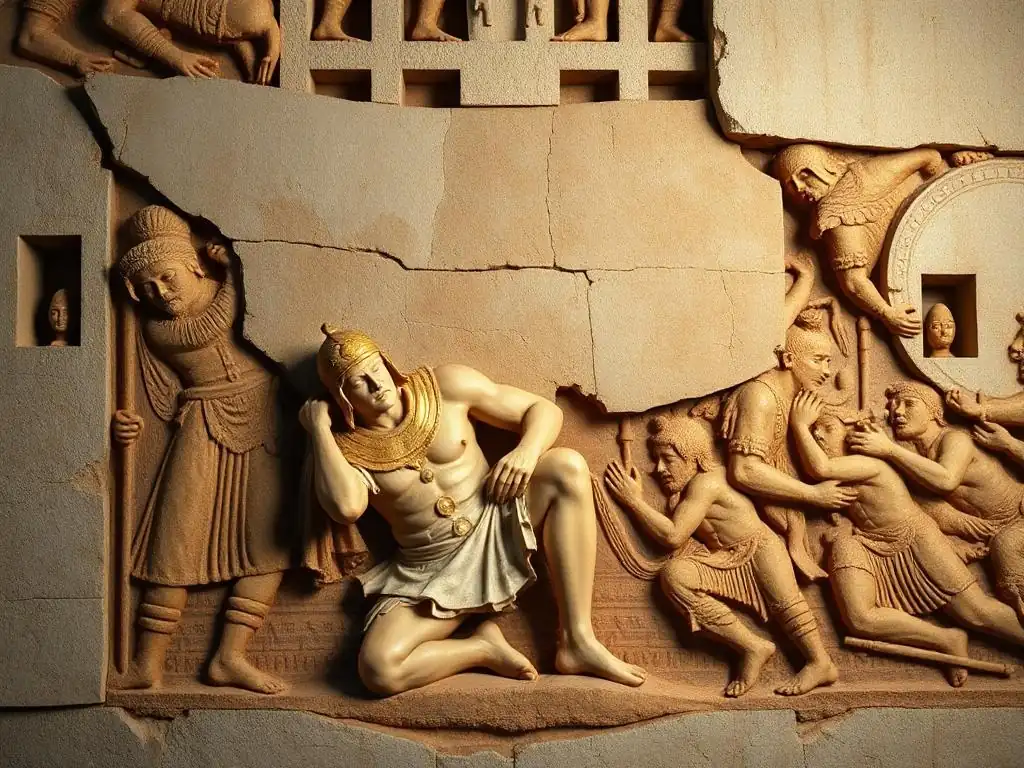
The Black Obelisk of Shalmaneser III: Detailed analysis of the artwork
The Black Obelisk of Shalmaneser III, dating to around 825 BCE, is a prime example of Neo-Assyrian palace art authority being articulated through a multi-faceted narrative. This 2-meter-tall basalt stele, discovered in Nimrud, commemorates Shalmaneser III's military campaigns and achievements over 31 years of his reign. It features five registers of relief carvings on each of its four sides, depicting 27 distinct scenes of tribute-bearers from various conquered regions, accompanied by cuneiform inscriptions. The most famous panel shows Jehu, king of Israel, prostrating himself before Shalmaneser, delivering tribute—an unprecedented visual record of a biblical monarch's submission to Assyrian power.
The obelisk's composition is highly symbolic. At the top, the king stands flanked by winged deities and sacred symbols, underscoring his divine mandate. The registers below systematically present the subjugation of distinct foreign peoples, each identified by their unique attire, animals, and goods (e.g., Bactrian camels from Gilzanu, elephants and monkeys from Musri).
This systematic portrayal of diverse tributaries from across the known world served as a powerful visual testament to the vast reach of the Assyrian Empire and the king's unparalleled ability to exact wealth and submission. The obelisk, likely displayed in a prominent public area, was a constant reminder of Assyria's imperial dominance and the universal recognition of its Neo-Assyrian palace art authority.
Reliefs from the Northwest Palace at Nimrud: Detailed analysis of the artwork
The reliefs from the Northwest Palace of Ashurnasirpal II at Nimrud (Kalhu), constructed around 879 BCE, represent a monumental artistic program designed to glorify the king and cement his Neo-Assyrian palace art authority. Spanning nearly 1.5 miles of carved alabaster panels, these reliefs primarily adorn the walls of the palace's public reception rooms and courtyards. The dominant themes include military campaigns, royal hunts, and ritualistic scenes depicting the king's divine favor. One iconic relief shows Ashurnasirpal II leading his army across a river, with soldiers swimming on inflated animal skins, showcasing the logistical prowess of the Assyrian military.
Other prominent scenes include the king's triumphant return from battle, receiving tribute from vanquished foes, and engaging in ritual lion hunts, symbolizing his role as the protector of order. The stylistic elements are characteristic of early Neo-Assyrian art: muscular, idealized figures, precise detailing of armor and weaponry, and a clear narrative flow.
The repetition of the king's image as a powerful, divinely sanctioned warrior-ruler across countless panels ensured that the message of absolute royal and imperial power was deeply ingrained in the minds of all who entered the palace. The sheer scale and consistent messaging of these Nimrud reliefs were instrumental in establishing the visual language of Neo-Assyrian palace art authority for subsequent reigns.
The Lachish Reliefs: Depicting the Siege and Conquest of Lachish
The Lachish Reliefs, found in the South-West Palace of Sennacherib at Nineveh (c. 700-692 BCE), are a singular example of a continuous narrative cycle dedicated to a single military campaign: the Assyrian siege and conquest of the Judean city of Lachish in 701 BCE. These reliefs are unique for their detailed, almost journalistic, portrayal of a specific historical event.
The narrative begins with the Assyrian army marching towards the fortified city, then shows the construction of a massive siege ramp, the deployment of battering rams, and archers providing covering fire. The scene escalates to the breaching of the walls and the brutal aftermath.
The panels vividly depict the chaos and suffering of the besieged city: Judean defenders being impaled, others surrendering, and long lines of captives being led away, some with their possessions bundled on their backs. At the culmination of the narrative, King Sennacherib himself is shown seated on a throne before Lachish, receiving the spoils and the submission of the city's inhabitants.
The meticulous detail, the dynamic composition, and the chronological progression of events make these reliefs an unparalleled source for understanding Assyrian military tactics and the psychological impact of their conquests. The Lachish Reliefs served as a powerful testament to Sennacherib's military might and the inevitable outcome for any city that dared to defy the formidable Neo-Assyrian palace art authority.
Comparing Neo-Assyrian Art to Other Ancient Empires: A Study in Visual Strategies
Contrasting Assyrian Art with Egyptian or Roman Imperial Art
When contrasting Neo-Assyrian palace art with that of other ancient empires like Egypt or Rome, distinct differences in their visual strategies for reinforcing imperial authority become apparent. Ancient Egyptian art, while also serving pharaonic legitimacy, often focused on eternal order (Ma'at), the divine nature of the pharaoh, and the afterlife. Its compositions tend to be more static, symbolic, and less focused on dynamic military action.
While battle scenes exist, they are often highly stylized and depict the pharaoh single-handedly vanquishing foes, emphasizing divine power rather than the collective might of the army. Roman imperial art, particularly historical reliefs like those on Trajan's Column, also narrates military campaigns but often emphasizes discipline, engineering prowess, and the orderly administration of the empire. Roman art tends to be more naturalistic in its depiction of individuals and events, sometimes even showing the suffering of Roman soldiers, a rare sight in Assyrian art.
In contrast, Neo-Assyrian art is characterized by its relentless focus on conquest, military might, and the brutal subjugation of enemies. It is intensely narrative, often depicting sequential events of campaigns, sieges, and the gruesome fates of rebels. The Assyrian king is always at the center, but the collective power and organization of the Assyrian army are also heavily emphasized.
While Egyptian art sought to maintain cosmic balance and Roman art to showcase civic order, Neo-Assyrian art primarily aimed to instill fear and awe through the explicit display of overwhelming military force and the relentless expansion of the Neo-Assyrian palace art authority. The narrative intensity and graphic nature of Assyrian reliefs set them apart, reflecting a distinct imperial ideology built on conquest and deterrence.
Unique Features of Neo-Assyrian Visual Propaganda
Several unique features distinguish Neo-Assyrian visual propaganda from that of its contemporaries. Foremost among these is the unparalleled emphasis on the detailed, sequential narration of military campaigns. Unlike the more symbolic or summarized battle scenes in other cultures, Assyrian reliefs often present a continuous visual chronicle of an entire campaign, from the army's departure to the final triumph and tribute collection. The Lachish Reliefs are the quintessential example, offering a step-by-step account of a siege. This narrative depth served to fully immerse the viewer in the empire's military prowess.
Another unique aspect is the graphic depiction of violence and cruelty towards enemies. While other empires might show defeated foes, Assyrian art frequently portrays impalement, flaying, and decapitation in explicit detail. This served as a potent psychological deterrent, leaving no ambiguity about the consequences of defying the empire.
Furthermore, the systematic portrayal of diverse conquered peoples, identified by their specific ethnic markers and goods, in tribute scenes was a unique way to visually underscore the vastness and diversity of the empire's dominion. These distinct characteristics contributed to the potent and unique expression of Neo-Assyrian palace art authority, making it a highly effective tool for imperial control.
The Influence of Neo-Assyrian Art on Later Artistic Traditions
Despite its distinct characteristics, Neo-Assyrian art exerted a notable influence on later artistic traditions in the ancient Near East and beyond. Its emphasis on narrative relief sculpture, particularly for historical and military themes, can be seen in the art of subsequent empires. The Achaemenid Persian Empire, which eventually conquered Assyria, adopted and adapted many Assyrian artistic conventions. The monumental reliefs at Persepolis, for instance, feature long processions of tribute-bearers from various nations, reminiscent of Assyrian compositions, though generally less violent and more focused on harmonious imperial unity.
Elements like the depiction of winged genii, stylized rosettes, and certain animal motifs found their way into various regional artistic vocabularies. The very concept of using vast, continuous narrative reliefs to adorn palace walls as a means of royal propaganda found echoes in later cultures, including to some extent, Roman triumphal arches and columns. While the specific content and tone evolved, the fundamental idea of leveraging large-scale, public art to communicate imperial power and legitimacy, a hallmark of Neo-Assyrian palace art authority, left an indelible mark on the visual rhetoric of successor empires in the ancient world.
The Legacy of Neo-Assyrian Palace Art: Understanding Ancient Power
How Neo-Assyrian Art Shaped Perceptions of the Empire
Neo-Assyrian art profoundly shaped perceptions of the empire, both internally and externally. For the Assyrian populace, particularly the elite, the palace reliefs served as a constant reinforcement of their king's divine mandate, military invincibility, and the prosperity that flowed from conquest. They instilled a sense of national pride and justified the often-brutal imperial policies as necessary for maintaining divine order and security. The consistent visual narrative of triumph and abundance fostered loyalty and discouraged dissent by presenting the empire as a divinely favored and unchallengeable entity.
Externally, for foreign emissaries, conquered peoples, and potential adversaries, the art projected an image of overwhelming, unyielding power. The graphic depictions of military might and the fate of rebels were intended to instill fear and deter resistance, while the grand scenes of tribute demonstrated the futility of opposition and the economic benefits of submission.
This dual strategy of intimidation and awe, visually communicated through the Neo-Assyrian palace art authority, was highly effective in maintaining control over a vast and diverse empire for centuries. The art was a tangible manifestation of Assyrian might, broadcasted to all who entered the royal precincts, leaving no doubt about the empire's dominance.
The Archaeological Significance of Neo-Assyrian Reliefs
The archaeological significance of Neo-Assyrian reliefs is immense, extending far beyond their artistic merit. These artworks are invaluable primary sources for understanding various aspects of ancient Assyrian civilization, from military tactics and siege warfare to daily life, dress, and religious practices. The detailed depictions of weaponry, armor, chariots, and siege engines provide unique insights into ancient military technology that are not always available from textual sources. For example, the Lachish Reliefs offer a visual blueprint of a 7th-century BCE siege, including details of the construction of a ramp that archaeologists later identified at the actual site of Lachish.
Furthermore, the reliefs offer crucial ethnographic data, depicting the appearance, customs, and tribute of numerous foreign peoples, providing insights into the diverse cultures of the ancient Near East. They also illuminate the complex administrative structures of the empire, showcasing the logistics of tribute collection and the organization of large-scale campaigns.
As such, these reliefs are not merely artistic masterpieces but critical historical documents, offering a window into the political, social, economic, and military realities of one of the ancient world's most powerful empires. Their study continues to enrich our understanding of the profound Neo-Assyrian palace art authority and its impact on the ancient world.
Modern Interpretations and Debates Surrounding Neo-Assyrian Art
Modern interpretations and debates surrounding Neo-Assyrian art often revolve around its dual nature as both magnificent artistic achievement and brutal propaganda. While scholars acknowledge the technical skill and aesthetic power of these reliefs, there is ongoing discussion about how to reconcile this artistic beauty with the often-graphic depictions of violence and subjugation. Some interpretations view the art primarily as a reflection of a totalitarian regime's calculated use of terror to maintain control, emphasizing the psychological impact on both internal and external audiences.
Other debates focus on the historical accuracy of the reliefs, recognizing that while they depict real events, they are inherently biased and propagandistic. Scholars meticulously compare artistic narratives with textual sources (royal annals, letters) and archaeological evidence to discern the degree of exaggeration or omission.
There is also a growing interest in understanding the audience's reception of these artworks—how did foreign dignitaries truly perceive these displays of Neo-Assyrian palace art authority? These ongoing discussions highlight the complex legacy of Neo-Assyrian art, recognizing it not only as a record of ancient power but also as a subject for critical analysis regarding the intersection of art, politics, and historical truth.
Conclusion: Neo-Assyrian Palace Art and the Art of Imperial Control
The Enduring Power of Visual Narratives in Ancient History
The study of Neo-Assyrian palace art vividly demonstrates the enduring power of visual narratives in ancient history, particularly as instruments of imperial control. Unlike written texts, which might have limited literacy among the populace, the visual language of the reliefs was universally accessible, transcending linguistic barriers.
The sheer scale, repetitive themes, and strategic placement of these artworks ensured that the message of Assyrian supremacy, military invincibility, and divine favor was constantly reinforced. These visual stories, depicting grand victories, the crushing of rebellions, and the flow of tribute, were not just records of the past but active tools shaping the present and future.
This pervasive visual propaganda created a powerful psychological environment within the royal palaces, designed to awe, intimidate, and legitimize the king's rule. The continuous narrative of conquest and control, etched in stone, served as a constant reminder of the empire's vast reach and its unassailable power. The Neo-Assyrian experience underscores that in an era before mass media, monumental art was arguably the most effective means for a powerful state to broadcast its ideology and maintain its authority across diverse populations.
The Significance of Studying Neo-Assyrian Art for Understanding Ancient Warfare and Governance
Studying Neo-Assyrian art is profoundly significant for understanding ancient warfare and governance, offering insights that textual records alone cannot provide. The detailed depictions of military campaigns, siege techniques, and weaponry offer an unparalleled visual encyclopedia of ancient combat, revealing the sophistication and brutal efficiency of the Assyrian war machine. From the construction of siege ramps to the tactical deployment of archers and chariots, the reliefs provide concrete evidence of military engineering and strategy.
Beyond warfare, the art illuminates the mechanisms of imperial governance. The elaborate scenes of tribute collection, the portrayal of foreign dignitaries, and the symbolic representation of the king's divine connection all speak to a highly organized and ideologically driven state. The very existence of such a massive artistic program reflects a deliberate and sophisticated approach to maintaining power through propaganda and psychological control. Thus, Neo-Assyrian palace art authority stands as a testament to the complex interplay between art, military might, and political ideology, providing invaluable lessons for understanding how ancient empires established and maintained their dominion.
Frequently Asked Questions
What was the primary function of NeoAssyrian palace art?
NeoAssyrian palace art primarily served as a form of propaganda, reinforcing the king's power and authority. It visually communicated the empire's military prowess and divine mandate.
How did NeoAssyrian palace art depict warfare and conquest?
Reliefs frequently depicted scenes of battle, sieges, and the humiliation of enemies. These images served to intimidate potential rivals and glorify the Assyrian military.
What types of materials and techniques were used in creating NeoAssyrian palace art?
The most common material was alabaster, carved in low relief. Artists employed techniques to create depth and detail, emphasizing the power and grandeur of the scenes.
Where were these artworks typically located, and who was meant to view them?
These artworks were primarily located within royal palaces, intended to be viewed by visiting dignitaries, courtiers, and members of the elite. Their purpose was to impress and awe.
How does NeoAssyrian palace art contribute to our understanding of their empire?
It provides invaluable insight into their military strategies, religious beliefs, and the structure of their society. These artworks are a primary source for understanding NeoAssyrian imperial ideology.
Final Reflection: Echoes of Power in Stone
The study of NeoAssyrian palace art, as we've explored, is not merely an exercise in art history; it's a vital window into understanding how power was constructed and maintained in the ancient world. The deliberate and calculated use of visual propaganda to reinforce imperial and military authority remains a potent lesson for us today, as we navigate a world saturated with carefully crafted narratives designed to influence our perceptions and actions. The echoes of those ancient reliefs resonate in modern political discourse, reminding us of the enduring power of visual communication.
This exploration of NeoAssyrian art has underscored the profound impact that art can have on shaping societal beliefs and solidifying power structures. It compels us to consider the messages embedded within the art and media we consume daily. As the art historian Irene Winter aptly stated: Art is not a mirror held up to reality but a hammer with which to shape it.
This quote encapsulates the essence of NeoAssyrian palace art and its enduring relevance in understanding the manipulation of visual narratives throughout history.
Now, consider the lessons learned from these ancient stones. How can we, as informed citizens, become more discerning viewers of the visual narratives that surround us? Let us strive to critically analyze the messages we receive, recognizing the potential for manipulation and bias. By understanding the strategies employed by the NeoAssyrian kings, we can better equip ourselves to navigate the complexities of our own world and become more empowered participants in shaping our own narratives.
Ignite Your Inner Explorer: Unearth More Ancient Wonders!
Thank you for delving into the fascinating world of Neo-Assyrian art and its powerful message! Now that you've explored how visual narratives shaped an empire, let's keep the journey alive.
Here are a few ways to continue your exploration:
- Start Your Own Visual Archive: Begin collecting images of ancient art that resonate with you. Consider researching the symbolism and context behind each piece to understand their hidden messages.
- Dive Deeper: Read academic papers or books that detail Neo-Assyrian art or related eras.
- Share and Discuss: Share this article on your social media channels or with friends who are interested in ancient history. Spark discussions about the role of art in conveying power and shaping perceptions.
What other ancient civilizations used art to solidify their rule, and how do you think they compare to the Neo-Assyrian approach? Let’s discuss in the comments!